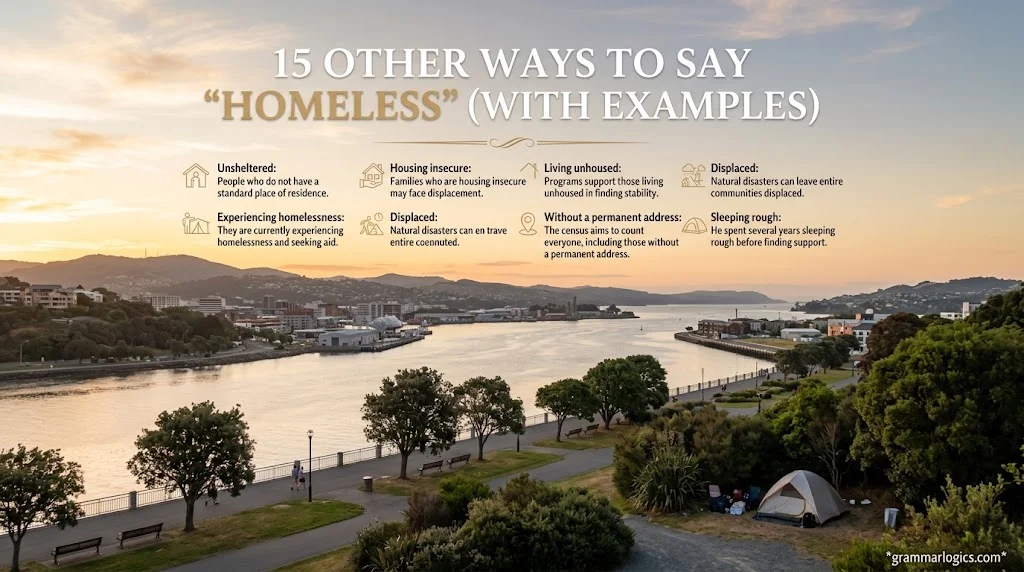
The word “homeless” describes people who do not have a stable place to live. Choosing respectful and thoughtful language helps us discuss this sensitive topic with care, understanding, and compassion.
Sometimes, a different expression can communicate the same meaning while emphasizing a person’s circumstances rather than defining their identity. Learning other ways to say “homeless” can help you write more clearly, speak more respectfully, and create meaningful content for different audiences. Whether you are writing a blog post, preparing an educational article, or discussing housing challenges, the right words can make your message more empathetic, inclusive, and impactful.
Language matters when talking about people experiencing housing insecurity. Expressions such as “people experiencing homelessness,” “without stable housing,” and “unhoused individuals” can offer more person-centered alternatives, depending on the context. These phrases recognize that homelessness is often a circumstance rather than a person’s entire identity. Understanding the differences between these expressions can help you choose words that sound natural, convey your intended meaning, and avoid unnecessary stigma. In this article, we will explore 15 other ways to say “homeless,” with clear meanings and practical examples to help you communicate with greater sensitivity and confidence.
What Does “Homeless” Mean?
Homeless describes a person who does not have a stable, safe, or adequate place to live. Someone experiencing homelessness may sleep in a shelter, stay temporarily with friends or relatives, live in a car, or sleep outdoors because they lack permanent housing. The term does not necessarily mean that a person has no possessions or family connections. It refers primarily to their housing situation, which may be temporary or long-term. In everyday English, the word is commonly used in conversations, news reports, social services, and discussions about poverty and housing. However, some people prefer expressions such as person experiencing homelessness because they emphasize the individual rather than defining the person by their circumstances.
Common Situations Where “Homeless” Is Used
The word homeless appears in many contexts, including news reporting, public discussions, charity campaigns, school assignments, social media posts, and conversations about housing problems. It may describe people who sleep outdoors, stay in emergency shelters, or lack a permanent residence.
In professional settings, social workers, housing organizations, researchers, and community groups may use more specific language to explain someone’s circumstances. For example, people experiencing homelessness can sound more person-centered in reports and public communications. In everyday conversations, expressions such as without stable housing may help explain a situation without making assumptions about the person’s experiences.
Choosing an alternative can be especially useful when the original term feels too broad, when a person’s housing circumstances need clarification, or when respectful language is important. The goal is to communicate accurately without creating unnecessary stigma.
Is It Professional or Polite to Say “Homeless”?
Yes, homeless is a widely understood and generally acceptable word in professional and everyday English. It is commonly used in journalism, public policy, community services, and ordinary conversation. However, its suitability depends on the context and the preferences of the people being described.
In formal writing, people experiencing homelessness is often a thoughtful choice because it recognizes people as individuals rather than defining them solely by their housing circumstances. Expressions such as people without stable housing may also work when discussing housing insecurity more broadly. In contrast, terms such as vagrant can sound judgmental or carry negative historical associations, so they should not be treated as neutral synonyms.
When discussing an individual, use respectful language, avoid assumptions, and follow the person’s own preferred wording when known. The most appropriate expression is the one that communicates the circumstances accurately while preserving the person’s dignity.
Advantages and Disadvantages of Saying “Homeless”
Advantages
The word homeless is short, familiar, and easy to understand. It communicates a housing problem directly, making it useful in everyday conversations, headlines, public awareness campaigns, and discussions about housing assistance. Because it is widely recognized, readers generally understand the subject without needing an additional explanation. It can also help people discuss homelessness as a social issue and draw attention to the need for shelter, housing support, and community resources.
Disadvantages
Although the term is widely accepted, homeless can sometimes reduce a person’s identity to their housing circumstances. It may also be too broad to distinguish between someone sleeping outdoors, someone living temporarily with relatives, and someone staying in emergency accommodation. In sensitive communications, person experiencing homelessness may provide a more respectful and person-centered alternative. More specific expressions can also improve clarity when the exact housing situation matters. However, no single phrase is appropriate for every circumstance, and respectful language should never come at the expense of accuracy.
15 Synonyms and Alternatives for “Homeless”
The following alternatives have different meanings and uses. Some are close substitutes, while others describe particular housing circumstances or are suitable only in specific contexts.
- Person Experiencing Homelessness
- Without Stable Housing
- Unhoused
- Without a Permanent Home
- Housing-Insecure
- Lacking Shelter
- Living in a Shelter
- Living on the Streets
- Without a Place to Call Home
- Displaced
- Temporarily Housed
- At Risk of Homelessness
- Inadequately Housed
- Rough Sleeping
- Without Secure Accommodation
1. Person Experiencing Homelessness
Meaning
Person experiencing homelessness describes an individual who currently lacks stable housing. This expression emphasizes the person’s humanity and presents homelessness as a circumstance rather than a permanent identity.
Definition
An individual who does not have a stable, safe, or permanent place to live.
Detailed Explanation
This is a person-centered expression often used in social services, public policy, and respectful public communication. Unlike the single word homeless, it places the individual before the housing problem. It can also acknowledge that homelessness may be temporary and that a person’s circumstances can change. Although the expression is longer, it is especially useful when discussing people with care and dignity.
Scenario Examples
Scenario: A community organization publishes a report about local housing needs.
Example: “Our program provides meals and support to people experiencing homelessness.”
Scenario: A student writes an assignment about poverty.
Example: “People experiencing homelessness may face difficulties accessing healthcare and employment.”
Best Use
Use this expression in formal reports, educational writing, charity communications, public policy discussions, and respectful everyday conversation.
Tone
Tone: Respectful, compassionate, person-centered.
It focuses on the person rather than treating their housing situation as their entire identity.
2. Without Stable Housing
Meaning
Without stable housing describes someone who does not have a dependable place to live. It may refer to homelessness or a situation in which accommodation is temporary or uncertain.
Definition
Lacking a reliable and consistent living arrangement.
Detailed Explanation
This expression focuses on housing stability rather than whether someone has a roof over their head at a particular moment. It can describe a person moving between temporary accommodations or facing the possibility of losing their current housing. It is not always identical to homeless, because someone can have a temporary place to stay without having stable housing. The wording is particularly useful when explaining ongoing uncertainty about where someone will live.
Scenario Examples
Scenario: A social worker explains a family’s circumstances.
Example: “The family has been without stable housing since leaving their previous apartment.”
Scenario: A community report discusses housing challenges.
Example: “Young adults without stable housing may need help finding affordable accommodation.”
Best Use
Choose this phrase in social services, housing discussions, educational writing, and conversations about temporary or uncertain living arrangements.
Tone
Tone: Neutral, considerate, informative.
It describes the housing situation without making unnecessary assumptions about the person.
3. Unhoused
Meaning
Unhoused describes a person who does not have a home or stable housing. It is often used as an alternative to homeless in community discussions and advocacy.
Definition
Not having a stable place to live.
Detailed Explanation
Unhoused is a concise alternative that emphasizes the absence of housing rather than suggesting that a person lacks a sense of belonging. Some people and organizations prefer it for its direct, person-conscious framing. However, preferences vary, and the term is not automatically better for every audience. It should be used when it fits the publication’s style and the circumstances being described.
Scenario Examples
Scenario: A volunteer discusses a local outreach program.
Example: “The team distributes warm clothing to unhoused people during the winter.”
Scenario: A neighborhood organization shares a community update.
Example: “We are working with local partners to connect unhoused residents with support services.”
Best Use
Use unhoused in community outreach, advocacy, public communication, and writing where the term is familiar to the intended audience.
Tone
Tone: Modern, direct, respectful.
It provides a concise alternative while keeping attention on the person’s housing circumstances.
4. Without a Permanent Home
Meaning
Without a permanent home describes someone who does not have a long-term place to live. The person may be staying temporarily with others, moving between accommodations, or living in an emergency shelter.
Definition
Lacking a lasting and established place of residence.
Detailed Explanation
This expression emphasizes the absence of a permanent living arrangement. It can be useful when a person has somewhere to stay temporarily but cannot settle into a lasting home. Unlike homeless, it may communicate housing instability without specifying whether someone is sleeping outdoors. The phrase is descriptive and easy for English learners to understand, although it may be less precise than a more specific description of the person’s circumstances.
Scenario Examples
Scenario: A family member explains a relative’s situation.
Example: “He has been without a permanent home since his lease ended.”
Scenario: A school assignment discusses housing challenges.
Example: “Some families without a permanent home rely on temporary accommodation while searching for affordable housing.”
Best Use
Use this phrase in personal conversations, educational writing, human-interest stories, and explanations of long-term housing uncertainty.
Tone
Tone: Gentle, descriptive, sympathetic.
It highlights the lack of permanence without adding judgment.
5. Housing-Insecure
Meaning
Housing-insecure describes someone whose housing situation is unstable, unaffordable, or at risk. It can include people who are homeless as well as those who may soon lose their accommodation.
Definition
Experiencing uncertainty or difficulty maintaining safe, stable, and affordable housing.
Detailed Explanation
This term covers a broader range of housing difficulties than homelessness alone. A person may be housing-insecure because they cannot reliably afford rent, face eviction, or live in accommodation that may not be available for long. It does not necessarily mean that the person currently lacks a place to sleep. The term is particularly valuable when discussing the circumstances that can lead to homelessness or prevent people from maintaining stable housing.
Scenario Examples
Scenario: A researcher discusses affordability.
Example: “Many housing-insecure households spend a large share of their income on rent.”
Scenario: A community worker explains a prevention program.
Example: “The service helps housing-insecure residents understand their rental options.”
Best Use
Choose this expression for housing research, social policy, community programs, and discussions about the risk of losing accommodation.
Tone
Tone: Professional, analytical, informative.
It describes a housing problem broadly rather than identifying one specific living arrangement.
6. Lacking Shelter
Meaning
Lacking shelter describes someone who does not have access to a place that provides protection from the weather and other environmental conditions. It is especially relevant when discussing people sleeping outdoors.
Definition
Not having suitable shelter for protection and rest.
Detailed Explanation
This phrase focuses on the immediate absence of physical protection or shelter. It may accurately describe someone sleeping outside without a tent, building, or other protective space. However, it is narrower than homeless, because some people experiencing homelessness have access to shelters or temporary accommodation. Use it when the absence of shelter is the important detail rather than as a universal replacement for the original term.
Scenario Examples
Scenario: A volunteer describes an emergency response.
Example: “The team provided blankets to people lacking shelter during the cold spell.”
Scenario: A news report discusses severe weather.
Example: “Officials opened an emergency facility for residents lacking shelter.”
Best Use
Use this phrase in emergency response updates, weather-related reporting, outreach descriptions, and discussions of immediate shelter needs.
Tone
Tone: Serious, compassionate, factual.
It draws attention to a practical need without implying that every person experiencing homelessness lives outdoors.
7. Living in a Shelter
Meaning
Living in a shelter describes someone staying in a facility that provides temporary accommodation. It is relevant to some people experiencing homelessness, but it does not describe everyone in that situation.
Definition
Staying in a designated place that provides temporary housing or protection.
Detailed Explanation
This expression identifies a specific living arrangement rather than a general housing status. It may refer to emergency shelters, temporary accommodation centers, or facilities serving people who need immediate housing support. The phrase is more precise than homeless when a person’s shelter arrangement is known. However, it should not be used unless the person actually lives in a shelter, and shelter residents should not be assumed to share the same experiences or needs.
Scenario Examples
Scenario: A community worker describes a housing program.
Example: “Several families are living in a shelter while waiting for longer-term accommodation.”
Scenario: A friend explains why someone needs assistance.
Example: “She is living in a shelter and could use help finding affordable housing.”
Best Use
Use this phrase in case descriptions, community reports, personal conversations, and updates about temporary accommodation when the information is accurate.
Tone
Tone: Neutral, specific, considerate.
Its strength is precision: it tells readers where someone is staying without making broader assumptions.
8. Living on the Streets
Meaning
Living on the streets describes someone who lives outdoors in public spaces rather than in stable accommodation. It is often associated with visible homelessness.
Definition
Living outdoors in streets or other public places without a regular indoor residence.
Detailed Explanation
This phrase is more specific than homeless because it suggests that a person is staying outdoors. It may be appropriate when describing street homelessness in a report, news story, or conversation. However, not everyone experiencing homelessness lives on the streets; some people stay in shelters, cars, or temporary arrangements with other people. Use the phrase carefully, especially when the person’s actual living situation is unknown.
Scenario Examples
Scenario: A news article describes a street outreach service.
Example: “The outreach team offers food and information to people living on the streets.”
Scenario: A community meeting discusses local support.
Example: “Residents requested more services for people living on the streets during the winter.”
Best Use
Use this expression in street outreach reports, news coverage, and discussions specifically about people sleeping or staying outdoors.
Tone
Tone: Direct, serious, descriptive.
It communicates a particular living situation but should not be used as a general label for everyone without housing.
9. Without a Place to Call Home
Meaning
Without a place to call home describes someone who lacks a stable place where they can live and feel settled. It can also convey the emotional difficulty of not having a home.
Definition
Having no dependable living place that provides a lasting sense of home.
Detailed Explanation
This expression is more emotional and personal than a straightforward term such as homeless. The words call home can suggest belonging, comfort, and security as well as physical accommodation. It works well in human-interest writing, personal messages, and community awareness campaigns. However, it is less precise in technical reports because the idea of a home can include emotional attachment as well as a physical residence.
Scenario Examples
Scenario: A charity writes a fundraising message.
Example: “Every person deserves a safe place to call home.”
Scenario: A writer describes a family’s housing difficulties.
Example: “After several months of moving between relatives, the family still had no place to call home.”
Best Use
Choose this expression for personal stories, awareness campaigns, compassionate messages, and creative writing.
Tone
Tone: Warm, empathetic, emotional.
It communicates the human importance of having a safe and dependable home.
10. Displaced
Meaning
Displaced describes someone who has been forced or compelled to leave their usual home or place of residence. Displacement may result from conflict, natural disasters, eviction, or other circumstances.
Definition
Forced or otherwise compelled to leave one’s usual home or living area.
Detailed Explanation
Displaced is not an exact synonym for homeless. A displaced person may lack housing, but they may also have temporary accommodation or live with relatives. The term focuses on being moved from one’s home, often because of circumstances beyond one’s control. It is especially appropriate in discussions of disasters, conflict, and community relocation. If the main issue is the person’s current lack of housing, additional wording may be needed to make that clear.
Scenario Examples
Scenario: A relief organization reports on a natural disaster.
Example: “The flood displaced hundreds of residents from their homes.”
Scenario: A community worker describes a family seeking assistance.
Example: “The displaced family is staying temporarily with relatives while searching for housing.”
Best Use
Use this term in disaster reporting, humanitarian communication, relocation discussions, and situations involving people forced to leave their homes.
Tone
Tone: Formal, factual, serious.
It highlights the loss of a previous living arrangement rather than necessarily describing a person’s current housing status.
11. Temporarily Housed
Meaning
Temporarily housed describes someone who has accommodation for a limited period but does not yet have a permanent living arrangement. It can apply to people who previously experienced homelessness.
Definition
Provided with a place to stay that is not intended to be permanent.
Detailed Explanation
This phrase focuses on the temporary accommodation available to someone rather than simply describing the absence of a home. It may refer to a person staying in transitional housing, emergency accommodation, or another short-term arrangement. Unlike homeless, it implies that the person currently has somewhere to stay, even if their long-term situation remains uncertain. It should not be used to describe someone who has no accommodation unless temporary housing has actually been provided.
Scenario Examples
Scenario: A support worker updates a case record.
Example: “The family is temporarily housed while the team helps them search for a permanent apartment.”
Scenario: A community organization reports on its services.
Example: “The program has temporarily housed several residents who lost their accommodation.”
Best Use
Use this expression in housing support reports, social services, program updates, and discussions of transitional accommodation.
Tone
Tone: Neutral, professional, solution-focused.
It acknowledges that accommodation is available while making clear that the arrangement may not last.
12. At Risk of Homelessness
Meaning
At risk of homelessness describes someone who still has accommodation but may lose it because of financial difficulties, eviction, family conflict, or other circumstances.
Definition
Facing circumstances that could lead to losing stable housing.
Detailed Explanation
This expression refers to a potential housing crisis, not necessarily current homelessness. Someone may be at risk because they cannot afford rent, have received an eviction notice, or are experiencing an unstable living arrangement. The phrase is useful for describing prevention efforts and identifying people who may need support before losing their homes. It should not be used interchangeably with homeless, because the person may still have a place to live.
Scenario Examples
Scenario: A housing organization explains its assistance program.
Example: “The service helps tenants at risk of homelessness access rental support.”
Scenario: A school counselor discusses family needs.
Example: “The counselor connected a student’s family, who were at risk of homelessness, with local housing resources.”
Best Use
Choose this expression for prevention programs, housing policy, social work, and discussions of eviction or housing instability.
Tone
Tone: Professional, concerned, preventative.
It focuses on the possibility of losing housing and the importance of timely assistance.
13. Inadequately Housed
Meaning
Inadequately housed describes someone whose living conditions do not meet their basic needs for safe, suitable, or sufficient accommodation. It does not necessarily mean the person has no home.
Definition
Living in accommodation that is unsuitable, unsafe, overcrowded, or otherwise insufficient.
Detailed Explanation
This expression focuses on the quality and suitability of housing, rather than whether a person has a residence. Someone may be inadequately housed while living in an unsafe building, an overcrowded room, or accommodation that does not meet essential needs. This is different from homelessness, although inadequate housing can contribute to housing insecurity. The term is particularly useful in research and policy discussions where the condition of a home matters as much as its availability.
Scenario Examples
Scenario: A housing report examines poor living conditions.
Example: “The study considers households that are inadequately housed because of overcrowding and unsafe conditions.”
Scenario: A community group discusses building standards.
Example: “Families living in inadequately housed conditions may need repairs or access to safer accommodation.”
Best Use
Use this phrase in housing research, policy reports, community planning, and discussions about unsafe or unsuitable accommodation.
Tone
Tone: Formal, analytical, descriptive.
It describes housing quality without automatically implying that someone has no home.
14. Rough Sleeping
Meaning
Rough sleeping is a term, particularly common in British English, for sleeping outdoors or in places not intended for regular accommodation, such as doorways or other public spaces.
Definition
Sleeping outside or in places not designed for residential use.
Detailed Explanation
This expression refers to a specific form of homelessness rather than all situations involving housing insecurity. It is commonly used in British public services, news reporting, and discussions about street homelessness. Someone experiencing homelessness may never sleep rough if they have access to a shelter or temporary accommodation. Because the term is more common in certain English-speaking regions, readers elsewhere may find a simpler explanation more familiar.
Scenario Examples
Scenario: A local authority announces a winter support service.
Example: “The council expanded its outreach services for people sleeping rough during cold weather.”
Scenario: A news report discusses emergency accommodation.
Example: “The charity works with people who are rough sleeping to help them access housing support.”
Best Use
Choose this term for British English, local authority reports, street outreach updates, and discussions specifically about sleeping outdoors.
Tone
Tone: Direct, factual, region-specific.
It is useful when the exact situation is rough sleeping, rather than homelessness in general.
15. Without Secure Accommodation
Meaning
Without secure accommodation describes someone who does not have a dependable, safe, and reliable place to stay. It can refer to people without housing as well as those whose current arrangements are unstable.
Definition
Lacking reliable accommodation that offers safety and continuity.
Detailed Explanation
This expression emphasizes the security and reliability of a person’s living arrangement. It may describe someone moving between temporary places, facing the loss of current accommodation, or lacking a dependable residence. The phrase can be useful in professional communication because it focuses on the practical circumstances without reducing the person to a label. However, it is broader than homeless and may require additional context to clarify whether someone currently has any accommodation.
Scenario Examples
Scenario: A social service report explains a person’s circumstances.
Example: “The outreach team is assisting residents who are without secure accommodation.”
Scenario: A community organization discusses housing support.
Example: “People without secure accommodation can contact the service for guidance on available options.”
Best Use
Use this expression in professional reports, social services, housing support communications, and discussions of uncertain living arrangements.
Tone
Tone: Professional, respectful, measured.
It focuses on the absence of reliable housing and is especially useful when discussing unstable accommodation.
FAQs
What is another way to say “homeless”?
One respectful alternative is person experiencing homelessness. Other options include unhoused and without stable housing. The best choice depends on whether you are describing a general housing situation, a specific living arrangement, or the risk of losing accommodation.
What does “homeless” mean?
Homeless means lacking a stable, safe, or adequate place to live. It may describe someone sleeping outdoors, staying in an emergency shelter, or moving between temporary living arrangements.
Is “homeless” a professional term?
Yes. Homeless is widely used in professional writing, journalism, social services, and public policy. In person-centered communication, people experiencing homelessness may be preferred because it emphasizes the individual rather than defining them by their housing circumstances.
What is a more polite way to say “homeless”?
Person experiencing homelessness is often a considerate alternative. Without stable housing is another useful option when the main concern is the person’s uncertain living arrangement. When possible, respect the terminology preferred by the individual or community being discussed.
Which alternative works best in formal communication?
Person experiencing homelessness is a strong general choice for formal reports, educational materials, and public communications. However, choose a more specific expression when accuracy requires it. For example, rough sleeping refers to sleeping outdoors, while at risk of homelessness describes someone who may lose housing but has not necessarily done so.
Conclusion
Choosing the right words to describe homelessness can make communication clearer, more respectful, and more useful. Although homeless is a widely understood and acceptable term, expressions such as person experiencing homelessness, unhoused, and without stable housing may better suit particular audiences and situations. Other phrases, including displaced, temporarily housed, and at risk of homelessness, describe different circumstances and should not be treated as exact synonyms.
Before choosing an alternative, consider whether you are discussing someone’s current living arrangement, housing security, or the possibility of losing a home. Above all, use language that reflects the facts without making assumptions about a person’s life. Respectful communication begins with accuracy, empathy, and recognition of each person’s dignity.