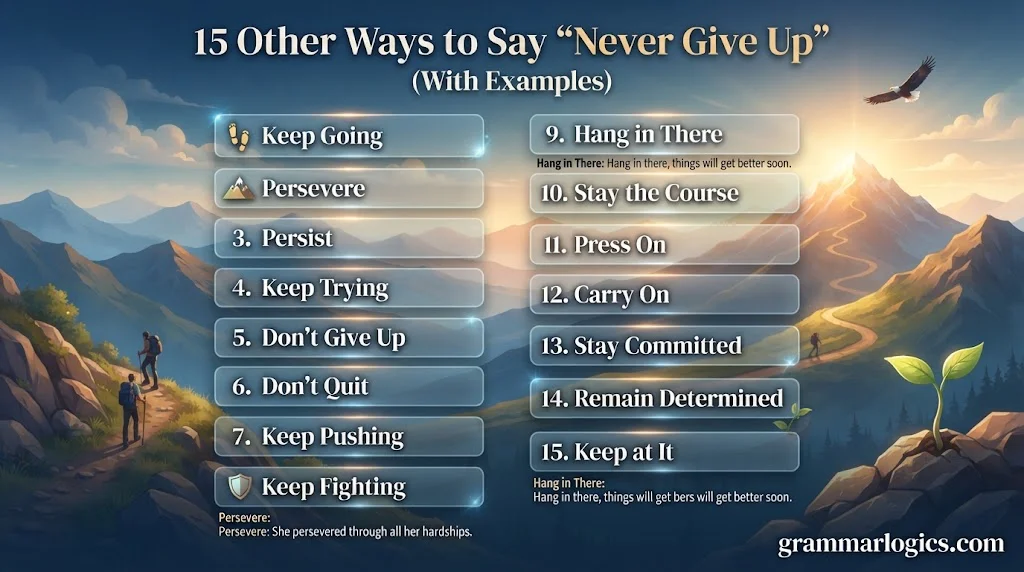
Never give up is a powerful phrase that encourages persistence, hope, and determination during difficult times.
When someone faces failure, challenges, or uncertainty, saying “Never Give Up” can provide motivation and emotional support. However, using the same phrase repeatedly may feel predictable, especially in conversations, speeches, emails, or motivational writing. Fortunately, there are many natural alternatives that express the same idea while adding variety and personality to your message. Whether you want to encourage a friend, motivate a colleague, support a student, or inspire an audience, choosing the right expression can make your words more meaningful. Phrases such as “Keep going,” “Stay strong,” “Don’t lose hope,” and “Keep pushing forward” can communicate encouragement in different ways. Understanding these alternatives helps you choose expressions that match the situation, relationship, and tone you want to create.
In this guide, you will discover other ways to say “Never Give Up” in a variety of personal, professional, and motivational situations. Each alternative offers a slightly different tone, from gentle encouragement to strong determination. You will also find practical examples showing how these phrases can be used naturally in everyday communication. Learning these encouraging expressions can help you sound more confident, supportive, and expressive when someone needs motivation. Whether you are writing an inspirational message, giving advice, preparing a speech, or simply cheering someone on, these alternatives can help you communicate your support clearly. By expanding your vocabulary, you can make your messages more engaging, thoughtful, and powerful while encouraging others to keep moving forward.
What Does “Never Give Up” Mean?
“Never Give Up” means to continue trying despite difficulties, failure, disappointment, or obstacles. It encourages someone not to abandon a goal simply because progress is slow or circumstances are challenging. The phrase communicates determination, persistence, courage, and hope. It can be directed toward yourself or another person and is commonly used when someone is facing a difficult situation.
The expression can also carry an emotional message of resilience. When you tell someone to “Never Give Up,” you are encouraging them to keep making an effort instead of accepting defeat. The phrase does not necessarily mean that a person must continue with exactly the same approach forever; sometimes persistence involves changing strategies while continuing to pursue the larger goal. Its meaning is therefore strongly connected to staying committed despite setbacks.
Common Situations Where “Never Give Up” Is Used
“Never Give Up” is common in personal conversations, motivational messages, speeches, social media posts, sports, education, and everyday encouragement. A parent might use it to encourage a child who is struggling with schoolwork, while a friend might say it to someone dealing with a difficult personal challenge.
The phrase also appears frequently in workplace and professional communication, especially when discussing long-term projects, career goals, business challenges, or learning new skills. However, the directness of the expression can sometimes make another phrase more suitable. For example, a coworker may respond better to a calm expression such as “Stay committed” than to a highly emotional “Keep fighting.”
People may also want an alternative because they have used “Never Give Up” repeatedly. Different expressions allow the speaker to communicate a similar idea while adding a particular tone, emotional strength, or level of formality.
Is It Professional or Polite to Say “Never Give Up”?
Yes, “Never Give Up” can be polite and professional, but its suitability depends heavily on context. In a friendly conversation, motivational speech, classroom, or supportive message, it usually sounds positive and encouraging. It shows that you believe the other person can overcome a challenge.
In professional communication, however, the phrase can sometimes sound motivational rather than practical. If a colleague is struggling with a project, “Stay committed” or “Keep working toward the goal” may sound more measured. Similarly, in a formal email, a calmer expression may communicate support without sounding overly emotional.
“Never Give Up” is therefore best when you want to emphasize resilience and determination. For professional or sensitive situations, choose an alternative based on the relationship, circumstances, and emotional tone you want to create.
Advantages and Disadvantages of Saying “Never Give Up”
Advantages
“Never Give Up” is short, memorable, and encouraging. It communicates determination immediately and can give someone emotional motivation when they feel discouraged. Because the phrase is widely understood, it does not require much explanation. It can also work well in speeches, personal messages, motivational writing, and social media because of its strong and positive emotional impact.
Another advantage is its versatility. You can say it to someone facing an academic challenge, athletic setback, career difficulty, or personal disappointment. It can also be used as a personal reminder when working toward a long-term goal.
Disadvantages
The phrase can sometimes sound too absolute or intense. Not every situation requires someone to continue pursuing the same goal indefinitely. In some circumstances, changing direction, taking a break, or choosing a different approach may be sensible.
It may also sound somewhat generic when used repeatedly. If you want to acknowledge someone’s specific situation, a more precise expression can feel more thoughtful. For example, “Stay committed to your goal” focuses on commitment, while “Hang in there” offers gentler emotional support.
15 Alternatives for “Never Give Up”
- Keep Going
- Persevere
- Persist
- Keep Trying
- Don’t Give Up
- Don’t Quit
- Keep Pushing
- Keep Fighting
- Hang in There
- Stay the Course
- Press On
- Carry On
- Stay Committed
- Remain Determined
- Keep at It
1. Keep Going
Meaning
“Keep Going” means to continue moving forward or continue making an effort even when something becomes difficult. It is one of the most natural and flexible alternatives to “Never Give Up.”
Definition
Keep Going: Continue with an activity, effort, journey, or goal instead of stopping.
Detailed Explanation
“Keep Going” sounds encouraging, natural, and conversational. Unlike “Never Give Up,” it does not sound quite as absolute, so it can feel more practical in everyday situations. You can use it when someone needs encouragement to get through a difficult moment, finish a task, or continue pursuing a long-term goal. It focuses on continued effort and forward movement rather than simply refusing to accept defeat.
Scenario Examples
Scenario: A friend is studying for an important exam and feels exhausted.
Example: “I know you’re tired, but keep going. You’re making more progress than you realize.”
Scenario: A colleague is working through a difficult project.
Example: “The first stage was challenging, but keep going. We’re getting closer to the finish line.”
Scenario: Someone is learning a new skill.
Example: “Keep going with your practice. It will become easier with time.”
Best Use
Use “Keep Going” in casual conversation, personal messages, encouragement, education, sports, and workplace communication. It is especially useful when you want to sound supportive without being overly dramatic.
Tone
Tone: Friendly, encouraging, positive
The phrase feels natural because it offers simple encouragement without putting excessive emotional pressure on the listener.
2. Persevere
Meaning
“Persevere” means to continue making an effort despite difficulties or obstacles. It emphasizes determination and sustained effort.
Definition
Persevere: Continue working toward something despite challenges, failure, or difficulty.
Detailed Explanation
“Persevere” is a stronger and somewhat more formal alternative to “Never Give Up.” It is particularly appropriate when discussing education, professional goals, personal development, or difficult long-term projects. The word highlights the ability to remain committed even when progress is slow. Because it is less conversational than “Keep Going,” it works especially well in formal writing and thoughtful encouragement.
Scenario Examples
Scenario: A teacher is encouraging students before a challenging examination.
Example: “The material may seem difficult at first, but persevere and continue practicing.”
Scenario: Someone is developing a demanding professional skill.
Example: “Persevere through the difficult stages; your experience will grow with every challenge.”
Best Use
Use “Persevere” in formal writing, education, professional communication, speeches, personal development, and motivational content.
Tone
Tone: Determined, formal, motivational
The word has a serious and purposeful quality, making it suitable when you want to emphasize long-term effort.
3. Persist
Meaning
“Persist” means to continue doing something despite difficulty, resistance, or a lack of immediate success. It emphasizes continued effort.
Definition
Persist: Continue firmly with an action or effort despite obstacles or difficulties.
Detailed Explanation
“Persist” is concise and somewhat more formal than “Keep Going.” It can describe a person who continues working toward a goal even when the results are not immediate. The word often highlights consistency and determination rather than emotional encouragement. It is particularly useful when discussing work, learning, research, personal goals, or situations requiring repeated effort.
Scenario Examples
Scenario: A student has not yet mastered a difficult subject.
Example: “If you persist with your practice, the concepts will gradually become clearer.”
Scenario: A team is trying to solve a complicated problem.
Example: “We haven’t found the answer yet, but we should persist and explore another approach.”
Best Use
Use “Persist” in professional communication, academic writing, formal advice, and serious discussions about long-term effort.
Tone
Tone: Serious, determined, purposeful
“Persist” sounds focused and disciplined, making it useful when encouragement needs to feel thoughtful rather than emotional.
4. Keep Trying
Meaning
“Keep Trying” encourages someone to continue making attempts after difficulty or failure. It focuses on effort and learning through repeated attempts.
Definition
Keep Trying: Continue making an effort instead of stopping after an unsuccessful attempt.
Detailed Explanation
“Keep Trying” is a warm and accessible phrase that works especially well when someone has failed or made a mistake. It is softer than “Never Give Up” because it focuses on making another attempt rather than making an absolute promise. The phrase is particularly natural when encouraging children, students, beginners, or anyone learning something new. It communicates that failure is part of the process.
Scenario Examples
Scenario: A child is learning to ride a bicycle.
Example: “You almost had it that time. Keep trying, and you’ll get it.”
Scenario: A friend has received several job rejections.
Example: “I know the search has been frustrating, but keep trying. The right opportunity may still be ahead.”
Scenario: Someone is practicing a new language.
Example: “Don’t worry about making mistakes. Keep trying to speak, and you’ll become more confident.”
Best Use
Use “Keep Trying” in friendly conversations, education, personal messages, coaching, parenting, and supportive communication.
Tone
Tone: Warm, patient, reassuring
It sounds supportive because it recognizes that mistakes and unsuccessful attempts do not have to be the end of the effort.
5. Don’t Give Up
Meaning
“Don’t Give Up” directly tells someone not to stop pursuing something important. It is very close in meaning to “Never Give Up.”
Definition
Don’t Give Up: Continue making an effort rather than abandoning a goal or situation.
Detailed Explanation
“Don’t Give Up” is one of the closest natural alternatives to “Never Give Up.” The main difference is that it is usually directed at someone in a specific moment of difficulty, whereas “Never Give Up” can sound more like a general principle. It is direct, emotional, and easy to understand. Because it is so closely related to the original expression, it works in many of the same situations.
Scenario Examples
Scenario: A friend feels discouraged after failing an important test.
Example: “One bad result doesn’t define you. Don’t give up.”
Scenario: A person is struggling with a personal goal.
Example: “You’ve already come this far, so don’t give up now.”
Best Use
Use “Don’t Give Up” in personal conversations, texts, motivational messages, sports, education, and everyday encouragement.
Tone
Tone: Direct, supportive, motivating
Its directness makes it powerful when someone needs immediate encouragement.
6. Don’t Quit
Meaning
“Don’t Quit” means do not stop an activity, effort, or pursuit, particularly when things become difficult.
Definition
Don’t Quit: Continue what you are doing instead of stopping because of difficulty or frustration.
Detailed Explanation
“Don’t Quit” is a short, strong, and direct expression. Compared with “Never Give Up,” it can sound slightly more forceful because “quit” clearly suggests stopping an activity. It works especially well in sports, training, challenging tasks, and situations where persistence is expected. However, it can sound too blunt in sensitive situations, so the relationship and context matter.
Scenario Examples
Scenario: A coach is encouraging an athlete during difficult training.
Example: “You’re tired, but don’t quit before you finish the final set.”
Scenario: A friend is considering abandoning a creative project.
Example: “You’ve put so much work into it. Don’t quit just because this part is difficult.”
Best Use
Use “Don’t Quit” in sports, training, informal conversations, coaching, and situations requiring strong encouragement.
Tone
Tone: Strong, direct, energetic
The expression has a firm quality, so it is most effective when the listener appreciates straightforward motivation.
7. Keep Pushing
Meaning
“Keep Pushing” encourages someone to continue putting in effort, especially when progress requires extra energy or determination.
Definition
Keep Pushing: Continue working hard and making progress despite difficulty or resistance.
Detailed Explanation
“Keep Pushing” has a more energetic and action-oriented feeling than “Never Give Up.” It suggests that someone should make another effort and move beyond their current obstacles. The expression is common in fitness, sports, education, business, and personal development. It can be motivating, but because it emphasizes effort, it may not be appropriate when someone genuinely needs rest rather than additional pressure.
Scenario Examples
Scenario: An athlete is close to completing a demanding workout.
Example: “You’re almost there. Keep pushing for a few more minutes.”
Scenario: A business owner is working through a difficult period.
Example: “The results aren’t immediate, but keep pushing and continue improving the strategy.”
Best Use
Use “Keep Pushing” in sports, fitness, career goals, education, business, and motivational conversations.
Tone
Tone: Energetic, motivating, determined
It creates a sense of momentum and encourages active effort.
8. Keep Fighting
Meaning
“Keep Fighting” means continue resisting a difficult situation and continue making an effort instead of surrendering.
Definition
Keep Fighting: Continue facing a difficult challenge with courage and determination.
Detailed Explanation
“Keep Fighting” is a particularly emotional and powerful expression. It can describe literal competition, but it is often used figuratively when someone is facing a major challenge. Compared with “Never Give Up,” it carries stronger emotional intensity and can suggest courage in the face of serious adversity. Because of that intensity, it should be used thoughtfully, especially when discussing sensitive personal circumstances.
Scenario Examples
Scenario: A sports team is behind late in a close game.
Example: “We’re still in this match. Keep fighting until the final whistle.”
Scenario: A friend is dealing with a difficult period and needs encouragement.
Example: “Take things one day at a time and keep fighting for the future you want.”
Best Use
Use “Keep Fighting” in sports, powerful motivational messages, personal encouragement, and situations involving significant challenges.
Tone
Tone: Powerful, emotional, courageous
The expression has a strong emotional impact, so it is best reserved for situations where that intensity feels appropriate.
9. Hang in There
Meaning
“Hang in There” means remain patient and continue coping with a difficult or stressful situation.
Definition
Hang in There: Stay strong and continue through a difficult period without becoming discouraged.
Detailed Explanation
“Hang in There” is a gentler and more conversational alternative to “Never Give Up.” It does not necessarily suggest that someone must work harder or pursue a specific goal. Instead, it often means that a difficult period will require patience and endurance. This makes it especially useful when someone is tired, stressed, worried, or emotionally discouraged.
Scenario Examples
Scenario: A coworker is dealing with a particularly stressful week.
Example: “I know this week has been overwhelming. Hang in there; the deadline is almost here.”
Scenario: A friend is waiting for important news.
Example: “Hang in there. I know the waiting is difficult, but you’ll have an answer soon.”
Scenario: A student feels overwhelmed during exam season.
Example: “Hang in there and take one assignment at a time.”
Best Use
Use “Hang in There” in casual conversation, texting, friendly messages, supportive communication, and everyday situations involving temporary difficulty.
Tone
Tone: Warm, casual, comforting
It sounds caring without being overly dramatic or forceful.
10. Stay the Course
Meaning
“Stay the Course” means continue following a chosen plan or direction despite obstacles or temporary problems.
Definition
Stay the Course: Remain committed to an established plan or goal despite difficulties.
Detailed Explanation
“Stay the Course” is more specific than “Never Give Up” because it focuses on remaining with an existing plan or direction. It does not simply mean trying harder; it suggests that the current strategy is worth continuing. The expression is common in professional, financial, organizational, and formal motivational contexts. Because it has a more formal feel, it may sound less natural in casual conversations with close friends.
Scenario Examples
Scenario: A project team is uncertain about its long-term strategy.
Example: “The early results are mixed, but we should stay the course and evaluate the results over time.”
Scenario: Someone is following a long-term study plan.
Example: “You’ve created a good routine, so stay the course and remain consistent.”
Best Use
Use “Stay the Course” in professional communication, formal discussions, leadership, planning, education, and long-term goal setting.
Tone
Tone: Professional, steady, confident
The phrase suggests calm commitment rather than emotional intensity.
11. Press On
Meaning
“Press On” means continue moving forward despite difficulty, delay, or opposition.
Definition
Press On: Continue forward with determination even when circumstances are challenging.
Detailed Explanation
“Press On” has a slightly more formal and literary quality than everyday expressions such as “Keep Going.” It communicates forward movement and determination without sounding overly emotional. The phrase can be useful in speeches, formal writing, motivational messages, and thoughtful personal communication. It may sound less conversational in everyday texting, but it can be effective when you want your words to feel purposeful.
Scenario Examples
Scenario: A community group is working through a difficult project.
Example: “The road ahead will not be easy, but we must press on and complete the work.”
Scenario: Someone is pursuing a long-term creative goal.
Example: “The first draft wasn’t successful, but she decided to press on and try again.”
Best Use
Use “Press On” in formal writing, speeches, motivational content, professional communication, and reflective messages.
Tone
Tone: Determined, dignified, motivational
Its slightly formal style gives encouragement a sense of purpose and resolve.
12. Carry On
Meaning
“Carry On” means continue doing something rather than stopping. It can also mean continuing normally despite an interruption or difficulty.
Definition
Carry On: Continue with an activity, task, or course of action.
Detailed Explanation
“Carry On” is a versatile expression, but its exact tone depends on context and regional usage. As encouragement, it can mean continue and don’t let the difficulty stop you. It is generally less emotionally intense than “Never Give Up,” making it useful when you simply want someone to continue with what they are doing. In some contexts, however, “carry on” can also mean behaving noisily or making a fuss, so the surrounding sentence matters.
Scenario Examples
Scenario: A colleague pauses during a presentation after making a small mistake.
Example: “It’s okay—just carry on with the presentation.”
Scenario: Someone is continuing a long-term creative project.
Example: “The first version wasn’t perfect, but carry on refining it.”
Best Use
Use “Carry On” in everyday conversation, workplace communication, practical encouragement, and situations where someone simply needs to continue.
Tone
Tone: Calm, practical, encouraging
It usually sounds less dramatic than “Never Give Up” and is useful when the focus is simply on continuing.
13. Stay Committed
Meaning
“Stay Committed” means continue giving attention, effort, or loyalty to a goal, responsibility, relationship, or plan.
Definition
Stay Committed: Remain dedicated to something instead of abandoning your responsibility or goal.
Detailed Explanation
“Stay Committed” is particularly useful when persistence involves responsibility and long-term dedication. Unlike “Never Give Up,” it does not necessarily focus on overcoming a dramatic obstacle. Instead, it highlights consistency and continued dedication. This makes it a strong choice for professional communication, education, personal development, teamwork, and long-term projects.
Scenario Examples
Scenario: A manager encourages employees to maintain progress on a long-term initiative.
Example: “Stay committed to the project, even when some stages take longer than expected.”
Scenario: Someone is trying to establish a regular study routine.
Example: “Stay committed to your schedule, and give yourself time to improve.”
Scenario: A person is working toward a personal goal.
Example: “The results may take time, so stay committed to the process.”
Best Use
Use “Stay Committed” in professional communication, education, personal development, teamwork, goal setting, and formal encouragement.
Tone
Tone: Professional, responsible, supportive
The phrase emphasizes dedication and consistency, making it especially suitable for serious goals.
14. Remain Determined
Meaning
“Remain Determined” means continue to have a strong intention to achieve something despite difficulties or setbacks.
Definition
Remain Determined: Continue showing firm purpose and resolve when pursuing a goal.
Detailed Explanation
“Remain Determined” has a more formal and deliberate tone than “Never Give Up.” It focuses on a person’s mental attitude and willingness to continue pursuing a goal. The expression works particularly well in formal writing, speeches, academic contexts, and professional encouragement. It is less likely to sound natural in a casual text message, where “Keep Going” may feel more conversational.
Scenario Examples
Scenario: A student is working toward an ambitious academic goal.
Example: “Remain determined, stay focused on your studies, and learn from each setback.”
Scenario: A professional is working toward a demanding career objective.
Example: “Remain determined even when progress is slower than you expected.”
Best Use
Use “Remain Determined” in formal writing, speeches, academic communication, professional settings, and serious motivational messages.
Tone
Tone: Formal, confident, resolute
The wording emphasizes inner determination and gives encouragement a polished quality.
15. Keep at It
Meaning
“Keep at It” means continue working on something, especially when it takes time or repeated effort to improve.
Definition
Keep at It: Continue practicing or working on something without stopping because progress is slow.
Detailed Explanation
“Keep at It” is a highly natural informal expression that works well when someone is developing a skill or trying to improve. It suggests steady repetition rather than dramatic courage. Compared with “Never Give Up,” it sounds lighter and more practical. It is especially useful when encouraging someone who needs to practice, learn, or gradually build competence.
Scenario Examples
Scenario: A beginner is learning to play an instrument.
Example: “Your timing is already improving, so keep at it.”
Scenario: A friend is learning a difficult computer program.
Example: “It feels confusing at first, but keep at it and you’ll get more comfortable.”
Scenario: Someone is trying to improve their writing.
Example: “Keep at it. The more you practice, the more natural your writing will become.”
Best Use
Use “Keep at It” in casual conversation, texting, education, hobbies, skill development, and friendly encouragement.
Tone
Tone: Casual, friendly, reassuring
It feels approachable and practical, making it especially natural between friends, teachers, coaches, and learners.
FAQs
What is another way to say “Never Give Up”?
Some natural alternatives include “Keep going,” “Stay strong,” “Don’t give up,” “Keep pushing forward,” “Stay determined,” and “Don’t lose hope.” The best choice depends on the situation and the tone you want to convey.
What is a professional way to say “Never Give Up”?
In professional communication, you can say “Stay committed,” “Keep moving forward,” “Remain persistent,” or “Continue working toward your goal.” These expressions sound encouraging while maintaining a professional tone.
How can I encourage someone without saying “Never Give Up”?
You can use supportive phrases such as “You’ve got this,” “Keep trying,” “Believe in yourself,” “Stay focused,” or “Keep moving forward.” These alternatives can sound more personal and comforting.
Is “Keep going” the same as “Never Give Up”?
Yes, in many situations, “Keep going” communicates a similar message of persistence and encouragement. However, it often sounds softer and more conversational than “Never Give Up.”
What is a motivational phrase similar to “Never Give Up”?
Popular motivational alternatives include “Keep fighting,” “Stay the course,” “Persevere,” “Keep pushing,” and “Believe in yourself.” Each phrase emphasizes determination and continuing despite challenges.
Conclusion
Knowing other ways to say “Never Give Up” can make your communication more inspiring, natural, and expressive. Different situations call for different levels of encouragement, whether you are supporting a friend, motivating a student, encouraging a coworker, or writing an inspirational message. Expressions like “Keep going,” “Stay strong,” “Don’t lose hope,” and “Keep pushing forward” give you more ways to communicate determination and support.
By adding these alternatives to your vocabulary, you can avoid repetition and choose words that better match your message and audience. The right encouraging phrase can provide motivation, confidence, and hope when someone needs it most. Use these expressions naturally, and let your words remind others that challenges may be difficult, but continuing forward can make all the difference.