Finding the right words after someone has passed away can be difficult, especially when you want to sound respectful, gentle, and sincere.
The phrase “passed away” is a widely used and considerate way to talk about someone’s death. However, depending on the situation, you may want to choose a different expression that feels more formal, compassionate, sensitive, or personal. Whether you are writing an obituary, offering condolences, speaking with family members, or simply discussing a loss, the words you choose can carry deep emotional meaning. Using thoughtful alternatives can help you communicate the reality of death while showing respect and empathy toward the person who has died and those who are grieving.
There are many meaningful other ways to say “passed away”, and each expression can suit a different context or tone. Some alternatives sound gentle and comforting, while others are more appropriate for formal writing, sympathy messages, obituaries, or everyday conversation. Understanding these phrases can help you express difficult news with greater care and sensitivity. In this guide, you will discover natural alternatives to “passed away,” along with examples showing how to use them appropriately. Whether you need a respectful phrase for a written message or a compassionate way to speak about someone’s death, these options can help you choose the right words for the situation.
What Does “Passed Away” Mean?
“Passed away” is a polite and gentle euphemism meaning that someone died. It is commonly used when discussing the death of a person in a respectful or compassionate way. The expression softens the directness of the word “died” without changing its basic meaning. For example, saying “Her grandfather passed away last year” communicates that her grandfather died, while using language that may feel less blunt. The phrase is widely understood in everyday English and is especially common in conversations about bereavement, condolences, obituaries, and personal loss.
Common Situations Where “Passed Away” Is Used
“Passed away” is frequently used in personal conversations, text messages, condolence notes, social media announcements, and formal notices about someone’s death. A person might say, “My uncle passed away yesterday” when informing friends or colleagues about a family loss. It is also common when offering sympathy, such as, “I’m sorry to hear that your mother passed away.”
The expression is particularly useful when the speaker wants to acknowledge death without sounding unnecessarily blunt. In professional communication, it can be appropriate when discussing the death of an employee, client, colleague, or relative. In writing, however, the best wording depends on the purpose. An obituary may use “died,” “departed,” or another formal expression, while a personal message may sound warmer with “left us” or “is no longer with us.”
Is It Professional or Polite to Say “Passed Away”?
Yes. “Passed away” is generally polite, respectful, and socially appropriate when referring to someone’s death. It is softer than “died” and is often preferred when speaking with grieving family members or discussing a sensitive loss.
The phrase is not excessively formal, so it works in both personal and many professional situations. For example, a manager might write, “We are saddened to learn that John’s father passed away.” However, “died” can sometimes be more precise and appropriate in factual, medical, legal, or historical contexts. The best choice depends on whether your priority is emotional sensitivity, directness, or factual clarity.
Advantages and Disadvantages of Saying “Passed Away”
Advantages
The main advantage of “passed away” is its respectful and gentle tone. It communicates the reality of death while avoiding the bluntness of “died.” This makes it particularly suitable for condolence messages, family conversations, announcements, and sympathetic communication. It is also widely understood, so readers and listeners are unlikely to misunderstand its meaning.
Disadvantages
Because “passed away” is a euphemism, it may sometimes sound less direct than necessary. In legal, medical, historical, or highly factual writing, “died” may communicate the information more clearly. The phrase can also become repetitive when used several times in the same piece of writing. In those situations, carefully chosen alternatives can provide greater variety and emotional nuance.
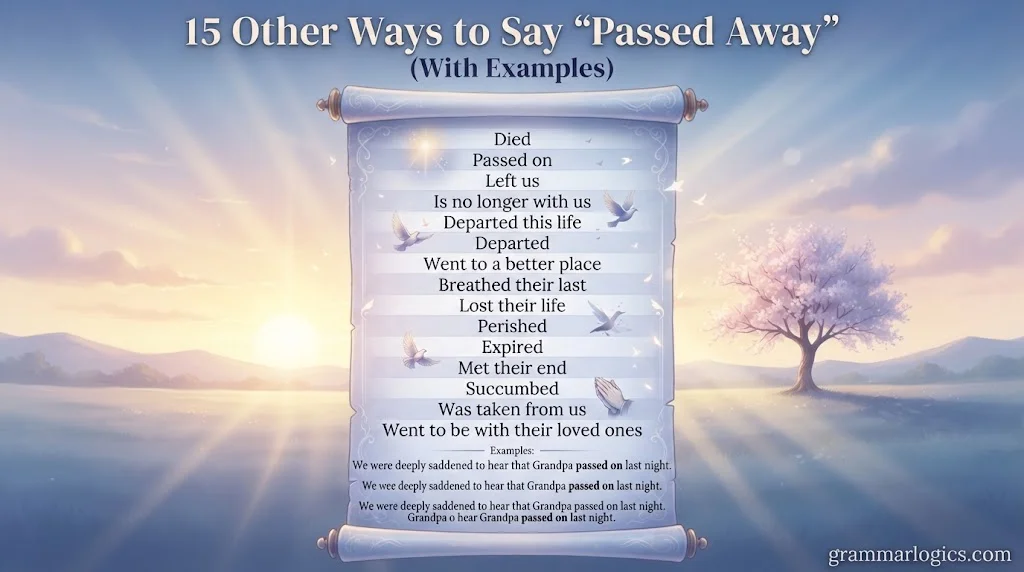
Synonyms for “Passed Away”
- Died
- Passed on
- Left us
- Is no longer with us
- Departed this life
- Departed
- Went to a better place
- Breathed their last
- Lost their life
- Perished
- Expired
- Met their end
- Succumbed
- Was taken from us
- Went to be with their loved ones
1. Died
Meaning
“Died” is the most direct and straightforward alternative to “passed away.” It simply states that a person’s life ended.
Definition
Died means that a living person ceased to be alive.
Detailed Explanation
Unlike “passed away,” “died” is not a euphemism. It communicates the fact directly and clearly, which makes it useful when accuracy and clarity are more important than softening the wording. Although direct, it is not automatically rude; its appropriateness depends heavily on context and tone. In compassionate writing, it can still be used respectfully when surrounded by thoughtful language.
Scenario Examples
Scenario: A factual historical discussion.
Example: “The author died in 1954 after a long and influential career.”
Scenario: Speaking honestly with a close friend.
Example: “I’m sorry to tell you, but her father died last night.”
Best Use
Best for factual writing, historical information, journalism, medical contexts, and direct conversation. It can also be appropriate in personal communication when clarity is important.
Tone
Tone: Direct, factual, clear
The word is emotionally neutral in itself, although the surrounding message can make it feel compassionate or blunt.
2. Passed on
Meaning
“Passed on” is a softer expression that can mean that someone died. It is similar in tone to “passed away.”
Definition
Passed on can be used as a euphemistic expression for death, particularly in informal or personal communication.
Detailed Explanation
This expression softens the subject of death and may feel less stark than “died.” It is generally understandable, although “passed away” is more universally recognizable as a euphemism for death. “Passed on” can occasionally have other meanings, so context matters. It is best used when the surrounding conversation clearly concerns someone’s death.
Scenario Examples
Scenario: Talking about an older family member.
Example: “My grandmother passed on peacefully surrounded by her family.”
Scenario: Remembering someone during a conversation.
Example: “He passed on several years ago, but we still talk about him often.”
Best Use
Best for personal conversations, reflective writing, and informal condolence messages.
Tone
Tone: Gentle, reflective, informal
It sounds softer than “died” but is somewhat less conventional than “passed away.”
3. Left Us
Meaning
“Left us” is a compassionate euphemism suggesting that someone is no longer alive and has left the people who loved them.
Definition
Left us means that a person died and is no longer present with their family, friends, or community.
Detailed Explanation
This expression focuses less on the physical fact of death and more on the sense of absence and loss experienced by others. It can sound particularly heartfelt when used in tributes or personal announcements. Because it emphasizes the people left behind, it is generally warmer and more emotional than “died.” It should be avoided when extreme precision is required.
Scenario Examples
Scenario: Announcing a family loss.
Example: “Our beloved aunt left us peacefully on Sunday evening.”
Scenario: Writing a memorial tribute.
Example: “Although he has left us, his kindness will remain in our hearts.”
Best Use
Best for memorials, tributes, personal announcements, condolence messages, and emotional writing.
Tone
Tone: Warm, emotional, compassionate
The expression highlights loss and remembrance, making it especially suitable for heartfelt communication.
4. Is No Longer With Us
Meaning
“Is no longer with us” is a gentle way of saying that someone has died.
Definition
It means that a person is no longer alive or present among the people who knew them.
Detailed Explanation
This expression avoids directly mentioning death and can therefore feel especially considerate in sensitive conversations. It is often used when discussing someone whose death may be difficult for listeners to hear. The wording also emphasizes the person’s absence rather than the event of death itself. Because it is indirect, it may be less suitable when precise factual language is required.
Scenario Examples
Scenario: Speaking to a group about a former colleague.
Example: “Many of you remember David, who is sadly no longer with us.”
Scenario: Writing a remembrance message.
Example: “She is no longer with us, but her generosity continues to inspire everyone who knew her.”
Best Use
Best for memorial services, workplace announcements, tributes, speeches, and sensitive personal conversations.
Tone
Tone: Respectful, gentle, compassionate
Its indirect wording makes it appropriate when you want to communicate sensitivity and emotional care.
5. Departed This Life
Meaning
“Departed this life” is a formal and somewhat literary expression meaning that someone died.
Definition
It means that a person left earthly life through death.
Detailed Explanation
This phrase has a formal, solemn, and traditional quality. It may appear in obituaries, memorial writing, religious contexts, or ceremonial language. Compared with “passed away,” it sounds more elevated and old-fashioned. Because of its formal character, it may feel unnatural in a casual text message or everyday conversation.
Scenario Examples
Scenario: Writing a formal obituary.
Example: “She departed this life peacefully at the age of eighty-seven.”
Scenario: A traditional memorial notice.
Example: “He departed this life surrounded by his family and close friends.”
Best Use
Best for obituaries, formal memorials, ceremonial writing, and traditional or literary contexts.
Tone
Tone: Formal, solemn, dignified
The phrase conveys respect and gravity, making it particularly suitable for serious written notices.
6. Departed
Meaning
“Departed” can be used as a respectful euphemism for someone who has died.
Definition
In this context, departed means that a person has died or has left this world.
Detailed Explanation
“Departed” has a dignified and somewhat literary feel. It is less direct than “died” and can sound more formal than “passed away.” The word may also have meanings unrelated to death, such as leaving a place, so the context must make the intended meaning clear. It is particularly effective in memorial or ceremonial writing.
Scenario Examples
Scenario: A memorial announcement.
Example: “We gather today to honor our departed friend and colleague.”
Scenario: A formal remembrance.
Example: “The family remembers their departed loved one with deep affection.”
Best Use
Best for formal memorial writing, ceremonies, obituaries, literature, and respectful tributes.
Tone
Tone: Dignified, formal, solemn
Its traditional character gives the expression a sense of respect and seriousness.
7. Went to a Better Place
Meaning
“Went to a better place” is a comforting euphemism suggesting that someone has died and is now somewhere peaceful or free from suffering.
Definition
It is a gentle expression used to suggest that a deceased person has moved on to a peaceful or better existence.
Detailed Explanation
This expression is often connected with comfort, hope, or spiritual beliefs. However, the phrase can carry religious or philosophical implications, so it should be used thoughtfully. It may be comforting to some people but inappropriate for others whose beliefs differ. When you do not know someone’s beliefs, a more neutral expression may be safer.
Scenario Examples
Scenario: Comforting someone after a long illness.
Example: “She suffered for a long time, but many people find comfort in believing she has gone to a better place.”
Scenario: Speaking with a friend who uses spiritual language.
Example: “I hope you can find some peace knowing that he has gone to a better place.”
Best Use
Best for personal conversations and condolence messages when the person or family is comfortable with spiritual or comforting language.
Tone
Tone: Comforting, hopeful, spiritual
The expression focuses on peace and reassurance rather than the direct fact of death.
8. Breathed Their Last
Meaning
“Breathed their last” is a traditional expression meaning that someone died.
Definition
It means that a person took their final breath and died.
Detailed Explanation
This phrase is much more literary and dramatic than “passed away.” It can be found in historical, religious, poetic, or narrative writing. Although it is understandable, it is not usually the most natural choice for a casual condolence message. Its imagery focuses specifically on the final breath, which can make it feel more solemn or dramatic.
Scenario Examples
Scenario: Historical writing.
Example: “The king breathed his last after a long period of illness.”
Scenario: Literary storytelling.
Example: “He breathed his last peacefully, with his family gathered around him.”
Best Use
Best for literary writing, historical narratives, dramatic storytelling, and solemn prose.
Tone
Tone: Literary, solemn, dramatic
It has stronger imagery than everyday expressions for death.
9. Lost Their Life
Meaning
“Lost their life” means that someone died, often with an emphasis on the circumstances that caused the death.
Definition
It means that a person died as a result of an event, accident, conflict, illness, or other circumstance.
Detailed Explanation
Unlike “passed away,” this expression often draws attention to the circumstances of death. It is commonly used in reports about accidents, disasters, wars, and other events involving fatalities. It can sound respectful but is generally less suitable when simply discussing an expected death from old age. The expression should therefore be chosen according to the circumstances.
Scenario Examples
Scenario: Reporting an accident.
Example: “Two passengers lost their lives in the tragic accident.”
Scenario: Discussing a natural disaster.
Example: “Several people lost their lives during the severe storm.”
Best Use
Best for news reports, formal statements, public announcements, and discussions of accidental or tragic deaths.
Tone
Tone: Serious, formal, factual
The phrase emphasizes the circumstances and seriousness of the loss.
10. Perished
Meaning
“Perished” means died, particularly in circumstances involving danger, destruction, disaster, or hardship.
Definition
Perished means that a person died, often as a result of a dangerous, violent, or difficult circumstance.
Detailed Explanation
“Perished” is not a general replacement for “passed away.” It usually suggests that death occurred under tragic, dangerous, or destructive circumstances. The word is more common in historical, literary, journalistic, or disaster-related contexts.
Scenario Examples
Scenario: Describing a historical disaster.
Example: “Many travelers perished when the ship sank.”
Scenario: Historical writing about a conflict.
Example: “Thousands of civilians perished during the conflict.”
Best Use
Best for historical writing, literary descriptions, disasters, wars, and tragic events.
Tone
Tone: Serious, dramatic, formal
It communicates not only death but often a sense of tragedy or harsh circumstances.
11. Expired
Meaning
“Expired” can mean that someone died, although it is a highly formal and sometimes clinical expression.
Definition
In formal usage, expired means that a person died or their life came to an end.
Detailed Explanation
This term has traditionally appeared in legal, medical, administrative, or older formal writing, but it can sound cold when used in ordinary conversation. For that reason, “passed away” is usually more considerate when speaking to family members or offering condolences. “Expired” should not normally be your first choice for a sensitive personal message.
Scenario Examples
Scenario: A historical or formal document.
Example: “The record states that the patient expired shortly after midnight.”
Scenario: Administrative documentation.
Example: “The official report records that he expired at the age of ninety-two.”
Best Use
Best for technical, historical, legal, or clinical contexts, depending on the conventions of the setting.
Tone
Tone: Clinical, formal, impersonal
Because of its technical quality, it can feel less warm and personal than “passed away.”
12. Met Their End
Meaning
“Met their end” means that someone died, usually with a literary or dramatic implication.
Definition
It means that a person’s life came to an end, often suggesting a notable or particular circumstance.
Detailed Explanation
This expression is more dramatic than the everyday phrase “passed away.” It often appears in stories, historical accounts, mysteries, or discussions of violent or unusual deaths. It can sound inappropriate for a gentle condolence message because “their end” may focus attention on the finality of death. Use it when the style or context genuinely calls for dramatic or literary wording.
Scenario Examples
Scenario: A historical narrative.
Example: “The ruler met his end after years of political conflict.”
Scenario: Fictional storytelling.
Example: “The villain finally met his end at the climax of the story.”
Best Use
Best for fiction, historical writing, dramatic narratives, and literary contexts.
Tone
Tone: Dramatic, literary, serious
The phrase emphasizes finality and circumstance rather than comfort or sympathy.
13. Succumbed
Meaning
“Succumbed” means that someone died after being unable to overcome a disease, injury, condition, or other powerful force.
Definition
Succumbed means that a person died because of an illness, injury, or other cause that overwhelmed them.
Detailed Explanation
“Succumbed” is not always a direct synonym for “passed away.” It normally requires or strongly implies a cause or circumstance, such as an illness or injury. For example, “He succumbed to cancer” is natural, while simply saying “He succumbed” may leave the meaning incomplete. The word is more formal and serious than everyday expressions.
Scenario Examples
Scenario: Discussing a serious illness.
Example: “After a long battle with the disease, she succumbed to complications.”
Scenario: Historical writing.
Example: “Many soldiers succumbed to their injuries before receiving medical attention.”
Best Use
Best for formal writing, medical or historical contexts, obituaries, and discussions where the cause of death is relevant.
Tone
Tone: Formal, serious, solemn
The expression often emphasizes the struggle or cause associated with the death.
14. Was Taken From Us
Meaning
“Was taken from us” is an emotional expression suggesting that someone died and their absence is deeply felt by others.
Definition
It means that a person died and was painfully separated from their family, friends, or community.
Detailed Explanation
This expression focuses strongly on grief and emotional loss. It can be particularly moving when someone dies unexpectedly or at a young age. Because it carries a strong emotional implication, it is not a neutral replacement for “passed away.” The phrase may also suggest that the death was premature, tragic, or unfair, so it should be used when that sentiment reflects the situation.
Scenario Examples
Scenario: Remembering someone who died unexpectedly.
Example: “We are heartbroken that our dear friend was taken from us so suddenly.”
Scenario: Writing a memorial tribute.
Example: “She was taken from us far too soon, but her memory will remain with everyone who loved her.”
Best Use
Best for memorial messages, tributes, condolence statements, and emotional personal writing.
Tone
Tone: Heartbroken, emotional, compassionate
It strongly communicates the pain of losing someone.
15. Went to Be With Their Loved Ones
Meaning
“Went to be with their loved ones” is a gentle and often spiritual way of referring to someone’s death.
Definition
It suggests that a deceased person has died and is imagined as being reunited with people they loved who had already died.
Detailed Explanation
This expression is highly dependent on personal beliefs and circumstances. It may provide comfort when a grieving family believes that deceased loved ones are reunited after death. However, it should not be presented as a universal belief because people have different religious, cultural, and philosophical views. When used appropriately, it can create a deeply personal and comforting message.
Scenario Examples
Scenario: A family shares a spiritual belief.
Example: “After a long and meaningful life, she went to be with her loved ones.”
Best Use
Best for personal condolence messages, spiritual writing, family announcements, and faith-sensitive contexts where the wording aligns with the person’s beliefs.
Tone
Tone: Comforting, emotional, spiritual
It emphasizes reunion, peace, and emotional comfort rather than the direct fact of death.
FAQs
What is another way to say “passed away”?
Some respectful alternatives include “died,” “left us,” “passed on,” “lost their life,” and “is no longer with us.” The best choice depends on the situation and the tone you want to convey.
What is a polite way to say someone died?
“Passed away” is one of the most polite and commonly used expressions. Other gentle alternatives include “passed on,” “is at peace,” and “left this world.”
What is a formal way to say “passed away”?
In formal writing, “died” can be appropriate and direct, while “passed away” is often softer. In obituaries and official contexts, the most suitable expression depends on the publication and audience.
Can I use “passed away” in a sympathy message?
Yes. “Passed away” is widely considered respectful and compassionate in sympathy messages. It can help communicate loss without sounding unnecessarily blunt or insensitive.
What is a gentle way to talk about death?
Expressions such as “passed away,” “passed on,” “left us,” and “is no longer with us” can sound gentler than directly saying someone died. Choose an expression that fits the relationship and situation.
Is “passed away” appropriate for an obituary?
Yes, “passed away” is commonly used in obituaries. However, some publications or families may prefer more direct wording, so it is important to consider the preferred style and wishes of those involved.
Conclusion
Finding the right words to describe someone’s death can be challenging, particularly when emotions are involved. While “passed away” remains a respectful and widely accepted expression, there are many other ways to communicate the same idea with sensitivity, compassion, and dignity.
The best alternative depends on the context, audience, and tone you want to create. Whether you are writing an obituary, expressing condolences, speaking with a grieving family, or discussing a loss, choosing thoughtful language can make your message feel more respectful and heartfelt. Use the alternatives in this guide to express yourself naturally while keeping the feelings of others in mind.