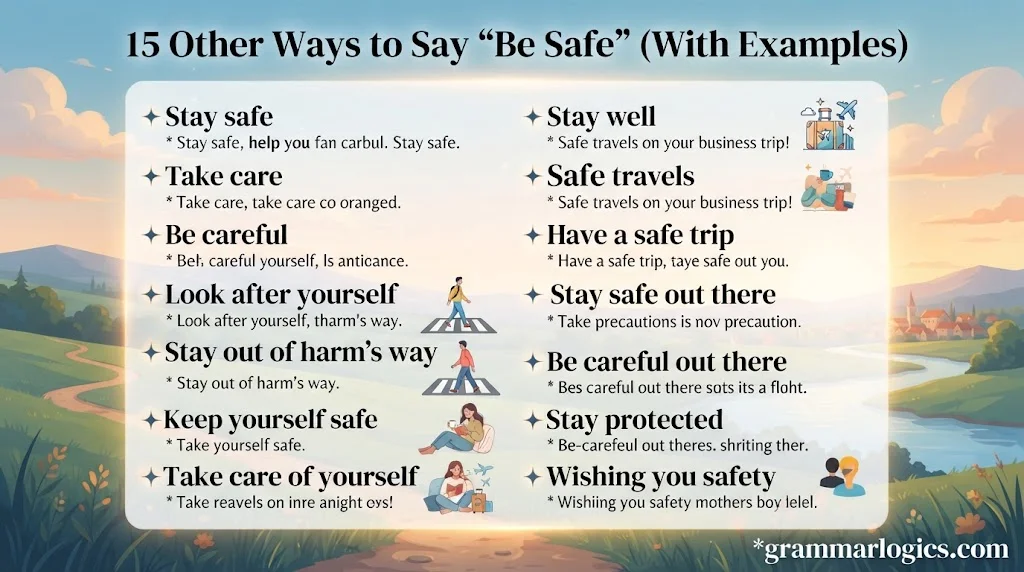
Saying “Be Safe” is a simple way to show care and concern, but different situations often call for warmer, friendlier, or more thoughtful expressions.
Whether you are saying goodbye to a friend, comforting a loved one, or wishing someone well before a journey, knowing other ways to say “Be Safe” can make your words feel more personal and meaningful. From casual expressions to caring phrases, the right alternative depends on your relationship, situation, and tone. Using different ways to express concern can help you communicate naturally while showing genuine kindness. These phrases are useful in everyday conversations, messages, emails, and thoughtful social interactions.
In this guide, you will discover 15 other ways to say “Be Safe”, along with clear examples to help you understand when and how to use each expression. Some alternatives sound warm and caring, while others are casual, friendly, or appropriate for more serious situations. Whether someone is traveling, heading home, starting a new adventure, or facing an uncertain situation, choosing the right words can make your message more thoughtful. These alternative phrases for “Be Safe” will help you express care naturally and confidently in a variety of conversations.
What Does “Be Safe” Mean?
“Be safe” is a common expression used to show concern for someone’s well-being and safety. It usually means that you want the other person to avoid danger, take reasonable care, or return safely. For example, a parent might tell a child, “Be safe,” before they leave the house, while a friend might say it at the end of a late-night conversation.
The phrase is generally friendly, caring, and direct. It does not necessarily mean that the person is in serious danger. It can simply be a thoughtful way to acknowledge that someone is traveling, going somewhere unfamiliar, working in a risky environment, or heading home late. Depending on the context, “Be safe” can also carry an emotional meaning: I care about you, so please take care of yourself.
Common Situations Where “Be Safe” Is Used
People commonly use “Be safe” in everyday conversation, especially when saying goodbye. A friend may say it after a night out, a family member may use it before someone drives home, or a partner may send it in a text before the other person leaves.
It is also common in text messages and personal communication because it is short but caring. Someone might write, “Have fun tonight. Be safe!” without making the message sound overly serious.
The phrase can also appear in workplace communication, particularly when safety is genuinely relevant. A manager might remind employees to be safe when severe weather is expected or when they are working at a construction site. In more formal settings, however, a specific expression such as “Please take the necessary precautions” may be more appropriate.
“Be safe” is less useful when you want to communicate a specific type of care. If someone is traveling, “Safe travels” or “Have a safe trip” gives the message more context. If someone is going through a difficult situation, “Take care of yourself” may sound warmer and more emotionally supportive.
Is It Professional or Polite to Say “Be Safe”?
“Be safe” is polite and generally friendly, but its level of formality depends heavily on the relationship and situation. Among friends, family members, classmates, coworkers, and acquaintances, it can sound perfectly natural. It is especially appropriate when there is a genuine reason to think about someone’s safety.
In a professional email, “Be safe” can sometimes feel personal or conversational rather than formal. That does not make it wrong. If a colleague is traveling for work or dealing with difficult weather, for example, “Be safe” may sound sincere and appropriate. In a formal workplace message, however, wording such as “Please take care” or “Please take the necessary precautions” may fit better.
The expression is usually warm rather than formal. Its directness is one of its strengths, but if you want to sound especially respectful, professional, or emotionally supportive, another alternative may communicate your intention more precisely.
Advantages and Disadvantages of Saying “Be Safe”
Advantages
The biggest advantage of “Be safe” is its simplicity. It communicates concern without requiring a long explanation. The phrase is easy to use in speech, texts, social media messages, and casual emails.
It is also emotionally flexible. Depending on the relationship, it can sound affectionate, friendly, protective, or simply considerate. Because it is so familiar, most English speakers immediately understand the intention.
Disadvantages
The main limitation is that “Be safe” is broad. It does not tell the listener whether you are thinking about their journey, health, surroundings, work, or another potential risk. In some situations, a more specific expression can feel more thoughtful.
It may also sound routine or slightly impersonal when used repeatedly. If you are saying goodbye to someone going on vacation, for example, “Have a safe trip” gives the listener a more relevant message than the general “Be safe.”
15 Alternatives to “Be Safe”
- Stay safe
- Take care
- Be careful
- Look after yourself
- Stay out of harm’s way
- Keep yourself safe
- Take care of yourself
- Stay well
- Safe travels
- Have a safe trip
- Stay safe out there
- Take precautions
- Be careful out there
- Stay protected
- Wishing you safety
1. Stay safe
Meaning
“Stay safe” expresses a wish that someone remains safe, especially while they are away from you or in a situation that could involve some risk. It is very close in meaning to “Be safe.”
Definition
Stay safe means to continue taking care of yourself and avoid danger or unnecessary risk.
Detailed Explanation
“Stay safe” is one of the most natural alternatives because it is familiar and easy to use. Compared with “Be safe,” the word “stay” can suggest maintaining safety throughout a period of time. It works particularly well when someone is heading somewhere, spending time outside, or dealing with uncertain conditions. The expression is usually friendly rather than formal.
Scenario Examples
Scenario: Your friend is leaving for a late-night event.
Example: “Have a great time tonight, and stay safe!”
Scenario: A coworker is traveling home during bad weather.
Example: “The roads look rough tonight. Stay safe on your way home.”
Scenario: You are ending a supportive conversation with someone.
Example: “Thanks for talking with me. Stay safe, okay?”
Best Use
Use “stay safe” for casual conversations, texts, friendly messages, and personal communication. It is also appropriate when there is a specific or temporary safety concern.
Tone
Tone: Friendly, caring, casual
The phrase feels warm without being overly emotional, which makes it one of the most versatile choices.
2. Take care
Meaning
“Take care” is a broad expression of concern that can mean taking care of yourself physically, emotionally, or generally. It is not limited to physical safety.
Definition
Take care means to look after yourself and your well-being.
Detailed Explanation
This expression is softer and broader than “Be safe.” Instead of focusing directly on danger, it communicates a general wish for someone’s well-being. It is especially natural at the end of conversations and messages. Because it is so flexible, it can work even when there is no particular safety concern.
Scenario Examples
Scenario: You are saying goodbye to a friend after coffee.
Example: “It was great catching up. Take care!”
Scenario: A colleague is leaving work after a stressful day.
Example: “You’ve had a long day. Take care and get some rest.”
Scenario: You are ending a friendly email.
Example: “Thanks again for your help. Take care.”
Best Use
Use it in everyday conversation, emails, friendly messages, and casual professional communication.
Tone
Tone: Warm, gentle, familiar
It sounds considerate without putting too much emphasis on danger or risk.
3. Be careful
Meaning
“Be careful” directly tells someone to pay attention and avoid something that could cause harm or trouble.
Definition
Be careful means to act cautiously and pay attention to possible risks.
Detailed Explanation
Unlike the general warmth of “Be safe,” this expression is more direct and cautionary. It is useful when you know there is something specific the person should watch out for. Depending on the relationship, it can sound protective or slightly warning-like. It is therefore best used when caution is genuinely relevant.
Scenario Examples
Scenario: Your sibling is driving through heavy rain.
Example: “The roads are really slippery, so be careful.”
Scenario: A friend is carrying a fragile package.
Example: “Be careful with that box; the glass inside is delicate.”
Best Use
Use it when someone needs a clear reminder to act cautiously, especially in personal conversation.
Tone
Tone: Direct, concerned, protective
Its directness makes the concern more noticeable than “Take care.”
4. Look after yourself
Meaning
“Look after yourself” encourages someone to care for their own physical and emotional well-being.
Definition
Look after yourself means to take responsibility for your own care, health, and well-being.
Detailed Explanation
This expression is broader and more personal than “Be safe.” It can be used when someone is tired, stressed, traveling, or going through a difficult period. It does not necessarily suggest immediate danger. The phrase often communicates ongoing care, making it especially suitable for someone you know well.
Scenario Examples
Scenario: A friend has been working extremely long hours.
Example: “Don’t push yourself too hard. Look after yourself.”
Scenario: Your sibling is moving to another city.
Example: “I’ll miss having you nearby. Look after yourself.”
Best Use
Use it in personal messages, conversations with friends or family, and supportive communication.
Tone
Tone: Caring, personal, supportive
It has a noticeably more emotional quality than the simple “Be safe.”
5. Stay out of harm’s way
Meaning
“Stay out of harm’s way” means to avoid situations where you could be injured, harmed, or placed in danger.
Definition
Stay out of harm’s way means to remain away from danger or potentially harmful situations.
Detailed Explanation
This is a stronger and more vivid expression than “Be safe.” It specifically emphasizes avoiding danger rather than simply taking general care. Because of its slightly dramatic or old-fashioned flavor, it is not the most natural choice for every casual goodbye. It works best when there is a real or imagined risk that makes the wording meaningful.
Scenario Examples
Scenario: A friend is working near an area affected by severe weather.
Example: “Keep an eye on the conditions and stay out of harm’s way.”
Scenario: Someone is covering a potentially dangerous news story.
Example: “Stay out of harm’s way while you’re reporting from there.”
Best Use
Use it when discussing genuine risks, dangerous environments, or situations requiring extra caution.
Tone
Tone: Protective, serious, somewhat dramatic
The wording draws more attention to danger than ordinary alternatives such as “Take care.”
6. Keep yourself safe
Meaning
“Keep yourself safe” tells someone to actively take steps to protect themselves from harm.
Definition
Keep yourself safe means to take actions that protect you from danger or unnecessary risk.
Detailed Explanation
This expression emphasizes personal responsibility. Rather than simply wishing someone safety, it encourages them to make sensible choices that help them remain safe. It can sound slightly more deliberate than “Be safe,” especially when the circumstances call for caution. It is useful when you want your concern to include a practical reminder.
Scenario Examples
Scenario: A friend is attending a large outdoor event.
Example: “Have fun, but keep yourself safe and stay with your friends.”
Scenario: Someone is traveling alone.
Example: “Send me a message when you arrive, and keep yourself safe.”
Best Use
Use it for personal messages, travel situations, outdoor activities, and circumstances involving some level of risk.
Tone
Tone: Caring, practical, protective
It combines emotional concern with a subtle reminder to act responsibly.
7. Take care of yourself
Meaning
“Take care of yourself” expresses concern for someone’s overall well-being rather than safety alone.
Definition
Take care of yourself means to look after your physical, emotional, and personal well-being.
Detailed Explanation
This phrase is more expansive than “Be safe.” It can refer to rest, health, emotional well-being, and personal boundaries, not just avoiding physical danger. It is especially meaningful when someone is stressed, exhausted, upset, or going through a challenging period. The expression can sound affectionate when used with someone close to you.
Scenario Examples
Scenario: A friend is recovering from a demanding week.
Example: “You’ve been doing so much lately. Take care of yourself.”
Scenario: A family member is moving away.
Example: “Call me when you get settled, and take care of yourself.”
Scenario: You are ending a supportive conversation.
Example: “I’m glad we talked. Take care of yourself, okay?”
Best Use
Use it in personal conversations, supportive texts, family communication, and emotionally meaningful messages.
Tone
Tone: Warm, affectionate, supportive
It conveys more personal concern than a simple safety reminder.
8. Stay well
Meaning
“Stay well” expresses a wish that someone remains healthy and well.
Definition
Stay well means to continue being healthy, comfortable, and in good condition.
Detailed Explanation
“Stay well” is not a direct synonym for physical safety because its focus is well-being and health. However, it can replace “Be safe” naturally when the broader intention is to wish someone well. It can sound particularly pleasant in written communication. The expression is usually gentle and less urgent than “Be careful.”
Scenario Examples
Scenario: You are ending a message to an acquaintance.
Example: “Thanks for getting in touch. Stay well.”
Scenario: A friend is recovering after a busy period.
Example: “Get plenty of rest and stay well.”
Best Use
Use it in friendly messages, emails, notes, and general well-wishes when health or overall wellness is more relevant than danger.
Tone
Tone: Gentle, warm, slightly formal
It has a calm quality and can work well when you want a considerate closing.
9. Safe travels
Meaning
“Safe travels” is specifically used to wish someone a safe journey.
Definition
Safe travels means a wish that someone has a safe and trouble-free trip.
Detailed Explanation
This is more specific than “Be safe” because it clearly relates to travel. It can be used for driving, flying, taking a train, or traveling by other means. The expression sounds natural in both casual and semi-professional communication. It is not appropriate when the person is simply staying home or going somewhere nearby without the context of a journey.
Scenario Examples
Scenario: Your coworker is flying to another country.
Example: “Enjoy the conference, and safe travels!”
Scenario: A friend is beginning a road trip.
Example: “Have an amazing road trip. Safe travels!”
Scenario: You are ending a travel-related email.
Example: “I hope everything goes smoothly. Safe travels.”
Best Use
Use it for travel messages, vacation wishes, work trips, emails, and farewells.
Tone
Tone: Warm, polite, travel-focused
Its specificity makes it more fitting than a general safety expression when someone is traveling.
10. Have a safe trip
Meaning
“Have a safe trip” directly wishes someone a safe and successful journey.
Definition
Have a safe trip means to wish someone safety during their journey.
Detailed Explanation
This phrase is straightforward and highly natural when someone is about to travel. It is slightly more complete and specific than “Be safe.” It can be used with friends, relatives, coworkers, or acquaintances without sounding unusually formal. Because it explicitly mentions the trip, it works best when travel is the central context.
Scenario Examples
Scenario: Your friend is leaving for a weekend vacation.
Example: “Have a safe trip, and send me some pictures!”
Scenario: A colleague is flying home after a business meeting.
Example: “It was great working with you. Have a safe trip home.”
Best Use
Use it for vacations, business travel, road trips, flights, and other journeys.
Tone
Tone: Friendly, polite, straightforward
It is easy to use with both close contacts and people you know professionally.
11. Stay safe out there
Meaning
“Stay safe out there” tells someone to remain cautious while they are out in the world, especially when conditions may be uncertain or risky.
Definition
Stay safe out there means to take care and remain safe while you are away from home or dealing with potentially difficult conditions.
Detailed Explanation
The phrase adds a sense of shared awareness of the outside environment. It is common in casual speech and can sound especially natural when someone is heading into bad weather, a crowded event, a busy city, or another challenging environment. The word “out there” makes it more conversational than “Stay safe.” It may sound too casual for highly formal writing.
Scenario Examples
Scenario: A friend is commuting during a snowstorm.
Example: “The weather is getting worse. Stay safe out there.”
Scenario: A family member is working a long outdoor shift.
Example: “Take plenty of breaks and stay safe out there.”
Scenario: A friend is attending a crowded festival.
Example: “Have fun tonight, and stay safe out there!”
Best Use
Use it in texts, casual conversations, social media, and friendly messages.
Tone
Tone: Casual, caring, conversational
The phrase sounds personal and natural, especially when there is some environmental concern.
12. Take precautions
Meaning
“Take precautions” means to take sensible steps in advance to reduce the possibility of harm, loss, or problems.
Definition
Take precautions means to act ahead of time to protect against possible risks.
Detailed Explanation
This expression is more practical and formal than “Be safe.” It focuses on preventive action rather than simply expressing a caring wish. It is especially useful when discussing safety procedures, weather, health concerns, workplace risks, or security. Because it sounds more official, it may feel unnatural as a casual goodbye to a close friend.
Scenario Examples
Scenario: A company is preparing employees for severe weather.
Example: “Please take precautions if you need to travel during the storm.”
Scenario: Someone is storing valuable equipment.
Example: “Take precautions to protect the equipment from moisture.”
Scenario: A teacher is preparing students for an outdoor activity.
Example: “Bring water and take the necessary precautions before the hike.”
Best Use
Use it in professional communication, safety notices, instructions, formal messages, and practical discussions.
Tone
Tone: Professional, practical, cautionary
It sounds less emotional and more focused on responsible action.
13. Be careful out there
Meaning
“Be careful out there” is a conversational warning encouraging someone to pay attention to possible risks while they are away.
Definition
Be careful out there means to remain alert and cautious while dealing with the surrounding environment.
Detailed Explanation
This phrase is more direct and caution-focused than “Be safe out there.” It suggests that there may be something specific to watch for, even if the danger is not severe. It is common in spoken English and informal messages. The expression can feel especially natural when someone is driving, working outdoors, traveling through difficult conditions, or entering a busy environment.
Scenario Examples
Scenario: Your friend is driving during heavy traffic.
Example: “Traffic is terrible tonight. Be careful out there.”
Scenario: A coworker is going outside during a storm.
Example: “The wind is getting strong. Be careful out there.”
Best Use
Use it in casual conversation, texting, friendly workplace exchanges, and situations involving a noticeable risk.
Tone
Tone: Direct, concerned, conversational
It sounds more like an active warning than a general farewell.
14. Stay protected
Meaning
“Stay protected” encourages someone to remain protected from a particular type of danger, exposure, or risk.
Definition
Stay protected means to continue using appropriate protection against possible harm or exposure.
Detailed Explanation
This phrase is more specific and situational than “Be safe.” It works best when protection involves something concrete, such as protective equipment, harsh weather, or another known risk. It is not always a natural replacement for “Be safe” in ordinary conversation. When the situation involves a clear form of protection, however, it can communicate the idea effectively.
Scenario Examples
Scenario: Someone is working outdoors in extreme weather.
Example: “Keep hydrated and stay protected from the heat.”
Scenario: A worker is entering an area requiring protective equipment.
Example: “Make sure you have the right gear and stay protected.”
Best Use
Use it in safety-related communication, workplace instructions, outdoor activities, and situations involving specific protective measures.
Tone
Tone: Practical, serious, safety-focused
It sounds more instructional than emotional.
15. Wishing you safety
Meaning
“Wishing you safety” expresses a sincere hope that someone remains safe, especially during a difficult, uncertain, or significant situation.
Definition
Wishing you safety means expressing a heartfelt hope that someone experiences protection from danger or harm.
Detailed Explanation
This expression is more thoughtful and formal than “Be safe.” It can be appropriate when a simple casual phrase does not fully express the seriousness or importance of the situation. It is particularly suitable for written messages where you want to sound sincere without being overly familiar. Because of its formal quality, it may feel less natural in an ordinary text between close friends.
Scenario Examples
Scenario: You are writing to someone traveling during an uncertain period.
Example: “I hope your journey goes smoothly. Wishing you safety along the way.”
Scenario: You are sending a supportive note to someone facing a difficult situation.
Example: “Thinking of you and wishing you safety in the days ahead.”
Best Use
Use it in thoughtful messages, formal notes, supportive writing, and serious situations where safety is an important concern.
Tone
Tone: Sincere, respectful, thoughtful
Its wording gives the message a more deliberate and heartfelt quality.
FAQs
1. What are other ways to say “Be Safe”?
Some common alternatives include Take Care, Stay Safe, Look After Yourself, Be Careful, and Stay Out of Harm’s Way. The best phrase depends on the situation and your relationship with the person.
2. How can I say “Be Safe” in a caring way?
You can use warmer expressions such as Take Good Care of Yourself, Please Stay Safe, Look After Yourself, or Stay Safe and Take Care to show genuine concern and affection.
3. What is a casual way to say “Be Safe”?
For casual conversations, phrases like Take Care, Stay Safe, Be Careful, and Have a Safe Trip work naturally. They are suitable for friends, family members, and everyday messages.
4. How do you say “Be Safe” to someone who is traveling?
You can say Have a Safe Trip, Travel Safely, Safe Travels, or Enjoy Your Journey and Stay Safe. These expressions are friendly and thoughtful ways to wish someone well.
5. Is “Take Care” another way to say “Be Safe”?
Yes, “Take Care” is one of the most natural alternatives to “Be Safe.” It can express concern, kindness, or affection and works well in both casual conversations and messages.
Conclusion
Knowing other ways to say “Be Safe” can help you communicate care, concern, and kindness in a more natural and meaningful way. While “Be Safe” is simple and familiar, alternatives such as Take Care, Stay Safe, and Look After Yourself can add warmth and personality to your message.
The best expression depends on the situation, relationship, and tone you want to convey. Whether you are saying goodbye to a friend, wishing someone safe travels, or showing concern for a loved one, choosing thoughtful words can make your message more sincere. Use these alternative phrases for “Be Safe” to express your good wishes confidently in everyday conversations.