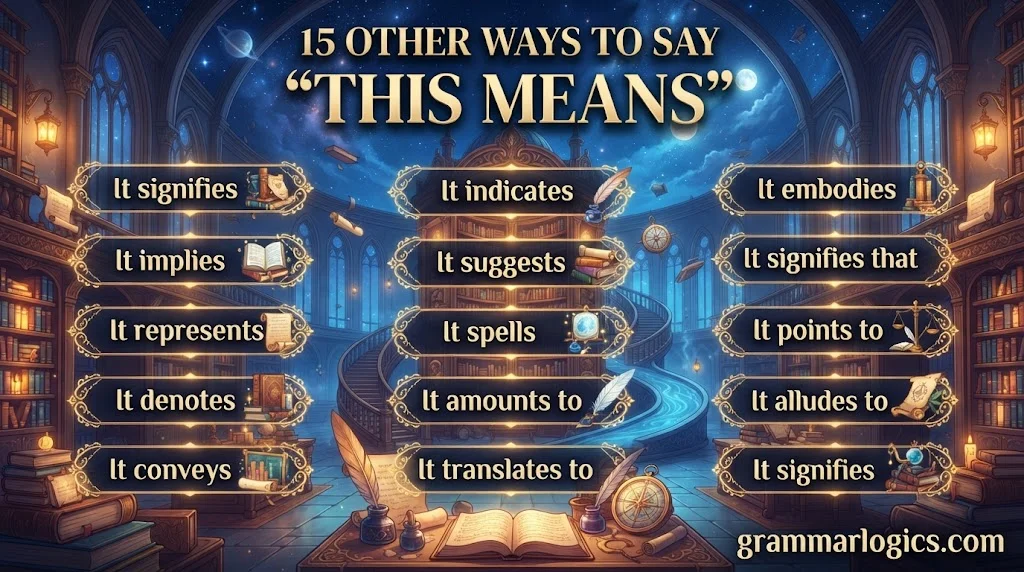
The phrase “this means” helps explain ideas, clarify information, and make communication easier to understand.
There are many situations where using the same phrase repeatedly can make your writing sound dull or less engaging. Whether you are writing a blog post, preparing an email, explaining a lesson, or having a conversation, choosing the right alternative to “this means” can make your message clearer and more natural. Different expressions can help you explain meanings, introduce conclusions, and connect ideas smoothly. Learning these alternatives will also improve your vocabulary, writing style, and communication skills in everyday and professional situations.
In this article, you will discover 15 other ways to say “this means”, along with clear explanations and practical examples to help you use each expression correctly. These alternatives will help you avoid repetition while making your sentences more interesting, professional, and easy to follow. Some phrases are ideal for formal writing and academic discussions, while others work well in casual conversations, blog posts, and everyday communication. By understanding when to use each expression, you can choose words that fit your purpose and audience. Explore these useful alternatives to make your English writing more effective, fluent, and engaging.
What Does “This Means” Mean?
“This means” is an expression used to explain the meaning, result, or implication of something mentioned earlier. It helps readers or listeners understand what a fact, statement, action, or situation tells us. For example, “The deadline has been moved to Friday. This means we have two extra days to finish the project.” In this sentence, the phrase explains the practical result of the new deadline. Depending on the context, “this means” can introduce a clarification, an inference, a consequence, or a simpler explanation of a complicated idea. Its precise meaning depends on the information that comes before it.
Common Situations Where “This Means” Is Used
People use “this means” in everyday conversations when explaining what something involves or why it matters. In text messages, it can clarify plans, instructions, or unexpected news. Students use it in essays and assignments to explain the significance of evidence, while teachers use it to make difficult concepts easier to understand. In professional communication, the phrase helps explain deadlines, decisions, requirements, and project updates. Bloggers and writers also use it to connect ideas and make information easier to follow. When the phrase appears repeatedly, choosing an alternative can improve clarity, variety, and flow without changing the original message.
Is It Professional or Polite to Say “This Means”?
Yes, “this means” is both professional and polite in most contexts. It is a neutral expression that works well in emails, reports, presentations, academic writing, and everyday conversations. It does not sound rude or overly casual, although its directness may feel slightly strong when explaining an inconvenient consequence. Expressions such as “this indicates” or “this suggests” can sound more analytical, while “in other words” is helpful when simplifying information. The best choice depends on whether you are explaining a definite fact, drawing a conclusion, or offering an interpretation. Using an appropriate alternative can make your message more precise and considerate.
Advantages and Disadvantages of Saying “This Means”
Advantages
The phrase “this means” is simple, direct, and easy to understand. It clearly connects information with its explanation, making it useful for readers of different English proficiency levels. It also works across casual, academic, and professional settings without requiring complicated vocabulary. Because the expression is familiar, it helps readers follow an explanation without unnecessary effort.
Disadvantages
Although the phrase is effective, repetition can make writing sound predictable. It may also be too general when a more precise expression would communicate the intended relationship better. For example, “this results in” emphasizes a consequence, whereas “this suggests” introduces an interpretation rather than a definite fact. Choosing the wrong alternative can also make a statement sound more certain than the evidence supports. The goal is not to avoid “this means” entirely, but to select wording that accurately reflects the message.
15 Synonyms and Alternatives for “This Means”
- In Other Words
- That Means
- This Indicates
- This Suggests
- In Other Terms
- Put Simply
- To Put It Another Way
- In Essence
- This Implies
- As a Result
- Therefore
- This Shows
- What This Means Is
- In Practical Terms
- This Translates To
1. In Other Words
Meaning
“In other words” introduces a different way of expressing or explaining an idea. It is especially useful when you want to make information easier to understand without changing its original meaning.
Definition
A phrase used to restate or clarify an idea using different words.
Detailed Explanation
“In other words” is one of the most natural alternatives when you want to explain something more clearly. Unlike “this means,” which often introduces a result or implication, this expression usually repeats an idea in a simpler or more understandable form. It works well when readers might misunderstand a technical statement or when you want to emphasize the main point. It is common in both spoken English and written communication.
Scenario Examples
– Scenario: Explaining a complicated instruction to a friend.
Example: You need to submit the form before Monday. In other words, don’t wait until the last minute.
– Scenario: Clarifying a workplace policy.
Example: Employees must complete the training first. In other words, you cannot start the new task until the course is finished.
– Scenario: Explaining a lesson.
Example: Plants need sunlight to grow. In other words, they need light to produce the energy required for healthy growth.
Best Use
Use this expression in educational content, blog posts, presentations, everyday conversations, and explanatory emails when restating information.
Tone
Tone: Clear, conversational, explanatory.
It sounds approachable and helps readers understand an idea without making the explanation overly formal.
2. That Means
Meaning
“That means” explains the significance or consequence of information already mentioned. It is very similar to “this means” and often sounds natural in everyday conversation.
Definition
An expression used to explain what a previously mentioned fact or situation signifies.
Detailed Explanation
“That means” works particularly well when referring to a specific fact, event, or statement. The word “that” often points back to information already discussed, while “this” can introduce something the speaker is currently explaining. In many situations, the two phrases are interchangeable. The difference is subtle and depends on context rather than a strict grammatical rule.
Scenario Examples
– Scenario: Discussing a change in travel plans.
Example: The train leaves at six now. That means we need to leave home earlier.
– Scenario: Talking about a school assignment.
Example: You scored above the required mark. That means you’ve passed the test.
– Scenario: Discussing a friend’s new job.
Example: Your office is moving closer to your house? That means your daily commute will be shorter.
Best Use
Choose this phrase for casual conversations, text messages, meetings, and explanations that refer to previously shared information.
Tone
Tone: Natural, friendly, direct.
It sounds straightforward and familiar, making it suitable for both personal and professional conversations.
3. This Indicates
Meaning
“This indicates” suggests that a fact, observation, or piece of evidence points toward a particular conclusion. It is especially useful when explaining information analytically.
Definition
A phrase meaning that something points to or provides evidence of a particular fact or condition.
Detailed Explanation
“This indicates” is more formal and analytical than “this means.” It is common in reports, research discussions, academic writing, and professional assessments. Unlike a simple explanation, an indication may not establish something with absolute certainty. The expression is therefore useful when interpreting evidence or identifying a pattern without claiming more than the available information supports.
Scenario Examples
– Scenario: Reviewing customer feedback.
Example: Most customers requested faster delivery. This indicates that shipping speed should be a priority.
– Scenario: Discussing classroom results.
Example: Several students struggled with the same question. This indicates that the topic may need further explanation.
– Scenario: Writing a business report.
Example: Sales increased for three consecutive months. This indicates a positive trend in demand.
Best Use
Use it in formal reports, academic writing, business presentations, research summaries, and evidence-based explanations.
Tone
Tone: Professional, analytical, measured.
Its formal wording helps communicate an evidence-based interpretation rather than a casual personal reaction.
4. This Suggests
Meaning
“This suggests” introduces a possible explanation, interpretation, or conclusion. It is useful when the available information points toward an idea but does not prove it completely.
Definition
An expression indicating that something makes a particular explanation or conclusion seem likely.
Detailed Explanation
This phrase is ideal when you want to communicate an idea cautiously. Unlike “this proves,” which expresses strong certainty, “this suggests” leaves room for other explanations. It is useful when discussing observations, research findings, feedback, and everyday situations where information is incomplete. Choosing it carefully helps you avoid presenting assumptions as established facts.
Scenario Examples
– Scenario: Reviewing website performance.
Example: More visitors are reading the full article. This suggests that the content is addressing their questions.
– Scenario: Discussing a student’s progress.
Example: Her latest assignments are much stronger. This suggests that the additional practice is helping.
– Scenario: Talking about a delayed response.
Example: He has not replied yet. This suggests that he may be busy, although we cannot be certain.
Best Use
Choose this phrase for analytical writing, research discussions, thoughtful conversations, and situations involving uncertainty.
Tone
Tone: Cautious, thoughtful, analytical.
It communicates a reasonable interpretation without claiming that the conclusion is definitely true.
5. In Other Terms
Meaning
“In other terms” can introduce an explanation using different terminology, particularly when describing a concept from another perspective. However, it is less idiomatic than “in other words” in ordinary English.
Definition
A phrase that presents an idea using different terminology or conceptual terms.
Detailed Explanation
“In other terms” is sometimes useful when discussing technical, mathematical, or specialized concepts. However, it should not automatically replace “this means” in everyday writing. If you simply want to make a sentence clearer, “in other words” is generally more natural. Use “in other terms” when you genuinely mean that an idea is being described through a different set of terms or a different conceptual framework.
Scenario Examples
– Scenario: Explaining a business concept.
Example: The company has a negative cash flow. In other terms, more money is going out than coming in.
– Scenario: Clarifying a mathematical relationship.
Example: The two quantities increase together. In other terms, they show a positive relationship.
– Scenario: Explaining a technical idea.
Example: The process reduces unnecessary data. In other terms, it removes information the system does not need.
Best Use
Use it selectively in technical explanations, specialized discussions, and contexts where terminology itself is important. For general audiences, consider “in other words” instead.
Tone
Tone: Technical, explanatory, somewhat formal.
It can fit specialized writing, but may sound less natural in casual conversation.
6. Put Simply
Meaning
“Put simply” introduces a straightforward explanation of an idea that may otherwise seem complicated. It tells readers that the next statement will focus on the essential point.
Definition
An expression meaning explained in a simple or easy-to-understand way.
Detailed Explanation
“Put simply” is useful when simplifying technical information, lengthy explanations, or unfamiliar concepts. It often introduces a shorter summary rather than a word-for-word restatement. Compared with “this means,” it places greater emphasis on simplicity and accessibility. However, it should not be used to oversimplify a subject when important qualifications or details need to be preserved.
Scenario Examples
– Scenario: Explaining a website feature to a new user.
Example: The tool stores your previous settings. Put simply, you won’t need to enter them every time.
– Scenario: Describing a financial concept.
Example: Inflation reduces purchasing power. Put simply, the same amount of money buys fewer things.
– Scenario: Helping a student understand a lesson.
Example: The character changes after facing several challenges. Put simply, the experiences teach the character an important lesson.
Best Use
Use this expression in blog posts, educational materials, presentations, tutorials, and conversations with people who may be unfamiliar with a topic.
Tone
Tone: Accessible, helpful, reassuring.
It signals that you want to make information easier to understand rather than overwhelm your audience.
7. To Put It Another Way
Meaning
“To put it another way” introduces a rephrasing of an idea to make it clearer, more precise, or easier to relate to.
Definition
A phrase used to express the same general idea in a different way.
Detailed Explanation
This expression is similar to “in other words,” but it often introduces a more deliberate explanation or a fresh perspective. It is useful when the first explanation has not fully communicated your point. The phrase works in both speaking and writing, although it is slightly longer than simpler alternatives. Make sure the new wording genuinely clarifies the original idea rather than merely repeating it.
Scenario Examples
– Scenario: Explaining a deadline to a colleague.
Example: We need the draft before the review meeting. To put it another way, please send it by Wednesday afternoon.
– Scenario: Discussing a personal boundary.
Example: I need some quiet time after work. To put it another way, I’d like a little space to recharge before we talk.
– Scenario: Explaining a learning objective.
Example: The exercise develops critical thinking. To put it another way, it teaches students to examine ideas instead of accepting them immediately.
Best Use
Choose this phrase for presentations, essays, tutorials, thoughtful conversations, and explanations that benefit from a second formulation.
Tone
Tone: Thoughtful, explanatory, conversational.
It sounds natural and gives the speaker room to clarify an idea without appearing abrupt.
8. In Essence
Meaning
“In essence” introduces the central idea or most important part of a statement. It focuses on what something fundamentally represents rather than every supporting detail.
Definition
An expression meaning at the most basic or important level.
Detailed Explanation
“In essence” is helpful when summarizing a complicated argument, policy, proposal, or situation. Rather than explaining every detail, it highlights the underlying principle. It can sound more polished and formal than “this means,” especially in professional writing. However, it is not always a direct substitute because it emphasizes the core idea rather than necessarily describing a consequence.
Scenario Examples
– Scenario: Summarizing a team strategy.
Example: We want to spend less time on routine tasks and more time helping customers. In essence, we’re trying to make the service more efficient and personal.
– Scenario: Explaining a book’s message.
Example: The story explores choices and their consequences. In essence, it asks readers to consider how their decisions affect others.
– Scenario: Describing a new policy.
Example: Staff can choose when to complete their assigned tasks within agreed limits. In essence, the policy offers flexibility while maintaining accountability.
Best Use
Use it in executive summaries, essays, reports, presentations, and discussions where you want to emphasize the main point.
Tone
Tone: Polished, concise, reflective.
It sounds composed and professional while helping readers focus on the most important message.
9. This Implies
Meaning
“This implies” introduces an idea or consequence that is suggested indirectly by a statement or situation. The conclusion may not have been expressed openly, but it can reasonably be inferred.
Definition
A phrase meaning that something indirectly suggests or carries a particular meaning or consequence.
Detailed Explanation
“This implies” is particularly useful when discussing the unstated meaning of words, decisions, or evidence. It differs from “this means” because an implication may require the reader to make an inference. It can be appropriate in academic writing, literary analysis, and professional discussions. Use it carefully, because what something implies may depend on context and may not be the only possible interpretation.
Scenario Examples
– Scenario: Interpreting a manager’s feedback.
Example: The manager asked us to review the figures before approving the plan. This implies that the current numbers may need further checking.
– Scenario: Discussing a message from a friend.
Example: She said she would prefer a quiet evening. This implies that a crowded party might not be her first choice.
– Scenario: Analyzing a story.
Example: The character repeatedly avoids the subject. This implies that the issue may be difficult for him to discuss.
Best Use
Choose this expression for literary analysis, formal discussions, careful interpretation, and situations involving indirect messages or unstated consequences.
Tone
Tone: Analytical, interpretive, measured.
It encourages readers to consider what information suggests beyond its literal wording.
10. As a Result
Meaning
“As a result” introduces an outcome caused by a previous action, event, or condition. It is best used when explaining consequences rather than simply restating information.
Definition
A linking expression meaning because of something that happened or was done.
Detailed Explanation
“As a result” is not an exact synonym for “this means.” It specifically emphasizes a cause-and-effect relationship. It works well when a sentence explains what happened after a decision, problem, or change. Using it when no causal connection exists can mislead readers, so make sure the preceding information actually helps explain the outcome.
Scenario Examples
– Scenario: Describing a workplace improvement.
Example: The team organized its files more effectively. As a result, employees can find documents faster.
– Scenario: Explaining a weather-related change.
Example: Heavy rain flooded the main road. As a result, the school delayed its opening.
– Scenario: Discussing a study routine.
Example: He reviewed his notes every evening. As a result, he felt better prepared for the examination.
Best Use
Use this phrase in reports, essays, business updates, explanations of events, and writing that clearly connects causes with outcomes.
Tone
Tone: Logical, professional, direct.
It creates a clear link between an event and its consequence, helping readers follow the sequence of ideas.
11. Therefore
Meaning
“Therefore” introduces a conclusion that follows logically from previously stated information. It is especially useful when showing how evidence or reasoning supports a final point.
Definition
An adverb meaning for that reason or as a logical consequence.
Detailed Explanation
“Therefore” often sounds more formal than “this means,” making it useful in academic assignments, business reports, and structured arguments. It signals that the next statement follows from the information already presented. However, it is not suitable for every explanation because it emphasizes a conclusion or consequence. If you are simply rewording a sentence, “in other words” may be more accurate.
Scenario Examples
– Scenario: Explaining a scheduling decision.
Example: All available appointments have been filled. Therefore, we will open additional time slots next week.
– Scenario: Presenting a logical argument.
Example: Every registered participant must complete the form, and Maya is registered. Therefore, Maya must complete the form.
– Scenario: Writing a project update.
Example: The supplier has not delivered the materials. Therefore, the installation cannot begin today.
Best Use
Choose “therefore” for formal emails, academic essays, business reports, logical arguments, and professional presentations.
Tone
Tone: Formal, logical, authoritative.
It communicates a reasoned conclusion and helps organize information in a clear, structured way.
12. This Shows
Meaning
“This shows” introduces information that demonstrates, reveals, or makes a particular point clear. It often connects evidence with an explanation.
Definition
A phrase meaning that something demonstrates or makes a fact, quality, or idea clear.
Detailed Explanation
“This shows” is a flexible expression that works in both casual and formal communication. It can introduce a conclusion supported by an example, observation, or result. Compared with “this suggests,” it may sound more confident because it presents the information as demonstrating a point. Still, the strength of the claim should match the evidence rather than exceed it.
Scenario Examples
– Scenario: Reviewing customer satisfaction.
Example: Customers repeatedly praised the support team’s response time. This shows that prompt service matters to them.
– Scenario: Discussing a student’s improvement.
Example: She made fewer mistakes in her latest assignment. This shows that her practice is paying off.
– Scenario: Explaining a character’s behavior.
Example: He returns to help his neighbor even after a disagreement. This shows that he still cares about their relationship.
Best Use
Use it in school assignments, presentations, feedback, reports, and everyday explanations supported by examples or observations.
Tone
Tone: Clear, confident, explanatory.
It helps connect evidence to a point without requiring complicated language.
13. What This Means Is
Meaning
“What this means is” introduces a direct explanation of the significance of a situation. It often signals that the speaker is about to clarify a point or highlight a practical consequence.
Definition
An expression used to introduce a fuller explanation of what something means.
Detailed Explanation
This phrase is especially helpful when you want to emphasize the explanation that follows. It is common in conversation, teaching, presentations, and informal professional discussions. Compared with the shorter “this means,” it sounds more deliberate and can help listeners recognize an important point. However, it may feel wordy if used repeatedly in concise writing.
Scenario Examples
– Scenario: Explaining a project deadline.
Example: The client needs the revised design by Thursday. What this means is we should finish our changes by Wednesday.
– Scenario: Clarifying a household arrangement.
Example: Everyone will share the cooking responsibilities. What this means is no one person has to prepare every meal.
– Scenario: Explaining an online course requirement.
Example: You must complete each module before moving forward. What this means is you cannot skip directly to the final assessment.
Best Use
Use it in spoken explanations, teaching, meetings, personal conversations, and presentations where you want to emphasize a practical point.
Tone
Tone: Conversational, clarifying, direct.
It draws attention to the explanation and helps the audience understand what a statement requires or involves.
14. In Practical Terms
Meaning
“In practical terms” explains what an idea means in real-life situations. It shifts attention from an abstract concept to its actual effects, requirements, or applications.
Definition
A phrase meaning when considered in terms of real-world use or consequences.
Detailed Explanation
This expression is valuable when explaining policies, plans, technical concepts, or general ideas that may seem abstract. Rather than simply restating information, it shows how that information affects people’s decisions or actions. It is especially useful in business and instructional writing. However, it should introduce a practical application rather than a purely theoretical definition.
Scenario Examples
– Scenario: Explaining a remote-work policy.
Example: Employees can work from home three days each week. In practical terms, they need to coordinate office days with their teams.
– Scenario: Discussing a household budget.
Example: The monthly budget has been reduced by ten percent. In practical terms, we need to cut some optional expenses.
– Scenario: Describing a software update.
Example: The update improves file organization. In practical terms, you can locate your saved documents more easily.
Best Use
Choose it for business communication, instructional articles, policy explanations, planning discussions, and practical advice.
Tone
Tone: Practical, professional, solution-focused.
It helps readers connect general information with the actions or changes that matter in everyday life.
15. This Translates To
Meaning
“This translates to” connects an idea, figure, or situation with its practical equivalent or real-world significance. It is useful when converting abstract information into something easier to understand.
Definition
An expression meaning that something corresponds to or results in a particular practical interpretation or outcome.
Detailed Explanation
“This translates to” is often used in business, finance, education, and data analysis to explain what information means in practical terms. For example, a percentage increase may translate to a specific amount of money or additional time. The expression is less suitable for every ordinary explanation because it emphasizes the connection between one form of information and another. In some contexts, “this works out to” or “in practical terms” may sound more natural.
Scenario Examples
– Scenario: Explaining a work schedule.
Example: Saving fifteen minutes on each of four daily tasks translates to an hour saved each day.
– Scenario: Discussing a price reduction.
Example: A twenty-percent discount translates to a saving of $20 on a $100 purchase.
– Scenario: Reviewing a team’s monthly performance.
Example: The team completed five additional projects this month. This translates to more work delivered within the same reporting period.
Best Use
Use this phrase in business reports, financial explanations, performance reviews, data summaries, and practical discussions involving measurable outcomes.
Tone
Tone: Analytical, professional, results-focused.
It is particularly effective when turning figures, abstract information, or general changes into concrete outcomes.
FAQs
1. What is another way to say “This Means”?
Some natural alternatives include “in other words,” “that means,” “this indicates,” “this suggests,” and “this shows.” The best choice depends on your purpose. Use “in other words” to clarify an idea, “this indicates” to interpret evidence, and “as a result” to explain a consequence.
2. What does “This Means” mean?
“This means” introduces an explanation of what a statement, fact, event, or situation signifies. It can clarify an idea, explain a consequence, or connect information with its practical significance. For example, “The shop closes at five. This means we need to arrive earlier.”
3. Is “This Means” professional?
Yes, “this means” is appropriate for professional communication. You can use it in emails, reports, presentations, and workplace discussions. If you need a more formal or analytical tone, expressions such as “this indicates” and “this suggests” may be more suitable, depending on the intended meaning.
4. What is a more polite way to say “This Means”?
The phrase is already neutral and generally polite. However, “in other words” can make a clarification sound approachable, while “what this means is” can introduce a more thoughtful explanation. When discussing a difficult situation, explaining the practical consequences gently can also make your message more considerate.
5. Which alternative works best in formal communication?
“This indicates” is useful when interpreting evidence, while “therefore” works well when presenting a logical conclusion. For reports and analytical writing, “this suggests” is appropriate when the evidence supports a possibility rather than a certainty. Choose the expression that accurately reflects the relationship between your ideas.
Conclusion
Choosing the right alternative to “this means” can make your writing clearer, more engaging, and more precise. Although the original phrase works well in everyday conversations, emails, essays, and professional documents, using different expressions can help you explain ideas with greater accuracy. For example, “in other words” simplifies an explanation, “this indicates” connects information with evidence, and “as a result” highlights a consequence.
These phrases have related purposes, but they are not always interchangeable. Consider your audience, the information you want to explain, and the tone you wish to create before selecting an alternative. With thoughtful word choices and natural examples, you can improve your vocabulary and communicate more effectively. The most useful expression is always the one that conveys your intended meaning clearly and accurately.