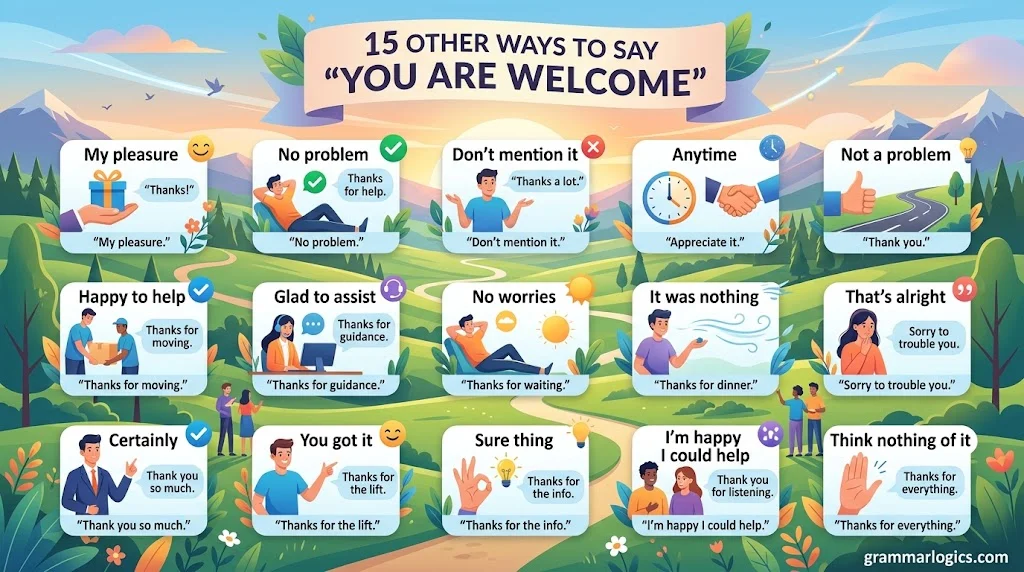
“You are welcome” is a polite expression used to respond to someone who thanks you. Learning other ways to say “you are welcome” can make your conversations sound more natural, friendly, and meaningful.
Whether you are replying to a friend, helping a colleague, or communicating professionally, choosing the right words can make a positive impression. Simple alternatives such as “My pleasure,” “Anytime,” and “Happy to help” allow you to express kindness in different ways. Each phrase carries its own tone, making it useful to understand when and how to use it in everyday conversations.
In this guide, you will discover 15 other ways to say “you are welcome” with clear meanings and practical examples. These alternatives will help you communicate with confidence in personal conversations, workplace emails, and professional discussions. You will also learn which expressions sound more formal, which feel warm and friendly, and which work best in casual situations. By understanding these useful phrases, you can respond to gratitude more naturally, strengthen relationships, and make your English communication more expressive, polite, and effective in different everyday situations.
What Does “You Are Welcome” Mean?
“You are welcome” is a polite expression used in response to someone who has thanked you. It acknowledges their gratitude and communicates that you are happy to have helped, offered something, or done a favor. For example, if a colleague says, “Thank you for sharing the report,” you can respond, “You are welcome.” The phrase is common in everyday English and works in both personal and professional conversations.
Depending on the context, the expression can also communicate friendliness, courtesy, and willingness to help. In some situations, it may sound formal or traditional, while in others, it feels perfectly natural. The shorter version, “You’re welcome,” is especially common in spoken English and everyday messages. Although both forms have the same basic meaning, the best response depends on the relationship, the situation, and the feeling you want to convey.
Common Situations Where “You Are Welcome” Is Used
People commonly use this phrase after receiving thanks in everyday conversations, text messages, emails, and face-to-face interactions. A friend might thank you for listening, a family member might appreciate your help, or a classmate might thank you for explaining a difficult lesson. In each case, the expression acknowledges the person’s gratitude without making the exchange complicated.
It is also appropriate in workplace communication, customer service, and school settings. For example, an employee may respond to a manager’s thanks with “You’re welcome,” while a customer service representative might use a warmer expression to make a customer feel appreciated. Alternatives are useful when you want to express extra warmth, emphasize that helping was easy, sound more formal, or avoid repeating the same response in every conversation.
Is It Professional or Polite to Say “You Are Welcome”?
Yes, “You are welcome” is both polite and professional in most situations. It is respectful, clear, and suitable for conversations with colleagues, managers, customers, teachers, and people you do not know well. The contraction “You’re welcome” is also appropriate in most workplace conversations and professional emails. The full form can feel slightly more deliberate, although neither version is automatically more formal in every context.
However, a different expression may sound more natural when you want to communicate a particular feeling. “My pleasure” can make your response feel especially gracious, while “Happy to help” sounds friendly and approachable. In a close friendship, “Anytime” may feel more relaxed and personal. Choosing the right wording helps you match the relationship without sounding distant, overly formal, or unnecessarily casual.
Advantages and Disadvantages of Saying “You Are Welcome”
Advantages
The main advantage of “You are welcome” is its clarity and versatility. Most English speakers understand it immediately, and it works in a wide range of situations, from casual conversations to professional exchanges. It acknowledges gratitude without requiring a long explanation. Because it is polite and familiar, it is a dependable choice when you are unsure how to respond to someone’s thanks.
Disadvantages
The phrase can sometimes feel routine or impersonal, particularly when someone has expressed deep gratitude for a meaningful favor. Repeating it in every interaction may also make conversations sound predictable. It does not always communicate whether you enjoyed helping, whether the person can ask for help again, or whether the favor was especially important to you. In these situations, a more specific response can express warmth, reassurance, or willingness to help more effectively.
15 Other Ways to Say “You Are Welcome”
- My pleasure
- Happy to help
- No problem
- Not a problem
- Anytime
- Don’t mention it
- It was nothing
- Glad I could help
- Of course
- You’re very welcome
- Think nothing of it
- The pleasure is mine
- I’m glad I could help
- No worries
- You’re most welcome
1. My Pleasure
Meaning
“My pleasure” means that you were happy to help someone or do something for them. It communicates more than basic politeness because it suggests that helping was enjoyable or personally satisfying.
Definition
A courteous expression used to show that assisting someone was a pleasure rather than a burden.
Detailed Explanation
“My pleasure” is a warm, gracious response to someone’s thanks. Compared with “You are welcome,” it places more emphasis on your willingness and enjoyment in helping. It is suitable for professional environments, customer service, and personal conversations where you want to sound considerate. Although it is polite, it does not sound stiff or overly formal.
Scenario Examples
Scenario: A colleague thanks you for reviewing a presentation.
Example: “Thank you for checking those slides before the meeting.”
“My pleasure. I’m glad I could help.”
Scenario: A restaurant guest thanks a server for providing excellent service.
Example: “Thank you for making our evening special.”
“My pleasure. We hope you enjoyed your visit.”
Best Use
Use this expression in professional emails, customer service, hospitality, and thoughtful personal interactions when you want to sound gracious.
Tone
Tone: Warm, courteous, professional
It expresses genuine goodwill while maintaining a respectful tone.
2. Happy to Help
Meaning
“Happy to help” communicates that you are willing and pleased to assist someone. It makes your response sound approachable and emphasizes your readiness to be helpful.
Definition
A friendly expression indicating that assisting someone is welcome and willingly offered.
Detailed Explanation
This phrase is especially natural after helping someone solve a problem or complete a task. Unlike a simple acknowledgment of thanks, it highlights your positive attitude toward providing assistance. It works well in professional communication because it sounds confident without being overly formal. You can also use it with friends when you want to show that helping them was no trouble.
Scenario Examples
Scenario: A teammate thanks you for explaining a spreadsheet.
Example: “Thanks for walking me through those formulas.”
“Happy to help! Let me know if anything else is confusing.”
Scenario: A customer thanks you for explaining a service.
Example: “Thank you for answering all my questions.”
“Happy to help. Please reach out if you need anything else.”
Best Use
Choose it for workplace conversations, support messages, emails, and everyday situations where willingness to help is the main message.
Tone
Tone: Friendly, helpful, approachable
It makes the other person feel comfortable asking questions or seeking assistance again.
3. No Problem
Meaning
“No problem” means that helping someone was not difficult, inconvenient, or troublesome. It reassures the person that they do not need to feel guilty about asking for assistance.
Definition
An informal expression used to acknowledge thanks while suggesting that the favor was easy or caused no inconvenience.
Detailed Explanation
“No problem” is common in casual conversation and everyday workplace exchanges. It sounds relaxed and reassuring, making it useful when a friend or colleague thanks you for a small favor. However, it is more informal than “My pleasure” and may not convey the same sense of graciousness in every setting. For formal customer communication, a warmer or more polished expression may be preferable.
Scenario Examples
Scenario: A friend thanks you for lending them a pen.
Example: “Thanks for letting me borrow this.”
“No problem! Just give it back when you’re done.”
Scenario: A coworker thanks you for sending a document.
Example: “Thanks for forwarding that file.”
“No problem. I’ve sent the latest version, too.”
Best Use
Use it in casual conversations, friendly texts, and relaxed workplace interactions involving small favors.
Tone
Tone: Casual, reassuring, easygoing
It communicates that the favor was not a burden, although it may sound too relaxed in some formal situations.
4. Not a Problem
Meaning
“Not a problem” tells someone that their request or the help you provided did not create a difficulty. It reassures them that the situation was manageable.
Definition
A polite, conversational response indicating that something was not inconvenient or troublesome.
Detailed Explanation
“Not a problem” is similar to “No problem,” but it can sound slightly more deliberate depending on the speaker and situation. It is useful when someone apologizes for asking for help as well as when they express gratitude. The phrase is common in everyday professional exchanges, although it is still conversational rather than highly formal. Your tone of voice matters: said warmly, it reassures; said sharply, it may sound dismissive.
Scenario Examples
Scenario: A classmate thanks you for explaining an assignment.
Example: “Thanks for explaining the instructions again.”
“Not a problem. They were a little confusing.”
Scenario: A coworker apologizes for asking you to resend an attachment.
Example: “Sorry to bother you again. Thanks for resending it.”
“Not a problem. I’ve attached it here.”
Best Use
Choose this expression for routine favors, workplace chats, school interactions, and situations where someone worries about inconveniencing you.
Tone
Tone: Reassuring, polite, conversational
It reduces the sense that the other person has caused trouble.
5. Anytime
Meaning
“Anytime” means that someone can approach you for help again. In response to thanks, it suggests that you are willing to assist in the future.
Definition
An informal expression communicating continued willingness to help or repeat a favor.
Detailed Explanation
“Anytime” adds a sense of openness that “You are welcome” does not necessarily express. It is particularly suitable when you have helped a friend, family member, or trusted colleague and want them to feel comfortable asking again. However, it can imply an ongoing willingness to help, so use it only when that is what you mean. In formal settings, a more specific offer of future assistance may sound clearer.
Scenario Examples
Scenario: A friend thanks you for helping them move.
Example: “I couldn’t have moved all those boxes without you.”
“Anytime! Just let me know if you need a hand again.”
Scenario: A colleague thanks you for explaining a work process.
Example: “Thanks for showing me how to submit the report.”
“Anytime. I’m happy to walk you through it again.”
Best Use
Use it in friendships, family conversations, casual team chats, and ongoing working relationships.
Tone
Tone: Friendly, generous, reassuring
It makes the person feel welcome to seek your help again, provided you genuinely mean it.
6. Don’t Mention It
Meaning
“Don’t mention it” means that the person does not need to make a big deal of thanking you. It suggests that the favor was small enough that no special acknowledgment is necessary.
Definition
A polite, informal expression used to downplay a favor and respond modestly to gratitude.
Detailed Explanation
This expression is useful when you want to be modest about something you have done. It can make a conversation feel relaxed, particularly when a friend thanks you for a simple favor. Compared with “Happy to help,” it focuses less on your willingness and more on minimizing the importance of the favor. Although it is usually friendly, it may feel dismissive if the other person is expressing deep or heartfelt gratitude.
Scenario Examples
Scenario: A neighbor thanks you for collecting a package.
Example: “Thank you for taking the parcel inside.”
“Don’t mention it. I was home anyway.”
Scenario: A friend thanks you for sharing class notes.
Example: “I really appreciate you sending me your notes.”
“Don’t mention it. I hope they help.”
Best Use
Choose it for small favors, informal conversations, and situations where modesty feels natural.
Tone
Tone: Modest, casual, considerate
It gently downplays the favor without requiring a lengthy response.
7. It Was Nothing
Meaning
“It was nothing” means that you consider the favor small or easy compared with the gratitude being expressed. It reassures the other person that they do not need to feel indebted to you.
Definition
An informal expression that minimizes the effort or importance of a favor.
Detailed Explanation
This phrase works when you have done something minor and want to reassure the other person that it was not a big deal. It can sound humble and caring, especially between people who know each other well. However, if someone has expressed sincere gratitude for a significant act of kindness, this response may unintentionally minimize their feelings. In those cases, acknowledging their thanks more directly may be more thoughtful.
Scenario Examples
Scenario: A friend thanks you for picking up a coffee.
Example: “Thanks for grabbing my coffee on your way here.”
“It was nothing. I was stopping there anyway.”
Scenario: A sibling thanks you for helping organize a small family gathering.
Example: “You did so much to get everything ready.”
“It was nothing. I’m just glad everyone had a good time.”
Best Use
Use it for minor favors and familiar relationships where downplaying your effort will not diminish the other person’s appreciation.
Tone
Tone: Humble, casual, reassuring
It emphasizes that the help was easy, though it is not always suitable for major acts of kindness.
8. Glad I Could Help
Meaning
“Glad I could help” expresses satisfaction that your assistance was useful. It acknowledges the person’s gratitude while emphasizing the positive outcome.
Definition
A friendly expression showing that you are pleased your help made a difference.
Detailed Explanation
This phrase is particularly effective when your assistance has solved a problem or made a task easier. It differs from “No problem” because it focuses on the value of the outcome rather than the absence of inconvenience. It sounds natural among colleagues, classmates, friends, and customers. The phrase is slightly more reflective than a quick “You’re welcome,” making it useful when the other person has received meaningful assistance.
Scenario Examples
Scenario: A classmate thanks you for helping them understand a lesson.
Example: “I finally understand how to solve those equations. Thanks!”
“Glad I could help. You’ve got the hang of it now.”
Scenario: A colleague thanks you for troubleshooting a technical issue.
Example: “Thanks for fixing the problem before the presentation.”
“Glad I could help. Everything should be working now.”
Best Use
Choose it for problem-solving, tutoring, teamwork, and situations where your assistance has made a clear difference.
Tone
Tone: Supportive, sincere, encouraging
It recognizes the usefulness of your help without making the exchange overly formal.
9. Of Course
Meaning
“Of course” can mean that helping someone was natural, expected, or something you were perfectly willing to do. When used in response to thanks, it can communicate reassurance and goodwill.
Definition
An expression of willing agreement that can acknowledge gratitude by suggesting that the help was readily given.
Detailed Explanation
“Of course” is a natural response when someone thanks you for doing something you were glad to do. It can feel especially warm when helping a friend or loved one, as it suggests that the favor was not an imposition. In a workplace, it can also sound professional when delivered politely. However, the phrase has other meanings, including certainty and agreement, so context and tone determine whether it works as a response to gratitude.
Scenario Examples
Scenario: A friend thanks you for listening during a difficult day.
Example: “Thank you for listening to me earlier.”
“Of course. I’m always glad to listen.”
Scenario: A coworker thanks you for sharing meeting notes.
Example: “Thanks for sending me the notes from the meeting.”
“Of course. I thought they might be useful.”
Best Use
Use it in personal conversations, friendly workplace exchanges, and situations where helping feels natural.
Tone
Tone: Reassuring, warm, confident
It communicates willingness, although a curt delivery can sometimes sound impatient.
10. You’re Very Welcome
Meaning
“You’re very welcome” is a slightly more emphatic version of “You’re welcome.” It conveys polite acknowledgment and can make a response feel more gracious or warm.
Definition
A courteous expression that responds to thanks with added emphasis.
Detailed Explanation
Adding “very” can make your response sound more deliberate and appreciative. It is useful when someone expresses sincere gratitude or when you want to maintain a particularly courteous tone. The phrase fits professional interactions, customer service, and personal conversations without sounding overly formal. Still, it is not necessary for every small exchange, and an exaggerated delivery may feel unnatural.
Scenario Examples
Scenario: A customer thanks you for helping resolve an order issue.
Example: “Thank you for sorting this out so quickly.”
“You’re very welcome. I’m glad we could resolve it.”
Scenario: A relative thanks you for arranging transportation.
Example: “Thank you for making sure I got home safely.”
“You’re very welcome. I’m glad I could help.”
Best Use
Choose it for polite conversations, customer service, thoughtful favors, and professional communication when extra courtesy is appropriate.
Tone
Tone: Courteous, gracious, warm
It adds emphasis while preserving the familiar meaning of the original phrase.
11. Think Nothing of It
Meaning
“Think nothing of it” means that the person should not worry about the favor or feel that they owe you anything for it. It presents your help as something you were happy to provide without expecting recognition.
Definition
A polite expression used to downplay a favor and reassure someone that no repayment or special acknowledgment is expected.
Detailed Explanation
This phrase sounds more traditional than “No problem” and often carries a sense of modesty. It works well when someone thanks you for a thoughtful gesture or a small act of kindness. Unlike “Anytime,” it does not specifically promise future help; instead, it focuses on the favor that has already happened. In very casual conversations, it may sound slightly old-fashioned, but it remains understandable and courteous.
Scenario Examples
Scenario: A neighbor thanks you for watering their plants while they were away.
Example: “Thank you for looking after my plants.”
“Think nothing of it. I was happy to do it.”
Scenario: A colleague thanks you for covering a short break.
Example: “I appreciate you stepping in while I was away.”
“Think nothing of it. We all help each other out.”
Best Use
Use it in polite personal conversations, considerate workplace interactions, and situations involving small acts of kindness.
Tone
Tone: Modest, considerate, traditional
It reassures the other person that the favor was freely given.
12. The Pleasure Is Mine
Meaning
“The pleasure is mine” means that you were the one who benefited from or enjoyed the interaction. It is a gracious way to respond when someone thanks you or expresses appreciation for your company or assistance.
Definition
A courteous expression indicating that helping or interacting with someone was enjoyable for you.
Detailed Explanation
This phrase is more formal and polished than “No problem.” It is especially suitable when someone thanks you after a pleasant meeting, a professional interaction, or a meaningful exchange. It can also suggest that you appreciated the opportunity just as much as the other person appreciated your help. Unlike “Glad I could help,” it emphasizes your own enjoyment of the interaction, so it may feel excessive after a very minor favor.
Scenario Examples
Scenario: A business partner thanks you for a productive meeting.
Example: “Thank you for taking the time to meet with our team.”
“The pleasure is mine. I enjoyed discussing the project.”
Scenario: A guest thanks a host for a lovely evening.
Example: “Thank you for inviting us. We had a wonderful time.”
“The pleasure is mine. I’m so glad you could come.”
Best Use
Choose it for professional meetings, formal social occasions, hospitality, and conversations where you want to express gracious appreciation.
Tone
Tone: Elegant, gracious, formal
It makes an exchange feel polished and appreciative without being cold.
13. I’m Glad I Could Help
Meaning
“I’m glad I could help” communicates that you feel pleased about being able to assist someone. It expresses a little more personal feeling than a short acknowledgment of thanks.
Definition
A complete, warm statement expressing satisfaction that your assistance was useful.
Detailed Explanation
This expression is similar to “Glad I could help,” but the full sentence sounds slightly more personal and considered. It is particularly useful when someone has genuinely benefited from your support or when you want to respond with a little extra sincerity. It works in professional emails as well as personal conversations. Because it highlights your feelings about the outcome, it is less suitable when you simply need a quick, neutral response.
Scenario Examples
Scenario: A friend thanks you for helping them prepare for an interview.
Example: “Your practice questions really helped me feel prepared.”
“I’m glad I could help. I hope the interview goes well.”
Scenario: A team member thanks you for reviewing an important document.
Example: “Thanks for catching those errors before I sent it.”
“I’m glad I could help. The final version looks much better.”
Best Use
Use it in personal messages, workplace emails, mentoring, and meaningful situations where your assistance has made a difference.
Tone
Tone: Sincere, supportive, thoughtful
It communicates genuine satisfaction rather than merely acknowledging that thanks have been offered.
14. No Worries
Meaning
“No worries” means that the other person’s request, thanks, or apology is not a concern. In response to gratitude, it reassures them that the favor was not a problem.
Definition
An informal expression used to dismiss concern or inconvenience and respond in a relaxed, friendly way.
Detailed Explanation
“No worries” is particularly common in casual English and friendly conversations. It can make an interaction feel relaxed and reassure someone who apologizes for asking for help. Although it is similar to “No problem,” it can also respond to apologies, which gives it a broader conversational use. It is generally fine in informal workplace chats, but a more polished expression may be better in a formal letter or a sensitive customer interaction.
Scenario Examples
Scenario: A friend thanks you for waiting while they finish an errand.
Example: “Thanks for waiting for me. I know I took a while.”
“No worries! I had a few things to do on my phone.”
Scenario: A teammate thanks you for helping them upload a file.
Example: “Thanks for helping me get that document submitted.”
“No worries. I’m glad we got it done before the deadline.”
Best Use
Choose it for casual conversations, friendly texts, everyday favors, and informal team communication.
Tone
Tone: Relaxed, friendly, reassuring
It helps remove tension from an interaction, but it may be too casual for some formal settings.
15. You’re Most Welcome
Meaning
“You’re most welcome” is a courteous way to respond to someone’s thanks. It adds emphasis to the welcome and communicates graciousness.
Definition
A polite expression that warmly acknowledges gratitude, often with a slightly formal or traditional feel.
Detailed Explanation
This phrase is especially familiar in some varieties of English, including British and South Asian English. It can sound gracious and respectful when someone expresses sincere appreciation. Compared with “You’re very welcome,” it may feel more formal or traditional to some speakers, although usage varies by region. It is a natural choice when you want to emphasize courtesy, but it can sound overly elaborate in a quick, casual exchange between close friends.
Scenario Examples
Scenario: A student thanks a teacher for extra guidance.
Example: “Thank you for staying after class to explain the topic.”
“You’re most welcome. Keep practicing, and you’ll improve.”
Scenario: A guest thanks a host for making them feel comfortable.
Example: “Thank you for making us feel so at home.”
“You’re most welcome. It was lovely having you here.”
Best Use
Use it in polite conversations, educational settings, hospitality, and formal or semi-formal exchanges, especially when this wording feels natural in your variety of English.
Tone
Tone: Respectful, gracious, traditional
It emphasizes courtesy and appreciation, making it suitable when a simple response feels insufficient.
FAQs
What is another way to say “You Are Welcome”?
Some natural alternatives are “My pleasure,” “Happy to help,” “No problem,” “Anytime,” and “Glad I could help.” Choose the expression that matches the situation. For example, “My pleasure” sounds gracious and professional, while “No worries” is more relaxed and conversational.
What does “You Are Welcome” mean?
“You are welcome” is a polite response to someone’s gratitude. It acknowledges their thanks and communicates that you are happy to have helped. The expression works in personal conversations, workplace interactions, emails, and customer service.
Is “You Are Welcome” professional?
Yes, “You are welcome” is professional and polite in most workplace situations. It is suitable for responding to colleagues, customers, managers, and business partners. Alternatives such as “My pleasure” and “The pleasure is mine” can sound especially gracious in more formal interactions.
What is a more polite way to say “You Are Welcome”?
“My pleasure” and “You’re very welcome” are excellent choices when you want to sound particularly courteous. “My pleasure” emphasizes that you were happy to help, while “You’re very welcome” adds warmth to a familiar expression of gratitude.
Which alternative works best in formal communication?
“My pleasure” is a versatile choice for formal or professional communication. “The pleasure is mine” is particularly appropriate after a meeting or a pleasant professional interaction. For routine workplace emails, “Happy to help” is also effective because it sounds approachable while remaining professional.
Conclusion
Choosing the right response to someone’s gratitude can make everyday communication more meaningful. Although “You Are Welcome” is polite and universally understandable, alternatives such as “My pleasure,” “Happy to help,” and “Glad I could help” let you express different levels of warmth, sincerity, and professionalism.
Casual expressions like “No worries” and “Anytime” work well with friends and familiar colleagues, while more gracious phrases suit formal conversations and thoughtful gestures. Remember that similar expressions do not always communicate exactly the same feeling. Consider your relationship with the other person, the effort involved, and the setting before choosing your words. The best expression is one that sounds natural, reflects what you genuinely mean, and makes the other person feel appreciated.