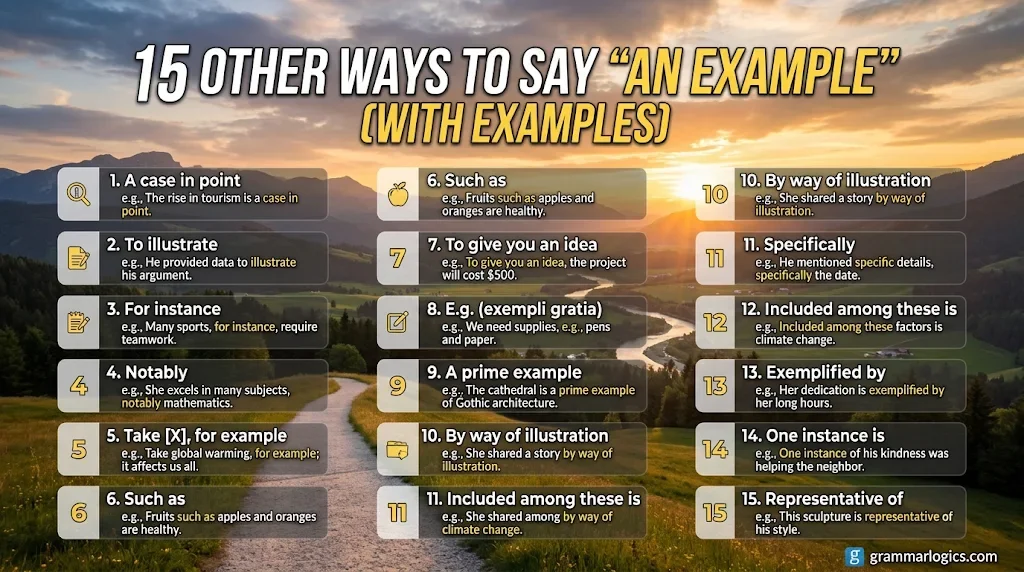
An example makes an idea easier to understand by showing how it works in real life. Choosing the right words can make your writing clearer and more effective.
When explaining something, repeating the phrase “an example” can sometimes make your writing sound repetitive. Using different expressions helps keep your content natural, engaging, and easy to follow. Whether you are writing an essay, preparing a presentation, communicating professionally, or creating blog content, having alternative phrases can improve the way you express your thoughts. The right wording also helps readers connect with your ideas and understand your message without confusion. From simple expressions to more formal alternatives, each phrase can add variety and clarity to your communication.
In this guide, we will explore 15 other ways to say “an example” with clear meanings and practical sentence examples. You will discover useful alternatives such as “for instance,” “for example,” “a case in point,” “to illustrate,” and “as an illustration.” Each expression has its own tone and purpose, making it suitable for different writing situations. Whether you want to improve your academic writing, make business communication more professional, or create more interesting everyday conversations, these alternatives will help you express ideas more confidently. By learning when and how to use each phrase, you can make your writing more varied, meaningful, and reader-friendly.
What Does “An Example” Mean?
“An example” refers to a person, thing, situation, or action that helps explain or demonstrate a particular idea. It makes information easier to understand by showing how something works or what it looks like in practice. For instance, when someone explains a grammar rule and provides a sentence to demonstrate it, that sentence is an example of the rule. The expression is widely used in everyday conversations, education, professional communication, and written content. Depending on the context, an example can be used to clarify information, support an argument, illustrate a point, or show a typical situation. It helps connect general ideas with specific details, making communication more effective.
Common Situations Where “An Example” Is Used
The phrase “an example” appears in many communication settings because it helps people explain unfamiliar or complicated ideas. Students and teachers use it when discussing lessons, answering questions, or demonstrating how a particular rule works. In professional environments, employees may provide examples during meetings, presentations, reports, and training sessions to make their explanations more practical.
It is also common in emails, articles, social media posts, and everyday conversations. Someone might use an example to explain a personal experience, support an opinion, or make a suggestion easier to understand. Writers sometimes choose alternatives such as “a case in point,” “an illustration,” or “a practical example” to avoid repetition and create more engaging content.
Is It Professional or Polite to Say “An Example”?
Yes, “an example” is both professional and polite in most situations. It is a neutral expression that works well in academic writing, workplace conversations, business emails, presentations, and everyday discussions. It does not sound overly formal or informal, which makes it a flexible choice for different audiences. For instance, saying “Let me give you an example” is a natural way to introduce supporting information during a meeting or conversation.
However, using the same phrase repeatedly may make longer explanations sound monotonous. In formal documents, expressions such as “an illustrative case” or “a representative instance” may sometimes sound more appropriate. In casual conversations, “for instance” or “a real-life example” can feel more natural. The best choice depends on your audience, purpose, and communication style.
Advantages and Disadvantages of Saying “An Example”
Advantages
- Easy to understand: The phrase communicates its purpose clearly, even to English learners.
- Widely applicable: It works in conversations, academic writing, business communication, and presentations.
- Neutral tone: It is neither too formal nor too casual.
- Helpful for explanations: It introduces supporting details that make complicated ideas easier to understand.
- Natural wording: Most English speakers understand and comfortably use this expression.
Disadvantages
- Repetition: Using it frequently can make an article or explanation sound repetitive.
- Limited variety: It may not communicate the specific purpose of an illustration or demonstration.
- Less descriptive: Sometimes, a more precise expression can explain the type of example being discussed.
- Context-dependent: Certain alternatives are more suitable for academic, professional, or conversational situations.
15 Synonyms and Alternatives for “An Example”
Here are 15 natural alternatives you can use depending on the meaning, context, and tone of your sentence.
- A Sample
- An Illustration
- A Case in Point
- An Instance
- A Demonstration
- A Representative Case
- A Model
- A Specimen
- A Concrete Example
- A Practical Illustration
- A Sample Case
- A Typical Case
- A Real-World Example
- An Illustrative Case
- A Use Case
1. A Sample
Meaning
“A sample” refers to a small part or selected item that represents a larger group, product, collection, or piece of work. It can be used as an alternative when you want to show someone what something looks like.
Definition
A sample is a representative portion or selected example used to demonstrate the characteristics of something larger.
Detailed Explanation
This expression is particularly useful when showing a preview of a product, document, design, or piece of writing. Unlike the general phrase “an example,” it often suggests that the item is selected from a larger collection. It sounds natural in professional, educational, and commercial communication. It is especially appropriate when someone needs to examine something before making a decision.
Scenario Examples
Scenario 1: Writing
Example: Please review this sample before preparing the final report.
Scenario 2: Shopping
Example: The company provided a free sample of its new skincare product.
Scenario 3: Education
Example: The teacher shared a sample essay to help students understand the assignment.
Best Use
Use “a sample” when presenting a preview of a document, product, design, essay, or other larger item. It works particularly well in business, education, and customer communication.
Tone
Tone: Professional, neutral, informative.
It sounds straightforward and practical, making it suitable for both formal and everyday communication.
2. An Illustration
Meaning
“An illustration” refers to something that explains or makes an idea easier to understand. It can be a written explanation, visual representation, or specific situation that clarifies a point.
Definition
An illustration is a description, picture, or situation used to explain or demonstrate an idea.
Detailed Explanation
This expression is useful when you want to make an abstract concept more understandable. It can refer to a real-life situation, a written explanation, or a visual image. Compared with “an example,” it places more emphasis on explaining or clarifying something. It is particularly effective in educational materials, articles, presentations, and formal writing.
Scenario Examples
Scenario 1: Teaching
Example: The teacher used a simple illustration to explain how fractions work.
Scenario 2: Writing
Example: This paragraph provides an illustration of how effective communication improves teamwork.
Scenario 3: Presentation
Example: Let me show you an illustration of the process before we continue.
Best Use
Choose “an illustration” when explaining a difficult idea, supporting an argument, or making educational and professional content easier to follow.
Tone
Tone: Educational, polished, explanatory.
It gives your writing a thoughtful and slightly formal quality.
3. A Case in Point
Meaning
“A case in point” refers to a specific situation or person that clearly supports an idea or statement. It is particularly useful when discussing something that proves or demonstrates what you are saying.
Definition
A case in point is a relevant situation that provides clear evidence or support for a particular statement.
Detailed Explanation
This expression is more specific than the general phrase “an example.” It introduces a situation that strongly demonstrates the truth of an argument or observation. It is commonly used in discussions, essays, articles, and professional communication. Unlike a simple illustration, a case in point often carries a stronger connection to the statement being supported.
Scenario Examples
Scenario 1: Workplace
Example: Our latest project is a case in point of what good teamwork can accomplish.
Scenario 2: Everyday Conversation
Example: My brother is a case in point; he improved his English through daily practice.
Scenario 3: Writing
Example: The growing popularity of online learning is a case in point when discussing changes in education.
Best Use
Use “a case in point” when supporting an argument, explaining an observation, or presenting a particularly relevant situation in professional or academic writing.
Tone
Tone: Confident, analytical, professional.
It sounds thoughtful and persuasive without being unnecessarily complicated.
4. An Instance
Meaning
“An instance” refers to a particular occurrence, situation, or occasion in which something happens. It can replace “an example” when discussing a specific event or situation.
Definition
An instance is a particular occurrence or individual case of something.
Detailed Explanation
This expression is useful when describing a specific situation rather than presenting a general illustration. It is often found in formal writing, reports, discussions, and explanations. Although it is related to “an example,” the word instance focuses more on an actual occurrence. It should not be used when you are presenting a sample of a product or a visual explanation.
Scenario Examples
Scenario 1: Professional Writing
Example: This is an instance of effective problem-solving within a team.
Scenario 2: Everyday Conversation
Example: I remember one instance when she helped everyone during a difficult situation.
Scenario 3: Academic Discussion
Example: The researcher described an instance of successful communication between the two groups.
Best Use
Choose “an instance” when referring to a particular event, occurrence, or situation in formal discussions, reports, and academic writing.
Tone
Tone: Formal, neutral, factual.
It is a good choice when you want to describe a specific occurrence objectively.
5. A Demonstration
Meaning
“A demonstration” refers to an explanation or display that shows how something works or how an activity is performed.
Definition
A demonstration is a practical presentation that shows the operation, use, or performance of something.
Detailed Explanation
This alternative is especially useful when an example involves showing rather than simply describing. It is commonly used in classrooms, product presentations, training sessions, and professional environments. Unlike a general example, a demonstration usually involves an action, process, or visible explanation. It helps people understand something by observing how it works.
Scenario Examples
Scenario 1: Technology
Example: The instructor gave us a demonstration of the new software.
Scenario 2: Cooking
Example: The chef prepared a quick demonstration of how to decorate a cake.
Scenario 3: Workplace Training
Example: Employees watched a demonstration of the new safety equipment.
Best Use
Use “a demonstration” when explaining a process, showing how to operate something, or presenting a practical skill.
Tone
Tone: Practical, informative, professional.
It communicates clarity and hands-on learning.
6. A Representative Case
Meaning
“A representative case” refers to a particular situation that reflects the characteristics of a larger group or category. It helps readers understand what is generally true about similar situations.
Definition
A representative case is an individual situation that accurately reflects the typical features of a wider group.
Detailed Explanation
This expression is useful when you want to discuss a situation that reflects a broader pattern. It is often used in research, reports, academic discussions, and professional analysis. Unlike an ordinary example, a representative case suggests that the selected situation is typical or meaningful in relation to a larger group. However, a single case should not automatically be treated as proof of a universal pattern.
Scenario Examples
Scenario 1: Research
Example: The study included a representative case of a small business adapting to digital technology.
Scenario 2: Business
Example: This company’s experience is a representative case of the challenges faced by new startups.
Scenario 3: Education
Example: The teacher discussed a representative case to explain common learning difficulties.
Best Use
Use “a representative case” in research papers, business reports, educational discussions, and analytical writing when a situation reflects a wider category.
Tone
Tone: Analytical, formal, objective.
It sounds precise and works best when discussing patterns or broader situations.
7. A Model
Meaning
“A model” refers to a person, system, design, or example that others can follow or use as a guide. It is particularly suitable when something demonstrates a desirable standard.
Definition
A model is an example or standard that can be followed, copied, or used as a guide.
Detailed Explanation
This expression is slightly different from a general example because it often suggests something worth learning from or imitating. A model can be a successful business strategy, a well-written document, or a person’s positive behavior. It is useful when you want to show not just what something looks like but also how it should be done. In some contexts, it may refer to a physical design or theoretical system rather than an example.
Scenario Examples
Scenario 1: Education
Example: The teacher shared a model answer to show students how to structure their responses.
Scenario 2: Workplace
Example: Her leadership style is a model for effective communication.
Scenario 3: Writing
Example: You can use this document as a model for your next project.
Best Use
Choose “a model” when presenting something as a standard, guide, or example worth following.
Tone
Tone: Positive, professional, instructive.
It suggests quality, guidance, and something others can learn from.
8. A Specimen
Meaning
“A specimen” refers to an individual item or sample selected for examination, study, or identification. It is often used in scientific, medical, and technical contexts.
Definition
A specimen is a specific object, material, or sample collected for examination or analysis.
Detailed Explanation
This expression is more specialized than “an example.” It is commonly used when discussing plants, animals, biological materials, laboratory samples, and other objects being studied. It can also describe an individual representative of a particular type, although this usage may sound unusual or even critical when referring to a person. Therefore, it is best to use the word in scientific or technical situations where it naturally fits.
Scenario Examples
Scenario 1: Science
Example: The students examined a plant specimen under the microscope.
Scenario 2: Medical Testing
Example: The laboratory received a blood specimen for further testing.
Scenario 3: Research
Example: Researchers collected a specimen of the rare plant for identification.
Best Use
Use “a specimen” in scientific research, laboratory work, biology, medicine, and technical discussions.
Tone
Tone: Scientific, technical, formal.
It is appropriate for specialized communication rather than ordinary casual conversations.
9. A Concrete Example
Meaning
“A concrete example” refers to a specific and clear situation that makes an idea easier to understand. It emphasizes practical details rather than general statements.
Definition
A concrete example is a specific illustration that explains an idea through clear, understandable details.
Detailed Explanation
This expression is especially helpful when discussing complicated, abstract, or theoretical subjects. It gives readers something specific to relate to instead of leaving them with a general explanation. Compared with a simple example, it emphasizes clarity and practical understanding. It is frequently used in educational writing, presentations, professional discussions, and explanations.
Scenario Examples
Scenario 1: Education
Example: Can you give me a concrete example of how this grammar rule works?
Scenario 2: Workplace
Example: The manager provided a concrete example of how better planning reduced delays.
Scenario 3: Everyday Conversation
Example: I understand your point, but I need a concrete example to see what you mean.
Best Use
Use “a concrete example” when explaining abstract ideas, supporting a statement with specific details, or helping someone understand a difficult concept.
Tone
Tone: Clear, practical, informative.
It makes explanations sound direct and focused on real understanding.
10. A Practical Illustration
Meaning
“A practical illustration” refers to an explanation that shows how an idea, method, or concept works in a real or useful situation.
Definition
A practical illustration is an explanation or demonstration that connects an idea with its real-life application.
Detailed Explanation
This expression is useful when theoretical information needs to be connected with everyday practice. It helps readers understand not only what something means but also how it can be applied. Unlike a general illustration, it places more emphasis on usefulness and real-world application. It works particularly well in training materials, educational resources, and professional presentations.
Scenario Examples
Scenario 1: Training
Example: The instructor provided a practical illustration of how to handle customer complaints.
Scenario 2: Education
Example: The textbook includes a practical illustration of how percentages are used when shopping.
Scenario 3: Business
Example: Let me share a practical illustration of how this strategy can improve productivity.
Best Use
Choose “a practical illustration” when explaining methods, procedures, skills, or ideas that readers can apply in real situations.
Tone
Tone: Professional, educational, practical.
It gives an explanation a useful and application-focused quality.
11. A Sample Case
Meaning
“A sample case” refers to a selected situation used to explain, examine, or demonstrate a particular issue. It is often used in research, training, and professional discussions.
Definition
A sample case is a selected situation used for study, analysis, or explanation.
Detailed Explanation
This expression is useful when discussing a particular situation as part of a larger subject or collection of cases. It may appear in business reports, case studies, training sessions, and educational materials. Unlike “a sample,” which can refer to a portion of almost anything, a sample case specifically focuses on a situation or case selected for examination. It should not be confused with a complete case study, which usually involves more detailed analysis.
Scenario Examples
Scenario 1: Business Training
Example: The trainer presented a sample case involving a customer service problem.
Scenario 2: Education
Example: Students reviewed a sample case to understand how to approach the assignment.
Scenario 3: Research
Example: This sample case highlights the difficulties faced by small businesses during expansion.
Best Use
Use “a sample case” in case-based learning, professional training, research, and discussions involving specific situations.
Tone
Tone: Formal, educational, analytical.
It sounds structured and is particularly useful in professional or academic settings.
12. A Typical Case
Meaning
“A typical case” refers to a situation that represents what commonly happens in a particular group, category, or circumstance.
Definition
A typical case is a situation that displays the usual or common characteristics of something.
Detailed Explanation
This expression is useful when discussing something that happens regularly or represents a familiar pattern. It is more specific than a general example because it suggests that the situation is ordinary or representative. It can help explain common behavior, recurring problems, or everyday experiences. However, a typical case is not necessarily universal, so it should not be used to suggest that every situation is identical.
Scenario Examples
Scenario 1: Everyday Life
Example: Forgetting an umbrella on a rainy day is a typical case of poor planning.
Scenario 2: Workplace
Example: This is a typical case of miscommunication between two departments.
Scenario 3: Education
Example: A student struggling with time management is a typical case discussed during the workshop.
Best Use
Choose “a typical case” when describing common situations, familiar patterns, or frequently occurring problems.
Tone
Tone: Neutral, descriptive, analytical.
It helps explain what usually happens without making the situation sound unusual.
13. A Real-World Example
Meaning
“A real-world example” refers to an actual situation or practical experience that demonstrates how something works outside theory.
Definition
A real-world example is a practical illustration based on an actual situation or everyday experience.
Detailed Explanation
This expression is particularly useful when connecting theoretical knowledge with everyday life. It helps readers understand how an idea works in genuine circumstances rather than only in textbooks or hypothetical discussions. It is common in business, education, technology, and professional communication. Unlike a fictional illustration, a real-world example should be based on an actual situation, although the details may sometimes be simplified for explanation.
Scenario Examples
Scenario 1: Technology
Example: The teacher shared a real-world example of how artificial intelligence helps businesses organize information.
Scenario 2: Business
Example: This company’s growth provides a real-world example of successful customer engagement.
Scenario 3: Education
Example: The lesson included a real-world example of how mathematical calculations are used in construction.
Best Use
Use “a real-world example” when explaining practical applications, sharing actual experiences, or connecting academic knowledge with everyday situations.
Tone
Tone: Practical, relatable, informative.
It makes explanations feel relevant and easier to connect with daily experiences.
14. An Illustrative Case
Meaning
“An illustrative case” refers to a particular situation used to explain or clarify a broader idea. It helps readers understand a concept through a specific situation.
Definition
An illustrative case is a situation presented to clarify or explain a particular subject or argument.
Detailed Explanation
This expression is often used in academic writing, professional reports, and analytical discussions. It introduces a situation that helps readers understand a larger concept without necessarily proving that the concept is always true. Compared with “a case in point,” it focuses more on explanation than evidence. It is especially useful when discussing complex subjects that benefit from additional context.
Scenario Examples
Scenario 1: Academic Writing
Example: The author included an illustrative case to explain the effects of poor communication.
Scenario 2: Business Report
Example: The company’s experience serves as an illustrative case of successful market adaptation.
Scenario 3: Discussion
Example: Consider this illustrative case to understand why careful planning matters.
Best Use
Choose “an illustrative case” when explaining theories, supporting academic discussions, or making professional reports easier to understand.
Tone
Tone: Formal, explanatory, analytical.
It creates a polished impression and is suitable for structured writing.
15. A Use Case
Meaning
“A use case” refers to a specific situation describing how a product, system, tool, or service can be used to achieve a particular purpose.
Definition
A use case is a practical scenario showing how something is used to accomplish a specific task or meet a particular need.
Detailed Explanation
This expression is especially common in technology, software development, business planning, and product discussions. It explains how a particular tool or system works in a specific situation. Unlike a general example, a use case focuses on the purpose and practical application of something. It is not a universal replacement for “an example,” but it is very useful when discussing functions, features, and possible applications.
Scenario Examples
Scenario 1: Technology
Example: One useful use case for this application is organizing customer information.
Scenario 2: Business
Example: The team discussed a use case for introducing automated email responses.
Scenario 3: Software Development
Example: The developer created a use case showing how users can reset their passwords.
Best Use
Use “a use case” when discussing software, technology, business solutions, product features, or specific applications of a tool.
Tone
Tone: Technical, professional, practical.
It is suitable for specialized workplace discussions and technology-related communication.
FAQs
1. What is another way to say “an example”?
Some natural alternatives include “a sample,” “an illustration,” “a case in point,” “an instance,” and “a concrete example.” The best expression depends on your purpose. For instance, use “a sample” when showing a preview of something, while “a case in point” works well when supporting an argument.
2. What does “an example” mean?
“An example” is a specific person, thing, situation, or action used to explain an idea or demonstrate how something works. It helps people understand information by connecting general concepts with specific details.
3. Is “an example” professional?
Yes, “an example” is professional, polite, and appropriate for workplace communication, academic writing, presentations, and business emails. It is a neutral expression that can be used with different audiences.
4. What is a more formal way to say “an example”?
More formal alternatives include “an illustrative case,” “a representative case,” “an instance,” and “a case in point.” These expressions are useful in academic papers, professional reports, and formal discussions, depending on the intended meaning.
5. Which alternative works best in formal communication?
“An illustration” and “an illustrative case” are useful choices for formal explanations. However, “a representative case” is more appropriate when discussing a situation that reflects a wider group, while “a case in point” works well when supporting an argument.
Conclusion
Choosing the right alternative to “an example” can make your writing clearer, more engaging, and easier to understand. Expressions such as “a sample,” “an illustration,” “a case in point,” and “a concrete example” offer different ways to explain ideas and provide useful details. However, these phrases are not always interchangeable.
Some are better suited to academic writing, while others work naturally in everyday conversations, business communication, or technical discussions. Before choosing an alternative, consider your audience, purpose, and intended meaning. Using varied vocabulary thoughtfully will help you avoid repetition and communicate with greater confidence. Remember, the best expression is the one that makes your message clear, natural, and meaningful.
Latest Posts:
- 15 Other Ways to Say “Poop” (With Examples)
 Talking about poop is a normal part of everyday life, … Read more
- 15 Other Ways to Say “Finally” (With Examples)
 Finally is a common English word used to express the … Read more
- 15 Other Ways to Say “I Love You Too” (With Examples)
 Responding with “I love you too” is a simple way … Read more