Finding the right words can make your writing and conversations more interesting, clear, and engaging.
The word “more” is commonly used to express an additional amount, greater quantity, or something extra. However, repeating the same word can sometimes make your language sound simple or repetitive. Learning different ways to say “more” can help you express your thoughts with greater clarity and variety. Whether you are writing an email, creating blog content, or having an everyday conversation, choosing the right alternative can make your message sound more natural. Different expressions can also add emphasis, highlight quantity, or communicate that something is needed beyond what is already available. Using the right words makes your communication more effective and meaningful.
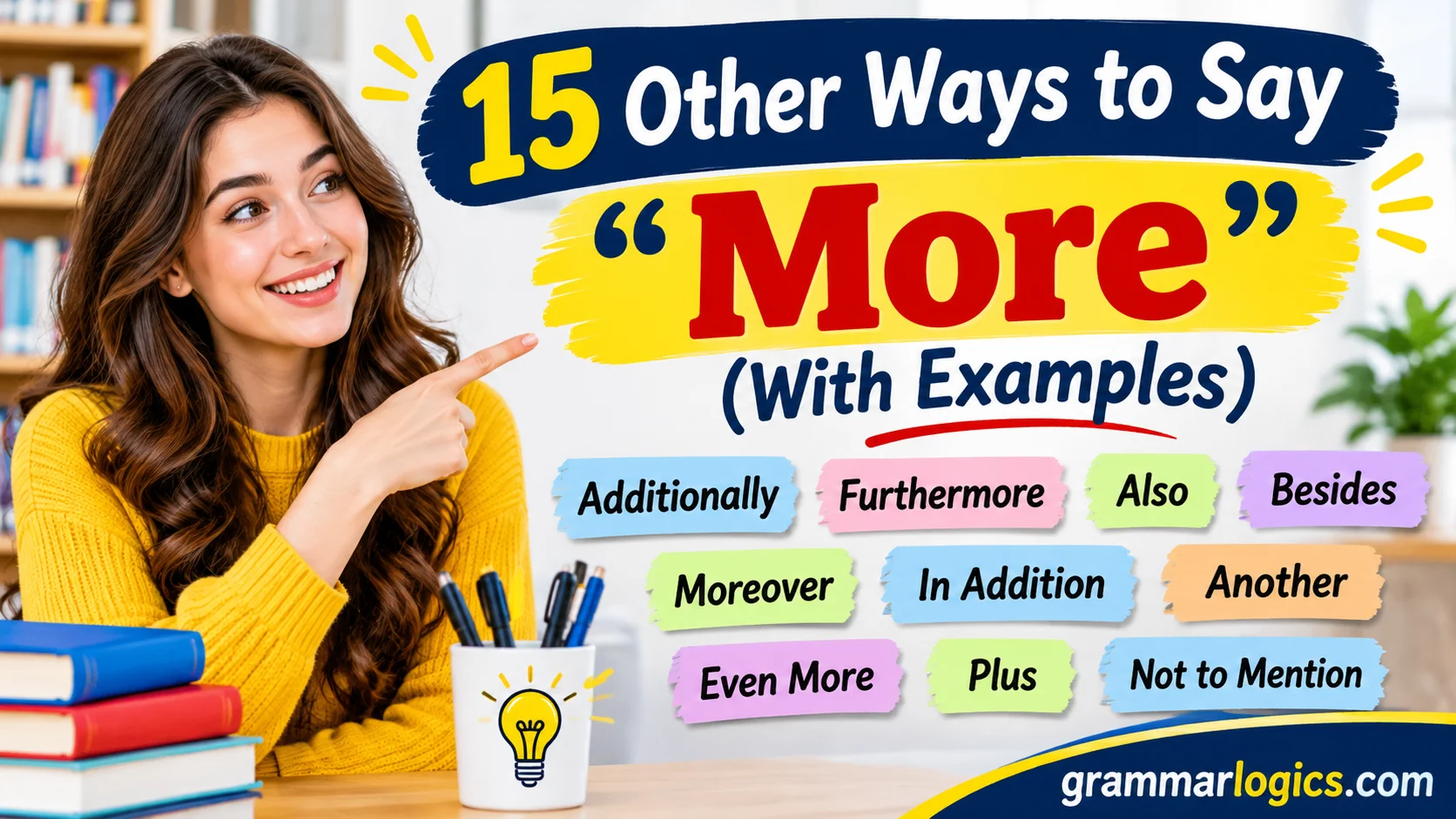
In this article, we will explore 15 other ways to say “more” with clear meanings and practical examples. These alternatives will help you expand your vocabulary and choose expressions that fit different situations, including professional writing, casual conversations, academic discussions and everyday communication. You will also discover how each phrase differs in tone, meaning, and usage. Whether you want to request additional information, describe a greater amount, or emphasize something extra, these useful alternatives will help you make your writing more expressive, professional, and engaging.
What Does “More” Mean?
The word “more” means an additional amount, number, or degree of something. It is commonly used when someone wants to indicate that they need, have, or want something beyond what is already available. For example, saying “I need more time” means that the available time is not enough, while “Would you like more coffee?” means offering an additional amount of coffee.
In everyday English, more can be used with both countable and uncountable nouns. It can also describe comparisons, showing that something has a greater quantity, intensity, or degree than something else. For instance, “She needs more books” refers to additional items, whereas “He is more confident now” describes a greater level of confidence. Depending on the context, the word can communicate an additional quantity, a higher degree, or further information.
Common Situations Where “More” Is Used
People use “more” in many everyday situations because it is a simple and flexible word. In personal conversations, someone might ask for more information, more time, or more help. Friends may use it when discussing food, entertainment, or shared activities.
In professional communication, the word frequently appears in emails, reports, presentations, and workplace discussions. For example, employees might request more details about a project or ask for more time to complete an assignment. Students also use it when requesting additional explanations, resources, or practice.
It is equally common in customer communication, social media posts, and formal writing. However, repeating the same word can make some messages feel less polished. Using alternatives such as additional, further, or increased can make your wording more specific and appropriate for the situation.
Is It Professional or Polite to Say “More”?
Yes, “more” is both professional and polite when used appropriately. It is a neutral English word that works in casual conversations, workplace emails, academic writing, and formal discussions. For example, saying “Could you please provide more information?” is perfectly acceptable in professional communication.
However, the best expression depends on what you want to communicate. In a business report, additional information may sound more polished than simply saying more information. Similarly, further assistance can be appropriate in a customer service conversation. The original word is not impolite or unprofessional; choosing an alternative simply allows you to adjust your tone, improve clarity, and avoid unnecessary repetition.
Advantages and Disadvantages of Saying “More”
Advantages
The main advantage of using “more” is its simplicity. Almost everyone understands it, making it useful in everyday conversations and professional communication. It works with different types of nouns and can describe additional quantities, greater degrees, and increased amounts. Its flexibility also makes it easy to use in both spoken and written English.
Disadvantages
Although the word is useful, repeating “more” too frequently can make writing sound monotonous. It may also be too general when a specific meaning is needed. For example, increased communicates growth in a measurable amount, while further can suggest additional information or progress. Choosing a more precise expression can make your message clearer and more effective.
15 Synonyms and Alternatives for “More”
- Additional
- Extra
- Further
- Another
- A Greater Amount
- A Larger Quantity
- A Greater Number
- Increased
- Greater
- More Extensive
- To a Greater Extent
- Increasingly
- Some More
- In Addition
- On Top of That
1. Additional
Meaning
Additional means extra or added to something that already exists. It describes something provided or included beyond the original amount.
Definition
Additional refers to something supplied, required, or introduced as an addition to what is already available.
Detailed Explanation
The word additional is a useful alternative when you want to describe extra items, resources, information, or support. It sounds slightly more formal and polished than the everyday word more. Unlike general quantity expressions, it emphasizes that something is being added to an existing amount. It is particularly useful in professional emails, academic writing, and business documents.
Scenario Examples
Scenario 1: Requesting information at work.
Example: We need additional details before approving the proposal.
Scenario 2: Discussing school resources.
Example: The teacher provided additional reading materials for the students.
Scenario 3: Customer communication.
Example: Please contact our support team if you require additional assistance.
Best Use
Use additional in professional emails, reports, academic assignments, business communication, and formal requests. It works particularly well with nouns such as information, resources, support, time, and requirements.
Tone
Tone: Professional, clear, formal, and informative.
It communicates the need or availability of something extra without sounding overly casual.
2. Extra
Meaning
Extra means something beyond what is normally expected, available, or required. It often describes an additional amount or item.
Definition
Extra refers to something added to the usual amount or provided beyond what is already included.
Detailed Explanation
Extra is one of the most natural alternatives to more in everyday English. It is shorter and more conversational than additional, making it suitable for friendly discussions and informal messages. The word can describe additional time, effort, money, food, or services. It may also suggest something optional rather than necessary, depending on the context.
Scenario Examples
Scenario 1: Talking about food with a friend.
Example: Would you like some extra pizza before we leave?
Scenario 2: Discussing work responsibilities.
Example: She put in extra effort to finish the project on time.
Scenario 3: Making a personal request.
Example: Could you give me a few extra minutes to get ready?
Best Use
Use extra in casual conversations, text messages, shopping discussions, everyday requests, and informal workplace communication.
Tone
Tone: Casual, friendly, simple, and approachable.
It feels natural in ordinary conversations and does not sound unnecessarily formal.
3. Further
Meaning
Further means additional, continuing, or going beyond what has already been discussed or completed.
Definition
Further describes something additional or a continuation of an existing action, discussion, or process.
Detailed Explanation
Further is particularly useful when discussing information, progress, investigation, or future action. It often sounds more professional than the general word more. For example, further discussion means another discussion or continued conversation about a subject. However, it is not always interchangeable with more because it often focuses on continuation rather than physical quantity.
Scenario Examples
Scenario 1: Professional email.
Example: Please let me know if you need further clarification.
Scenario 2: Workplace meeting.
Example: We will arrange a meeting to discuss the proposal further.
Scenario 3: Academic communication.
Example: Further research is needed to understand this issue.
Best Use
Use further in business emails, academic writing, formal discussions, instructions, and situations involving continued progress or additional information.
Tone
Tone: Professional, respectful, formal, and informative.
It gives your communication a polished feel, especially when discussing ongoing work or additional details.
4. Another
Meaning
Another means one more or an additional one of something. It is generally used when referring to a singular countable noun.
Definition
Another refers to one additional person, object, opportunity, or item of the same general type.
Detailed Explanation
Another is useful when you want one more item rather than an unspecified larger amount. For example, asking for another cup of tea means requesting one additional cup. It is more specific than more because it usually refers to a single additional item or alternative. It can also mean a different option, depending on the sentence.
Scenario Examples
Scenario 1: Ordering at a restaurant.
Example: Could I have another glass of water, please?
Scenario 2: Workplace discussion.
Example: Let’s schedule another meeting to review the results.
Scenario 3: Asking for a different option.
Example: This design doesn’t suit the project. Can you show me another one?
Best Use
Use another when requesting one additional item, suggesting a new option, or referring to an extra opportunity in everyday and professional communication.
Tone
Tone: Neutral, polite, conversational, and practical.
It sounds natural in both casual conversations and professional requests.
5. A Greater Amount
Meaning
A greater amount means a larger quantity of something, particularly something that cannot easily be counted as individual items.
Definition
A greater amount refers to a quantity that is larger than an existing or previously mentioned amount.
Detailed Explanation
This expression is useful when comparing quantities of materials, money, time, energy, or other measurable resources. It emphasizes that the quantity is higher rather than simply indicating that something additional is needed. Unlike additional, which focuses on adding something, a greater amount highlights the size of the quantity. It is particularly suitable for comparisons and explanations.
Scenario Examples
Scenario 1: Discussing a budget.
Example: The new project requires a greater amount of funding than we originally expected.
Scenario 2: Talking about time.
Example: Completing this assignment may require a greater amount of time.
Scenario 3: Comparing ingredients.
Example: This recipe needs a greater amount of water to achieve the right consistency.
Best Use
Use a greater amount in financial discussions, reports, academic writing, comparisons, and situations involving measurable quantities.
Tone
Tone: Formal, descriptive, and analytical.
It is especially useful when you want to emphasize a difference in quantity.
6. A Larger Quantity
Meaning
A larger quantity means a bigger amount of something. It generally emphasizes the size or volume of a supply.
Definition
A larger quantity refers to an amount that exceeds another quantity in size or volume.
Detailed Explanation
This expression works well when discussing products, materials, supplies, ingredients, or resources. It places emphasis on the physical or measurable amount rather than the general idea of adding something. Compared with extra, it sounds more precise and analytical. It is especially useful in business transactions, inventory discussions, and purchasing decisions.
Scenario Examples
Scenario 1: Ordering products.
Example: We would like to purchase a larger quantity of these products.
Scenario 2: Cooking at home.
Example: Prepare a larger quantity of rice because more guests are coming.
Scenario 3: Managing supplies.
Example: The warehouse needs a larger quantity of packaging materials this month.
Best Use
Use a larger quantity in shopping, inventory management, business communication, manufacturing, and discussions involving physical supplies.
Tone
Tone: Neutral, precise, professional, and practical.
It is suitable when discussing amounts in a clear and measurable way.
7. A Greater Number
Meaning
A greater number means a higher count of individual people, objects, events, or other countable things.
Definition
A greater number refers to a quantity that contains more individual units than another quantity.
Detailed Explanation
Unlike a greater amount, a greater number is generally used with countable plural nouns. It helps readers understand that the difference involves the number of individual items rather than an unmeasured quantity. This expression is useful in statistics, reports, surveys, and comparisons. It can make your writing more specific when discussing measurable totals.
Scenario Examples
Scenario 1: Discussing school attendance.
Example: A greater number of students attended the workshop this year.
Scenario 2: Business report.
Example: The company received a greater number of customer inquiries this month.
Scenario 3: Comparing survey results.
Example: A greater number of participants preferred the second option.
Best Use
Use a greater number in academic writing, business reports, surveys, statistics, research, and formal comparisons involving countable items.
Tone
Tone: Formal, analytical, objective, and informative.
It is particularly appropriate when accuracy and measurable comparisons matter.
8. Increased
Meaning
Increased means that something has become greater in quantity, size, level, or intensity.
Definition
Increased describes a rise or growth in an amount, value, level, or degree compared with an earlier state.
Detailed Explanation
Increased is an effective alternative when describing growth or a higher level of something. It focuses on a change over time rather than simply requesting additional items. For example, increased sales means that sales have risen compared with an earlier period. The expression is common in professional writing because it communicates measurable or noticeable changes clearly.
Scenario Examples
Scenario 1: Business performance.
Example: The company experienced increased sales during the holiday season.
Scenario 2: Workplace responsibilities.
Example: Employees have been given increased responsibility this year.
Scenario 3: Personal development.
Example: Regular practice has helped her develop increased confidence.
Best Use
Use increased in business reports, academic writing, financial discussions, performance reviews, and explanations of growth or improvement.
Tone
Tone: Professional, factual, analytical, and confident.
It works best when describing a noticeable rise or improvement.
9. Greater
Meaning
Greater means bigger, higher, stronger, or more significant in comparison with something else.
Definition
Greater describes something that has a higher level, value, importance, or degree than another thing.
Detailed Explanation
The word greater is useful when making comparisons or describing a higher level of quality, importance, influence, or ability. It is not simply a replacement for more in every sentence because it usually requires a comparison or a noun describing a degree. For example, greater confidence communicates a higher level of confidence. It can make your writing sound more concise and polished.
Scenario Examples
Scenario 1: Personal development.
Example: She has developed greater confidence in her communication skills.
Scenario 2: Workplace expectations.
Example: This position comes with greater responsibility.
Scenario 3: Discussing a goal.
Example: We need greater cooperation to complete the project successfully.
Best Use
Use greater in professional writing, comparisons, academic discussions, personal development topics, and situations involving importance, influence, responsibility, or ability.
Tone
Tone: Professional, thoughtful, confident, and descriptive.
It communicates a higher degree of something without sounding overly complicated.
10. More Extensive
Meaning
More extensive means broader, wider, or covering a larger range of details, activities, or subjects.
Definition
More extensive describes something that includes a greater range, scope, depth, or amount of detail.
Detailed Explanation
This expression is useful when describing something that has become broader or more comprehensive. It is especially suitable for research, explanations, reviews, projects, and investigations. Unlike extra, which often refers to additional individual items, more extensive emphasizes the overall scope or depth of something. It gives a more precise description when discussing work that covers additional areas.
Scenario Examples
Scenario 1: Academic research.
Example: The topic requires a more extensive investigation.
Scenario 2: Project planning.
Example: We need a more extensive plan before launching the campaign.
Scenario 3: Product information.
Example: The website provides a more extensive description of each product.
Best Use
Use more extensive in academic papers, research projects, business proposals, detailed reports, and discussions involving broader coverage or deeper investigation.
Tone
Tone: Formal, informative, analytical, and professional.
It is appropriate when emphasizing greater scope or depth.
11. To a Greater Extent
Meaning
To a greater extent means more strongly, more fully, or at a higher degree than something else.
Definition
This expression describes the degree to which an action, quality, or condition is present or occurs.
Detailed Explanation
To a greater extent is particularly useful when comparing the intensity or degree of two situations. Rather than describing an additional quantity, it explains how strongly something applies. For example, one person may contribute to a project to a greater extent than another. The phrase is more formal than simply saying more and works well in analytical or explanatory writing.
Scenario Examples
Scenario 1: Academic discussion.
Example: Technology influences modern education to a greater extent than it did in the past.
Scenario 2: Workplace evaluation.
Example: Her experience contributed to the project’s success to a greater extent.
Scenario 3: Comparing preferences.
Example: I enjoy outdoor activities to a greater extent during the summer.
Best Use
Use to a greater extent in essays, research, formal discussions, analytical writing, and comparisons involving degree or intensity.
Tone
Tone: Formal, analytical, thoughtful, and objective.
It is useful when you want to explain the level or strength of an effect.
12. Increasingly
Meaning
Increasingly means becoming more frequent, stronger, greater, or noticeable over time.
Definition
Increasingly is an adverb used to describe a gradual rise in the level, frequency, or intensity of something.
Detailed Explanation
This word is useful when describing a continuing change rather than a single additional amount. It suggests that something is growing or becoming more noticeable as time passes. For example, increasingly popular means that something is gaining popularity over time. It is a natural choice for reports, articles, professional communication, and discussions about changing trends.
Scenario Examples
Scenario 1: Discussing technology.
Example: Businesses are increasingly using digital tools to improve their services.
Scenario 2: Talking about personal interests.
Example: She is becoming increasingly interested in creative writing.
Scenario 3: Describing a workplace trend.
Example: Flexible working arrangements are increasingly important to many employees.
Best Use
Use increasingly in articles, professional reports, academic writing, trend discussions, and sentences describing gradual growth or change.
Tone
Tone: Professional, informative, descriptive, and analytical.
It communicates a developing situation rather than a simple request for something extra.
13. Some More
Meaning
Some more means an additional amount or a few additional items of something.
Definition
Some more refers to an unspecified additional quantity of something that is already available or being discussed.
Detailed Explanation
Some more is a natural and friendly expression in everyday English. It is commonly used when requesting or offering additional food, drinks, time, information, or other things. Unlike more formal alternatives, it sounds relaxed and conversational. The word some makes the request feel less demanding because it does not specify an exact quantity.
Scenario Examples
Scenario 1: Sharing food.
Example: Would you like some more cake?
Scenario 2: Talking with a friend.
Example: Let’s spend some more time together this weekend.
Scenario 3: Asking for an explanation.
Example: Could you give me some more information about the event?
Best Use
Use some more in friendly conversations, text messages, family discussions, informal requests, and everyday situations involving additional quantities.
Tone
Tone: Friendly, casual, warm, and polite.
It is especially useful when making relaxed requests or offering something to another person.
14. In Addition
Meaning
In addition means also or as another point. It introduces extra information, another reason, or an additional idea.
Definition
In addition is a connecting expression used to introduce something that complements or adds to information already presented.
Detailed Explanation
Unlike more, which often describes quantity or degree, in addition is primarily used to connect ideas. It helps writers introduce another point without repeating the same sentence structure. The expression is particularly useful in formal and semi-formal writing. It makes explanations, reports, and arguments easier to follow by showing that another relevant detail is being included.
Scenario Examples
Scenario 1: Writing a professional report.
Example: The company offers flexible working hours. In addition, employees receive professional development opportunities.
Scenario 2: Preparing an academic assignment.
Example: The program improves reading skills. In addition, it encourages independent learning.
Scenario 3: Explaining a service.
Example: We provide free delivery. In addition, customers can track their orders online.
Best Use
Use in addition in essays, articles, business reports, formal emails, presentations, and structured explanations.
Tone
Tone: Formal, organized, professional, and informative.
It helps your writing sound connected and well-structured when introducing another point.
15. On Top of That
Meaning
On top of that means in addition to something already mentioned. It introduces another detail, benefit, problem, or circumstance.
Definition
On top of that is an informal linking expression used to emphasize an additional point or situation.
Detailed Explanation
This phrase is a conversational alternative to in addition, but it often carries a stronger sense of emphasis. It can introduce another positive detail or highlight an extra difficulty. For example, someone might describe a busy day and then mention another problem using this expression. It is more natural in spoken English and informal writing than in highly formal documents.
Scenario Examples
Scenario 1: Sharing good news.
Example: I received a promotion, and on top of that, my manager offered me a salary increase.
Scenario 2: Talking about a difficult day.
Example: The train was delayed, and on top of that, it started raining.
Scenario 3: Discussing a purchase.
Example: The laptop has excellent battery life, and on top of that, it comes with a two-year warranty.
Best Use
Use on top of that in casual conversations, personal messages, storytelling, informal articles, and situations where you want to emphasize an additional point.
Tone
Tone: Conversational, expressive, friendly, and emphatic.
It makes an additional detail stand out and gives everyday communication a natural flow.
FAQs
1. What is another way to say “more”?
Some common alternatives to more include additional, extra, further, another, increased, greater, and some more. The best choice depends on the sentence and the meaning you want to communicate. For example, additional works well in professional writing, while extra sounds natural in everyday conversations.
2. What does “more” mean in English?
More means an additional amount, number, or degree of something. It is used when describing something beyond what is already available or when comparing two things. For example, “I need more time” indicates that the available time is insufficient.
3. Is “more” a professional word?
Yes, more is a completely acceptable word in professional communication. It is neutral, clear, and widely understood. However, alternatives such as additional, further, and increased may be more appropriate when writing formal reports, business emails, or academic documents.
4. What is a more formal way to say “more”?
Additional, further, and a greater amount are useful formal alternatives. For example, instead of writing “We need more information,” you can write “We require additional information.” The second version may sound more polished in a professional setting.
5. What is the difference between “more,” “additional,” and “extra”?
Although these words have similar meanings, their usage differs slightly. More is a general word for a greater amount or degree. Additional emphasizes something added to an existing amount and often sounds more formal. Extra is generally more casual and refers to something beyond what is normally expected or included.
Conclusion
Choosing suitable alternatives to “more” can make your communication clearer, more expressive, and less repetitive. Words such as additional, extra, and further are useful when discussing added items or information, while expressions such as increased, greater, and increasingly describe higher levels or gradual changes. Other phrases, including in addition and on top of that, help introduce extra ideas naturally.
Remember that these expressions are not interchangeable in every situation. Their meanings and grammatical uses depend on the context. Whether you are writing a professional email, completing an assignment, or having an everyday conversation, choose the wording that communicates your intended message most accurately. A little vocabulary variety can make your English sound more natural and effective.
Latest Posts please come now:
- 15 Other Ways to Say “Poop” (With Examples)
 Talking about poop is a normal part of everyday life, … Read more
- 15 Other Ways to Say “Finally” (With Examples)
 Finally is a common English word used to express the … Read more
- 15 Other Ways to Say “I Love You Too” (With Examples)
 Responding with “I love you too” is a simple way … Read more