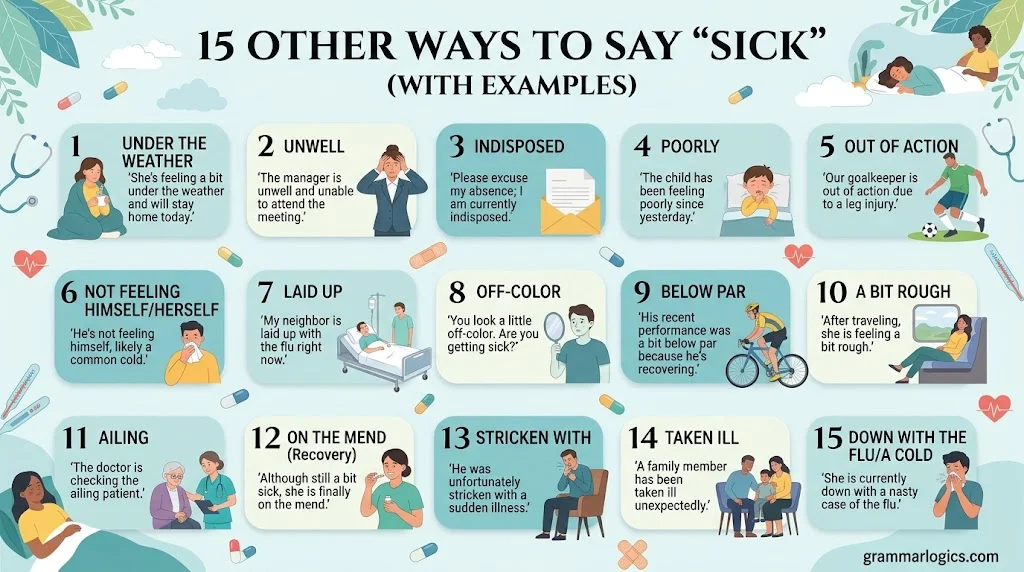
Words shape how we explain our health. Choosing a thoughtful expression for feeling sick can make everyday conversations clearer, kinder, more natural, and respectful today.
The word sick is familiar and useful, but it does not always clearly describe how someone feels with enough detail. In one situation, a person may have a mild cold; in another, they may feel nauseous, exhausted, or seriously unwell. The wording you choose can also affect the tone of your message. A simple phrase may suit a text to a friend, while a more polite or professional expression may work better in an email to a manager or teacher. Using varied vocabulary helps you communicate clearly without sharing more personal health information than necessary.
In this guide, you’ll discover 15 other ways to say “sick”, along with their meanings, definitions, and natural examples. Some alternatives, such as ill and unwell, describe general poor health, while expressions like queasy and feverish point to particular symptoms. You’ll also learn which phrases sound casual, which feel more formal, and when an expression is not an exact synonym. Context matters greatly. Whether you are writing a message, explaining an absence, or talking with someone who needs rest, these options can help you choose wording that feels accurate, considerate, and appropriate for the situation.
What Does “Sick” Mean?
The word sick generally means feeling physically unwell or suffering from an illness. It describes a person’s condition when they are not in their usual state of health. Someone who is sick might experience symptoms such as a headache, fever, cough, stomach pain, tiredness, or nausea. The word can refer to a mild condition, such as a common cold, or a more serious health problem. In everyday English, people also use sick to explain why they cannot attend work, school, or social activities. In some varieties of English, particularly American English, sick can also mean feeling nauseated or likely to vomit. Therefore, its exact meaning depends on the context in which it is used.
Common Situations Where “Sick” Is Used
People use the word sick in many everyday situations when discussing health, illness, or physical discomfort. It is especially common in conversations with friends, family members, coworkers, and classmates.
- Everyday conversations: People use sick to explain that they are not feeling healthy or are experiencing an illness.
- Text messages: Someone might tell a friend they are sick and cannot attend a planned activity.
- Workplace communication: Employees often use the word when explaining an absence or requesting sick leave.
- School: Students may use it to explain why they cannot attend classes or complete an activity.
- Personal relationships: Family members and partners use it when discussing someone’s health or expressing concern.
- Customer communication: Businesses may use more professional expressions when explaining that an employee is unavailable because of illness.
- Formal writing: Words such as ill, unwell, and indisposed may be more appropriate depending on the audience.
Using different expressions can make communication more specific. For example, saying someone feels queasy describes nausea, while saying someone is recovering from an illness explains that they are getting better.
Is It Professional or Polite to Say “Sick”?
Yes, sick is generally an acceptable and polite word in everyday and professional communication. It is simple, familiar, and easy to understand. Employees commonly use it when informing managers that they cannot attend work because of an illness. For example, saying, “I’m sick today and need to take a day off,” is perfectly understandable.
However, the word can sometimes sound too general when more specific information is necessary. In professional emails, expressions such as unwell, ill, or recovering from an illness may communicate the situation more appropriately. The expression indisposed can also sound formal, although it is less common in everyday workplace conversations. The best choice depends on the situation, your relationship with the reader, and how much information you want to share.
Advantages and Disadvantages of Saying “Sick”
Advantages
The word sick has several advantages because it is familiar, straightforward, and widely understood. It communicates that someone is experiencing a health problem without requiring a detailed medical explanation. It also works in casual conversations, text messages, and many workplace situations. Another benefit is its flexibility: it can describe different levels of illness, from temporary discomfort to more serious health conditions. This makes it a convenient word when you want to explain your condition quickly.
Disadvantages
Although sick is useful, it does not always explain the exact nature of someone’s condition. It could refer to nausea, a common cold, a fever, or another health problem. This lack of detail may create confusion when the listener needs more specific information. Repeating the same word can also make writing less expressive. In formal communication, a more precise expression may sound more appropriate. Choosing a suitable alternative helps explain the person’s condition, emotional state, or recovery more clearly.
15 Other Ways to Say “Sick”
Here are 15 natural alternatives and related expressions you can use depending on the meaning and context.
- Ill
- Unwell
- Under the Weather
- Not Feeling Well
- Poorly
- Ailing
- Indisposed
- Feeling Ill
- Nauseous
- Queasy
- Feverish
- Laid Up
- Bedridden
- Recovering from an Illness
- In Poor Health
1. Ill
Meaning
Ill means experiencing a physical illness or having a health problem. It is one of the closest and most widely understood alternatives to sick.
Definition
Ill describes someone who is suffering from an illness or is not physically healthy.
Detailed Explanation
The word ill communicates nearly the same general meaning as sick. It often sounds slightly more formal, making it useful in professional communication and written English. Unlike expressions that describe individual symptoms, ill refers broadly to a person’s health condition. It works particularly well when you want to explain that someone cannot participate in an activity because of illness.
Scenario Examples
Scenario 1: Workplace communication
Example: “I’m feeling ill today, so I won’t be able to attend the office.”
Scenario 2: Talking to a friend
Example: “My brother has been ill for the past few days.”
Scenario 3: School communication
Example: “She was absent from class because she was ill.”
Best Use
Use ill in professional emails, school messages, everyday conversations, and formal writing. It is especially suitable when you want a straightforward but slightly more formal expression.
Tone
Tone: Neutral, professional, and respectful.
It communicates a health problem without sounding overly emotional or informal.
2. Unwell
Meaning
Unwell means not feeling healthy or experiencing physical discomfort. It is a gentle way to explain that someone is sick.
Definition
Unwell describes a person who is experiencing an illness or does not feel physically well.
Detailed Explanation
Unwell is a polite and considerate expression that works particularly well when you do not want to describe someone’s symptoms. Compared with sick, it can sound softer and more tactful. It is commonly used in professional messages, conversations with acquaintances, and situations where privacy matters. It does not identify a particular illness, so it is best when a general explanation is enough.
Scenario Examples
Scenario 1: Sending a work email
Example: “I’m feeling unwell this morning and may need to take the day off.”
Scenario 2: Talking about a family member
Example: “My mother has been unwell recently, so I’m staying home with her.”
Scenario 3: Personal communication
Example: “You look a little unwell. Would you like to sit down?”
Best Use
Use unwell in workplace emails, polite conversations, personal messages, and situations where you prefer a gentle description.
Tone
Tone: Polite, gentle, and considerate.
Its softer wording makes it appropriate for both professional and personal communication.
3. Under the Weather
Meaning
Under the weather is an informal expression that means feeling slightly sick or physically uncomfortable.
Definition
This idiom describes someone who is experiencing mild illness or does not feel completely healthy.
Detailed Explanation
Under the weather is a familiar English idiom used when someone is not feeling their best. It often suggests a mild or temporary health problem rather than a serious illness. The expression sounds friendlier and more conversational than sick. However, it is not a precise medical description and may be unsuitable when explaining a serious condition or writing a formal medical report.
Scenario Examples
Scenario 1: Texting a friend
Example: “I’m feeling a little under the weather, so I’ll stay home tonight.”
Scenario 2: Casual workplace conversation
Example: “James is under the weather today, so he won’t be joining us.”
Scenario 3: Explaining a missed activity
Example: “I couldn’t make it to the gym because I was a bit under the weather.”
Best Use
Use under the weather in friendly conversations, casual messages, informal emails, and social situations.
Tone
Tone: Casual, friendly, and lighthearted.
It communicates mild illness without making the situation sound overly serious.
4. Not Feeling Well
Meaning
Not feeling well means experiencing physical discomfort or feeling less healthy than usual.
Definition
This expression describes someone who feels physically unwell or believes they may be getting sick.
Detailed Explanation
Not feeling well is a natural and flexible expression that can replace sick in many everyday situations. It is especially useful when you want to explain your condition without revealing private health information. Unlike some expressions that suggest a particular symptom, it leaves the exact reason open. It also sounds polite and approachable, making it suitable for conversations with friends, colleagues, teachers, and family members.
Scenario Examples
Scenario 1: Messaging a manager
Example: “I’m not feeling well today, so I’ll be taking a sick day.”
Scenario 2: Talking to a friend
Example: “I’m not feeling well enough to go shopping this afternoon.”
Scenario 3: Family conversation
Example: “Dad isn’t feeling well, so let’s keep the house quiet.”
Best Use
Use not feeling well in text messages, workplace communication, school conversations, personal messages, and everyday discussions.
Tone
Tone: Polite, neutral, and considerate.
It gives a clear explanation while allowing the speaker to maintain privacy.
5. Poorly
Meaning
Poorly can mean feeling sick or being in an unhealthy physical condition. It is particularly common in British English.
Definition
Poorly describes someone who is feeling unwell or experiencing an illness.
Detailed Explanation
Poorly is a familiar expression in British English, especially in informal conversations. Parents may use it when talking about a sick child, while adults may use it to describe their own condition. It can sound warmer and more conversational than ill. However, it is less common in American English, where unwell or not feeling well may sound more natural.
Scenario Examples
Scenario 1: Talking about a child
Example: “The baby has been poorly since yesterday.”
Scenario 2: Speaking with a friend
Example: “I’ve been feeling a bit poorly, so I decided to rest.”
Scenario 3: Family communication
Example: “Grandma is poorly this week, so we’re going to visit her.”
Best Use
Use poorly in informal British English, family conversations, and friendly personal messages.
Tone
Tone: Warm, casual, and gentle.
It often sounds affectionate when used to describe someone who needs care or attention.
6. Ailing
Meaning
Ailing means suffering from an illness, experiencing poor health, or becoming physically weak.
Definition
Ailing describes a person, organization, or system that is experiencing a condition of weakness or decline. When referring to a person, it generally means being in poor health.
Detailed Explanation
Ailing is more descriptive and somewhat more formal than sick. It often suggests an ongoing health problem rather than a brief episode of discomfort. The word is also frequently used in news articles and formal writing to describe someone whose health is deteriorating. Unlike ill, it can carry a stronger suggestion of weakness or prolonged health difficulties.
Scenario Examples
Scenario 1: Discussing an elderly relative
Example: “The family has been taking care of their ailing grandfather.”
Scenario 2: Newspaper-style writing
Example: “The actor canceled his appearance because of his ailing health.”
Scenario 3: Personal conversation
Example: “She has been caring for her ailing mother for several months.”
Best Use
Use ailing in formal writing, descriptive articles, news-style content, and conversations about ongoing health difficulties.
Tone
Tone: Formal, serious, and descriptive.
It communicates more than temporary discomfort and often suggests continuing health concerns.
7. Indisposed
Meaning
Indisposed means temporarily unable to participate in an activity because of illness or physical discomfort.
Definition
Indisposed describes someone who is not feeling well enough to carry out normal activities or commitments.
Detailed Explanation
Indisposed is a relatively formal expression that can politely explain someone’s absence without providing personal medical details. It is useful when declining an invitation, postponing an appointment, or explaining why someone cannot attend a meeting. Unlike sick, it focuses more on being unavailable than on the specific illness. It may sound somewhat old-fashioned or distant in casual conversations, so simpler wording is often better with close friends.
Scenario Examples
Scenario 1: Formal email
Example: “Unfortunately, I am indisposed and will not be able to attend today’s meeting.”
Scenario 2: Declining an invitation
Example: “I’m afraid she’s indisposed this evening and won’t be joining us.”
Scenario 3: Professional communication
Example: “The director is indisposed today, so the appointment will need to be rescheduled.”
Best Use
Use indisposed in formal emails, professional correspondence, polite refusals, and situations where you do not want to disclose health details.
Tone
Tone: Formal, reserved, and polite.
Its wording creates distance and maintains a respectful level of privacy.
8. Feeling Ill
Meaning
Feeling ill means experiencing symptoms or discomfort that make someone believe they are sick.
Definition
Feeling ill describes the personal experience of physical sickness or poor health.
Detailed Explanation
Feeling ill is a natural expression that focuses on how a person feels rather than simply labeling their health condition. It is useful when explaining the beginning of an illness or describing how you feel at a particular moment. It is similar to feeling sick, although the exact interpretation can depend on the variety of English being used. In American English, feeling sick can sometimes specifically suggest nausea, while feeling ill more commonly communicates general physical illness.
Scenario Examples
Scenario 1: Everyday conversation
Example: “I’m feeling ill, so I think I’ll go home early.”
Scenario 2: Talking to a colleague
Example: “I’ve been feeling ill since this morning.”
Scenario 3: Personal message
Example: “She started feeling ill during the journey.”
Best Use
Use feeling ill in everyday conversation, personal messages, workplace communication, and situations where you want to describe your current physical condition.
Tone
Tone: Neutral, clear, and slightly formal.
It communicates physical discomfort without sounding overly casual.
9. Nauseous
Meaning
Nauseous describes the feeling of nausea or the sensation that you might vomit.
Definition
Nauseous means experiencing an unpleasant sensation in the stomach that may lead to vomiting.
Detailed Explanation
Nauseous is a more specific word than sick because it describes a particular symptom rather than general illness. It is useful when someone feels uncomfortable after eating, traveling, or experiencing motion sickness. In American English, the word is commonly used to describe someone who feels like vomiting. It should not be used as a general replacement for every type of illness because a person can be sick without feeling nauseous.
Scenario Examples
Scenario 1: Traveling by car
Example: “I feel nauseous whenever I sit in the back seat.”
Scenario 2: Talking about food
Example: “That strong smell is making me nauseous.”
Scenario 3: Everyday conversation
Example: “She felt nauseous after eating too much.”
Best Use
Use nauseous when describing stomach discomfort, motion sickness, or the feeling that you may vomit.
Tone
Tone: Neutral, specific, and descriptive.
It clearly identifies a symptom rather than describing someone’s overall health.
10. Queasy
Meaning
Queasy means feeling slightly sick to your stomach or experiencing mild nausea.
Definition
Queasy describes an uncomfortable stomach sensation that can make someone feel as though they might vomit.
Detailed Explanation
Queasy is a useful alternative when the illness involves mild stomach discomfort. It sounds more conversational than nauseous and is commonly used in everyday English. The word can also describe an uneasy feeling caused by fear, discomfort, or an unpleasant experience. Therefore, its meaning depends on context. When discussing physical health, it usually refers to nausea rather than a general illness.
Scenario Examples
Scenario 1: On a boat
Example: “The rough waves made me feel queasy.”
Scenario 2: After eating
Example: “I felt a little queasy after that heavy lunch.”
Scenario 3: Talking with a friend
Example: “I’m feeling queasy, so I think I’ll skip dinner.”
Best Use
Use queasy in casual conversations about mild nausea, stomach discomfort, travel sickness, and reactions to unpleasant experiences.
Tone
Tone: Casual, descriptive, and slightly informal.
It is a softer way to describe an uncomfortable stomach sensation.
11. Feverish
Meaning
Feverish means having or appearing to have a fever, often accompanied by warmth, sweating, or chills.
Definition
Feverish describes a person who has an elevated body temperature or experiences symptoms associated with a fever.
Detailed Explanation
Feverish is more specific than sick because it describes a particular physical condition. Someone who feels feverish may experience sweating, chills, weakness, or a warm body temperature. The expression is useful when explaining symptoms, especially during a cold or infection. However, feeling feverish does not always confirm that someone has an actual fever; measuring body temperature is more reliable.
Scenario Examples
Scenario 1: Talking to a family member
Example: “I feel feverish, so I’m going to check my temperature.”
Scenario 2: Workplace communication
Example: “I’m feeling feverish today and won’t be able to come into the office.”
Scenario 3: Describing someone’s condition
Example: “The child looked feverish and needed some rest.”
Best Use
Use feverish when describing possible fever symptoms in everyday conversations, health-related discussions, and messages explaining why someone needs rest.
Tone
Tone: Neutral, descriptive, and health-focused.
It communicates a more specific physical symptom than the general word sick.
12. Laid Up
Meaning
Laid up is an informal expression meaning unable to carry out normal activities because of illness or injury.
Definition
Laid up describes someone who must stay in bed or remain at home while recovering from a health problem.
Detailed Explanation
Laid up is a phrasal expression commonly used in casual English. It suggests that an illness or injury has made someone temporarily unable to follow their usual routine. Unlike sick, it emphasizes the effect of the condition on daily activities. It can refer to someone resting at home because of the flu, an injury, or another health problem. It is not appropriate for highly formal medical writing.
Scenario Examples
Scenario 1: Talking to a friend
Example: “I’ve been laid up with the flu all week.”
Scenario 2: Workplace conversation
Example: “Mark is laid up at home with a bad back.”
Scenario 3: Explaining an absence
Example: “She was laid up for several days and couldn’t attend the event.”
Best Use
Use laid up in informal conversations, friendly messages, and casual explanations about being unable to work or participate in activities.
Tone
Tone: Casual, conversational, and informal.
It emphasizes temporary inactivity caused by illness or injury.
13. Bedridden
Meaning
Bedridden means unable to leave bed because of a serious illness, injury, or physical condition.
Definition
Bedridden describes someone who must remain in bed because their health or physical condition prevents normal movement.
Detailed Explanation
Bedridden is a stronger expression than sick because it suggests significant limitations in a person’s ability to move around. It is often used when describing someone with a serious illness, a major injury, or a condition that requires extended bed rest. Unlike under the weather, it does not suggest mild discomfort. This word should only be used when someone genuinely cannot get out of bed or is medically required to remain there.
Scenario Examples
Scenario 1: Family conversation
Example: “Her grandmother became bedridden after the serious illness.”
Scenario 2: Describing a patient’s condition
Example: “The patient was bedridden for several weeks during recovery.”
Scenario 3: Personal communication
Example: “He was bedridden for days and needed help with everyday activities.”
Best Use
Use bedridden in health-related writing, serious personal discussions, and descriptions of someone whose illness or injury prevents them from leaving bed.
Tone
Tone: Serious, factual, and descriptive.
It communicates a significant limitation in physical mobility.
14. Recovering from an Illness
Meaning
Recovering from an illness means gradually getting better after being sick.
Definition
This expression describes the process of returning to normal health following a period of illness.
Detailed Explanation
Recovering from an illness is not an exact synonym for sick because it describes the improvement process rather than the condition itself. It is especially useful when someone has passed the worst stage of an illness but has not fully returned to normal health. The phrase sounds positive and reassuring because it focuses on progress and improvement. It also provides more information than simply saying someone is unwell.
Scenario Examples
Scenario 1: Talking about a friend
Example: “My friend is recovering from an illness and should be back soon.”
Scenario 2: Workplace communication
Example: “I’m recovering from an illness and hope to return to work next week.”
Scenario 3: Family conversation
Example: “Grandpa is recovering from an illness, so we’re giving him plenty of time to rest.”
Best Use
Use recovering from an illness in professional updates, personal messages, family conversations, and situations where someone is gradually getting better.
Tone
Tone: Positive, considerate, and reassuring.
It emphasizes improvement rather than focusing entirely on the illness.
15. In Poor Health
Meaning
In poor health means experiencing an ongoing condition in which someone’s physical health is not good.
Definition
This expression describes a person whose overall health is weak or affected by one or more medical conditions.
Detailed Explanation
In poor health is a broader and more formal expression than sick. It often describes someone’s general physical condition rather than a temporary illness. For example, an elderly person with several ongoing health problems may be described as being in poor health. Unlike feeling ill, it does not necessarily suggest that the person has recently become sick. It is most appropriate when discussing continuing health difficulties or an overall decline in physical well-being.
Scenario Examples
Scenario 1: Formal writing
Example: “The elderly patient was in poor health and required regular medical attention.”
Scenario 2: Family conversation
Example: “His father has been in poor health for several years.”
Scenario 3: Describing a general condition
Example: “She decided to reduce her workload because she was in poor health.”
Best Use
Use in poor health in formal writing, health-related discussions, descriptive articles, and conversations about long-term physical conditions.
Tone
Tone: Formal, serious, and informative.
It describes a person’s overall health rather than a temporary episode of illness.
FAQs
What is another way to say “sick”?
Some common alternatives to sick include ill, unwell, under the weather, not feeling well, and poorly. The best expression depends on the situation. For professional communication, unwell and ill are useful choices. In casual conversations, under the weather sounds friendly and natural. If you are describing a specific symptom, words such as nauseous, queasy, or feverish provide more accurate information.
What does “sick” mean in everyday English?
In everyday English, sick generally means feeling physically unwell or suffering from an illness. It can describe conditions such as a cold, fever, headache, or stomach problem. In American English, it can also refer specifically to feeling nauseated or having the sensation that you might vomit. Its meaning depends on the context and the symptoms being discussed.
Is “sick” a professional word?
Yes, sick is acceptable in professional communication, especially when explaining an absence from work. However, alternatives such as ill and unwell may sound slightly more formal. For example, “I’m feeling unwell today and won’t be able to attend the meeting” is a polite workplace message. You do not need to share private medical details when explaining an absence.
What is a more polite way to say “sick”?
Unwell and not feeling well are two polite alternatives. Both expressions communicate that someone is experiencing a health problem without sounding too direct. For example, you could say, “I’m not feeling well today, so I need to rest.” These phrases are appropriate for workplace emails, personal conversations, and messages to people you do not know very well.
Which alternative to “sick” works best in formal communication?
Ill and unwell are among the best choices for formal communication. They are clear, respectful, and widely understood. You can use them in workplace emails, school correspondence, and professional messages. If you want to avoid sharing personal health information, indisposed may also work in certain formal situations, although it sounds more reserved and less conversational.
Conclusion
Choosing the right expression can make conversations about health more natural, respectful, and meaningful. Although sick is a simple and widely understood word, alternatives such as ill, unwell, and under the weather can offer different levels of formality and friendliness. More specific expressions, including nauseous, queasy, and feverish, help describe particular symptoms, while phrases such as recovering from an illness focus on improvement.
The most suitable choice depends on the person’s condition, your relationship with the listener, and the purpose of your message. Instead of using the same word repeatedly, explore these 15 alternatives to make your vocabulary more expressive. Remember, the best wording is always the one that communicates the situation accurately and naturally.
Latest Posts:
- 15 Other Ways to Say “Poop” (With Examples)
- 15 Other Ways to Say “Finally” (With Examples)
- 15 Other Ways to Say “I Love You Too” (With Examples)
- 15 Other Ways to Say “Best” (With Examples)
- 15 Other Ways to Say “Agree” (With Examples)