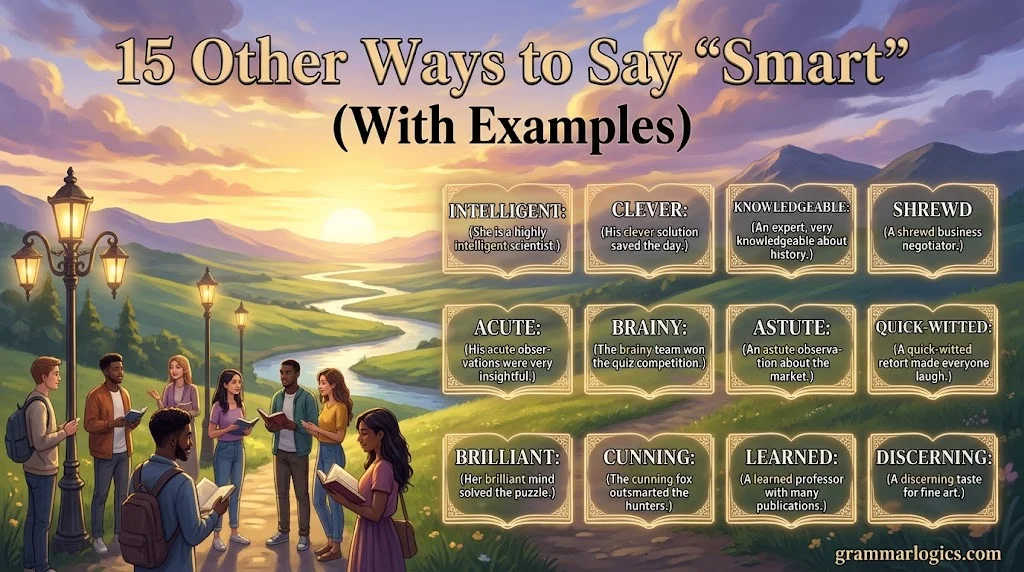
However, using the same word repeatedly can make your writing sound less interesting. Learning other ways to say “smart” can help you express someone’s intelligence and skills.
There are many ways to describe an intelligent person, depending on their abilities, personality, and knowledge. For example, words like intelligent, clever, bright, brilliant, and sharp-minded can communicate different levels and types of intelligence. Some expressions are suitable for everyday conversations, while others sound more professional or academic. Choosing the right alternative can make your sentences more meaningful, engaging, and precise. It also helps you appreciate different qualities, such as creativity, quick thinking, wisdom, and the ability to learn new things.
Whether you are writing an article, preparing a professional email, complimenting someone, or having a casual conversation, knowing different expressions for smart can improve your communication. Instead of repeating the same adjective, you can choose words that better describe a person’s particular strengths and abilities. For instance, brainy may describe someone with strong intellectual abilities, while quick-witted highlights a person’s ability to think and respond quickly. Similarly, knowledgeable describes someone with extensive information about a subject. These alternatives make your vocabulary richer and your writing more natural. In this guide, you will discover 15 other ways to say “smart”, along with clear meanings and practical examples to help you use each expression confidently.
What Does “Smart” Mean?
The word smart generally describes someone who is intelligent, quick to understand things, and capable of using knowledge effectively. A smart person can learn new information, solve problems, recognize patterns, and make sensible decisions. It is a common adjective used to describe students, professionals, friends, children, and people who demonstrate good judgment in everyday situations.
However, smart can have different meanings depending on the context. When describing someone’s personality or abilities, it usually refers to intelligence, knowledge, or good thinking skills. In other situations, smart can describe someone who looks stylish, neat, or well-dressed. It can also refer to technology, such as a smartphone or smart device. The intended meaning determines which alternative is most appropriate.
Common Situations Where “Smart” Is Used
People use the word smart in many everyday situations. It is especially common when discussing someone’s intelligence, skills, decisions, or appearance.
Some common situations include:
- Everyday conversation: Describing someone who understands things quickly or solves problems effectively.
- School and education: Praising a student who learns quickly, answers difficult questions, or performs well academically.
- Workplace communication: Recognizing an employee who demonstrates strong thinking skills and makes effective decisions.
- Personal relationships: Complimenting a friend or family member for giving thoughtful advice.
- Social media: Sharing appreciation for someone’s creativity, knowledge, or impressive achievements.
- Professional writing: Describing someone’s abilities, qualifications, or approach to problem-solving.
- Personal appearance: Referring to someone who looks neat, stylish, or appropriately dressed.
Using different expressions instead of repeating smart can make compliments more specific. For example, calling someone intelligent highlights their ability to understand complex ideas, while describing them as wise emphasizes their judgment and life experience.
Is It Professional or Polite to Say “Smart”?
Yes, smart is generally a polite and acceptable word in both casual and professional communication. It is a positive adjective that can express appreciation for someone’s intelligence, abilities, or decisions. For example, telling a colleague, “That was a smart decision,” is a natural way to recognize their good judgment.
In workplace communication, the word is suitable for conversations, emails, presentations, and performance discussions. However, more specific expressions may sound more polished when discussing professional abilities. For example, intelligent, knowledgeable, and resourceful can communicate particular strengths more clearly.
The word can also describe someone’s appearance, especially in expressions such as smart clothes or a smart outfit. Context matters because the meaning changes depending on what is being described.
Advantages and Disadvantages of Saying “Smart”
Advantages
- Simple and understandable: Almost everyone understands the meaning of smart.
- Positive expression: It communicates appreciation for someone’s intelligence or abilities.
- Versatile usage: It works in casual conversations, educational settings, and professional communication.
- Natural wording: It sounds friendly and familiar in everyday English.
- Easy to use: It can describe people, ideas, decisions, and certain types of technology.
Disadvantages
- Can be too general: Smart does not always explain what makes someone intelligent.
- Limited emotional detail: It may not communicate qualities such as wisdom, creativity, or experience.
- Repetition: Using it too often can make descriptions and compliments sound less interesting.
- Context-dependent: It can describe intelligence or appearance, which may sometimes create ambiguity.
Choosing a more specific expression can help communicate exactly what you admire about someone.
15 Synonyms and Alternatives for “Smart”
- Intelligent
- Clever
- Bright
- Brilliant
- Sharp
- Wise
- Knowledgeable
- Quick-Witted
- Perceptive
- Insightful
- Astute
- Resourceful
- Brainy
- Sensible
- Savvy
1. Intelligent
Meaning
Intelligent describes someone who has a strong ability to understand information, learn new things, and solve problems. It is one of the closest and most direct alternatives to smart.
Definition
Having the mental ability to think, understand, learn, and use information effectively.
Detailed Explanation
Intelligent is a slightly more formal and precise word than smart. It highlights a person’s ability to understand complicated subjects and apply knowledge. It can describe academic ability, logical thinking, and general mental capacity. This expression is particularly useful when you want to give someone a thoughtful and respectful compliment.
Scenario Examples
Scenario: A teacher praises a student who understands difficult lessons.
Example: Maria is an intelligent student who understands even the most challenging topics.
Scenario: A manager appreciates an employee’s problem-solving abilities.
Example: We need an intelligent person who can analyze these issues carefully.
Best Use
Use intelligent in professional writing, academic discussions, workplace communication, and formal compliments. It is especially appropriate when discussing someone’s overall mental abilities.
Tone
Tone: Respectful, professional, positive.
It sounds slightly more formal than smart and emphasizes genuine intellectual ability.
2. Clever
Meaning
Clever describes someone who can think creatively, find solutions, and understand how to handle different situations. It often highlights quick thinking and practical intelligence.
Definition
Having the ability to think quickly and find original or effective solutions.
Detailed Explanation
Clever is a natural alternative when someone demonstrates creativity or finds an unexpected solution to a problem. Unlike intelligent, which describes broader mental ability, clever often focuses on how someone uses their thinking skills. It can also describe an idea, joke, or strategy. Depending on the context, it may sometimes suggest someone is being slightly tricky or mischievous.
Scenario Examples
Scenario: A friend finds an easy solution to a difficult problem.
Example: That was a clever way to fix the broken chair!
Scenario: A student creates an interesting project for school.
Example: You came up with a clever idea for your science presentation.
Best Use
Use clever in casual conversations, friendly compliments, creative discussions, and situations involving problem-solving.
Tone
Tone: Friendly, playful, appreciative.
It feels conversational and often praises creativity rather than academic knowledge alone.
3. Bright
Meaning
Bright describes someone who learns quickly, understands information easily, and shows strong mental ability. It is often used when talking about children, students, or talented individuals.
Definition
Having a natural ability to learn, understand, and think clearly.
Detailed Explanation
Bright is a warm and encouraging alternative to smart. It often suggests that someone has strong potential and can understand new ideas without much difficulty. The expression is especially common when praising young people or students. Although it communicates intelligence, it can sound less formal than intelligent.
Scenario Examples
Scenario: A teacher praises a child who learns lessons quickly.
Example: Ahmed is a bright child who always asks interesting questions.
Scenario: A parent talks about their daughter’s academic abilities.
Example: My daughter is very bright and enjoys learning new things.
Best Use
Use bright in school conversations, family discussions, friendly compliments, and descriptions of young learners.
Tone
Tone: Warm, encouraging, positive.
It communicates natural ability while making the compliment sound gentle and supportive.
4. Brilliant
Meaning
Brilliant describes someone who demonstrates exceptional intelligence, creativity, or ability. It can also describe an outstanding idea, performance, or solution.
Definition
Extremely intelligent or exceptionally impressive in ability or achievement.
Detailed Explanation
Brilliant is generally stronger than smart because it suggests an unusually high level of ability. It is appropriate when someone produces an excellent result, understands something difficult, or develops an outstanding idea. In British English, brilliant is also commonly used as an enthusiastic way to say that something is excellent. Therefore, its intended meaning depends on the situation.
Scenario Examples
Scenario: A colleague develops an excellent solution for a workplace challenge.
Example: That is a brilliant solution to our scheduling problem.
Scenario: A student performs exceptionally well in an examination.
Example: She is a brilliant student with an impressive understanding of mathematics.
Best Use
Use brilliant in enthusiastic compliments, professional recognition, academic discussions, and conversations about exceptional ideas or achievements.
Tone
Tone: Enthusiastic, admiring, expressive.
It communicates stronger praise than smart and is best reserved for genuinely impressive abilities or ideas.
5. Sharp
Meaning
Sharp describes someone who thinks quickly, notices important details, and understands situations without needing lengthy explanations.
Definition
Having a quick and alert mind with a strong ability to notice and understand things.
Detailed Explanation
Sharp is particularly useful when describing quick thinking and mental alertness. A sharp person can recognize problems, understand details, and respond effectively. Unlike intelligent, which describes general intellectual ability, sharp focuses more on mental speed and awareness. It is commonly used in informal and professional conversations.
Scenario Examples
Scenario: An employee quickly identifies an error during a meeting.
Example: You have a sharp mind; you noticed the mistake immediately.
Scenario: A friend understands a complicated joke before everyone else.
Example: He’s sharp enough to understand the joke without an explanation.
Best Use
Use sharp in workplace discussions, casual conversations, problem-solving situations, and descriptions of quick thinkers.
Tone
Tone: Confident, direct, complimentary.
It highlights alertness, quick understanding, and attention to detail.
6. Wise
Meaning
Wise describes someone who makes good decisions by using knowledge, experience, and careful judgment. It emphasizes good judgment more than intelligence alone.
Definition
Showing good judgment and the ability to make sensible decisions based on knowledge and experience.
Detailed Explanation
Wise is not an exact replacement for smart in every situation. It describes someone who understands the possible consequences of their actions and chooses carefully. A person may be intelligent but still make poor decisions, while wisdom involves knowing how to apply knowledge appropriately. This word is especially meaningful when praising someone’s advice or life decisions.
Scenario Examples
Scenario: A young person receives thoughtful advice from a grandparent.
Example: My grandfather is a wise man who always gives helpful advice.
Scenario: A friend decides to save money instead of making an unnecessary purchase.
Example: It was wise of you to save your money for the future.
Best Use
Use wise in personal conversations, family discussions, meaningful compliments, advice, and situations involving important decisions.
Tone
Tone: Respectful, thoughtful, mature.
It suggests experience, patience, and sound judgment rather than simply having a high level of knowledge.
7. Knowledgeable
Meaning
Knowledgeable describes someone who knows a great deal about a particular subject or area. It highlights information, understanding, and expertise.
Definition
Having considerable knowledge or understanding of a specific topic.
Detailed Explanation
Knowledgeable is more specific than smart because it focuses on what someone knows rather than their general ability to think. Someone can be knowledgeable about technology, business, history, or science. The word is particularly useful when describing professionals or people who can explain a subject accurately. It does not necessarily mean that someone learns quickly or has exceptional problem-solving abilities.
Scenario Examples
Scenario: A customer asks an employee for technical assistance.
Example: Our support team is knowledgeable about computer software.
Scenario: A student explains an unfamiliar historical topic.
Example: Daniel is very knowledgeable about ancient history.
Best Use
Use knowledge in professional communication, educational writing, customer service, workplace discussions, and subject-specific descriptions.
Tone
Tone: Professional, informative, respectful.
It emphasizes subject expertise and familiarity with information.
8. Quick-Witted
Meaning
Quick-witted describes someone who can think and respond rapidly, especially during conversations or unexpected situations.
Definition
Having the ability to understand situations quickly and produce clever or appropriate responses.
Detailed Explanation
Quick-witted is especially suitable for people who respond intelligently without taking much time to think. It often describes someone who makes clever jokes, handles unexpected questions, or responds confidently during discussions. Unlike knowledgeable, it does not necessarily suggest extensive subject expertise. Instead, it highlights speed, creativity, and mental flexibility.
Scenario Examples
Scenario: A friend responds to a joke with an equally funny comment.
Example: Sarah is so quick-witted that she always has a clever reply.
Scenario: A presenter handles an unexpected question during a conference.
Example: His quick-witted response impressed everyone in the room.
Best Use
Use quick-witted in social conversations, humorous situations, public speaking, interviews, and descriptions of people who respond quickly.
Tone
Tone: Playful, confident, lively.
It emphasizes fast reactions and clever communication.
9. Perceptive
Meaning
Perceptive describes someone who notices small details, understands people’s feelings, and recognizes things that others might overlook.
Definition
Having a strong ability to notice, understand, and interpret details or situations.
Detailed Explanation
Perceptive focuses on awareness and the ability to understand what is happening beneath the surface. A perceptive person may recognize changes in someone’s mood or identify an issue before it becomes obvious. It differs from smart because it highlights observation and understanding rather than general intelligence. This expression is particularly useful when praising someone’s awareness of people or situations.
Scenario Examples
Scenario: A friend notices that someone is upset despite their cheerful expression.
Example: You are very perceptive; you noticed that I was having a difficult day.
Scenario: A manager recognizes a problem affecting team performance.
Example: She made a perceptive observation about the team’s communication problems.
Best Use
Use perceptive in personal relationships, workplace discussions, psychology-related writing, and situations involving observation or emotional awareness.
Tone
Tone: Thoughtful, respectful, observant.
It highlights someone’s ability to notice and understand details that others may miss.
10. Insightful
Meaning
Insightful describes someone who understands a subject deeply and offers valuable observations or ideas.
Definition
Showing a deep understanding of a situation, subject, or problem.
Detailed Explanation
Insightful is particularly useful when someone shares an idea that helps others understand something more clearly. It focuses on depth of understanding rather than how quickly someone learns. You can describe a person, comment, discussion, or analysis as insightful. It is often more suitable than smart when recognizing thoughtful contributions in professional or academic settings.
Scenario Examples
Scenario: A colleague shares a helpful perspective during a business meeting.
Example: Thank you for your insightful comments during the discussion.
Scenario: A student writes an impressive analysis of a novel.
Example: Her essay offers an insightful interpretation of the main character.
Best Use
Use insight in professional meetings, academic writing, discussions, presentations, and thoughtful feedback.
Tone
Tone: Intellectual, appreciative, professional.
It recognizes depth of understanding and the ability to provide meaningful perspectives.
11. Astute
Meaning
Astute describes someone who can understand situations accurately, recognize opportunities, and make clever judgments.
Definition
Having the ability to assess situations carefully and make intelligent, practical decisions.
Detailed Explanation
Astute is a more formal alternative that often describes people with strong judgment and awareness. It is especially useful when someone understands complex situations or recognizes important details that others overlook. Unlike bright, which often suggests natural learning ability, astute emphasizes practical understanding and sound assessment. It is frequently used in business, leadership, and professional writing.
Scenario Examples
Scenario: A business owner recognizes an opportunity in a changing market.
Example: The astute entrepreneur invested in the new technology at the right time.
Scenario: A manager notices a potential problem before it affects the project.
Example: That was an astute observation about the project’s future risks.
Best Use
Use astute in business communication, professional reports, leadership discussions, and descriptions of strategic decision-making.
Tone
Tone: Formal, analytical, sophisticated.
It conveys careful judgment, practical intelligence, and strong awareness.
12. Resourceful
Meaning
Resourceful describes someone who can find practical solutions and use available resources effectively, especially when facing difficulties.
Definition
Able to deal with problems creatively by making effective use of available resources.
Detailed Explanation
Resourceful is a useful alternative when smart refers to someone’s ability to handle challenges. It emphasizes practical problem-solving rather than academic intelligence. A resourceful person can adapt, think creatively, and find solutions even when resources are limited. This expression is particularly valuable when describing employees, students, and people who work independently.
Scenario Examples
Scenario: An employee finds a way to complete a project despite limited equipment.
Example: We need a resourceful team member who can handle unexpected challenges.
Scenario: A student creates a school project using inexpensive materials.
Example: She was resourceful enough to complete the project with what she had.
Best Use
Use resourceful in workplace communication, job recommendations, problem-solving discussions, and descriptions of practical abilities.
Tone
Tone: Positive, practical, professional.
It highlights adaptability, creativity, and the ability to find solutions.
13. Brainy
Meaning
Brainy describes someone who is very intelligent and particularly good at thinking, learning, or understanding difficult subjects.
Definition
Informally describing a person who has strong intellectual abilities.
Detailed Explanation
Brainy is a casual expression that emphasizes someone’s intellectual ability. It is commonly used when talking about students, academic interests, or people who enjoy challenging mental activities. Compared with intelligent, it sounds less formal and can sometimes feel playful. It is not usually the best choice for formal reports or professional assessments.
Scenario Examples
Scenario: Friends discuss a classmate who performs well in difficult subjects.
Example: Jake is really brainy and enjoys solving complicated math problems.
Scenario: A family member praises a child who loves science books.
Example: Our little brother is quite brainy for his age.
Best Use
Use brainy in casual conversations, friendly compliments, informal descriptions, and discussions about academic interests.
Tone
Tone: Casual, playful, complimentary.
It gives an informal impression of strong intellectual ability.
14. Sensible
Meaning
Sensible describes someone who makes practical, reasonable, and well-considered decisions.
Definition
Showing good judgment by choosing actions that are reasonable and appropriate.
Detailed Explanation
Sensible is a context-specific alternative to smart because it focuses on practical judgment rather than intelligence in general. A sensible person thinks about possible outcomes before making decisions. The word is especially useful when praising someone for making a responsible choice. It can describe people, plans, suggestions, and decisions.
Scenario Examples
Scenario: A friend decides to carry an umbrella after checking the weather forecast.
Example: That was a sensible decision because it looks like rain.
Scenario: A student creates a realistic study schedule before examinations.
Example: She made a sensible plan to manage her time more effectively.
Best Use
Use sensible in everyday conversations, family discussions, workplace decisions, practical advice, and descriptions of responsible behavior.
Tone
Tone: Practical, calm, approving.
It emphasizes reasonableness and good judgment rather than exceptional intellectual ability.
15. Savvy
Meaning
Savvy describes someone who has practical knowledge and understands how to handle a particular situation or area effectively.
Definition
Having practical understanding, experience, and the ability to make informed decisions.
Detailed Explanation
Savvy is especially useful when describing someone who understands a particular industry, activity, or type of technology. For example, a tech-savvy person is comfortable using technology, while a business-savvy person understands business matters. Unlike intelligent, savvy often refers to practical familiarity gained through experience. It is a natural choice in modern professional and everyday English.
Scenario Examples
Scenario: A company hires someone who understands online marketing.
Example: We need a marketing-savvy employee to improve our digital campaigns.
Scenario: A friend helps someone choose a suitable mobile application.
Example: Ask Daniel for advice because he is quite tech-savvy.
Best Use
Use savvy in business discussions, technology-related conversations, workplace communication, and descriptions of practical expertise.
Tone
Tone: Modern, confident, practical.
It communicates real-world understanding and the ability to handle a particular subject effectively.
FAQs
1. What is another way to say “smart”?
Some common alternatives include intelligent, clever, bright, brilliant, sharp, and wise. The best choice depends on what kind of intelligence you want to describe. For example, intelligent refers to general mental ability, while wise emphasizes good judgment.
2. What does “smart” mean?
Smart generally means having the ability to understand information, learn quickly, solve problems, and make good decisions. It can also describe someone who looks stylish or well-dressed, depending on the context.
3. Is “smart” a professional word?
Yes, smart is appropriate in professional communication. You can use it to describe effective decisions, practical ideas, or someone’s abilities. However, intelligent, knowledgeable, and astute may be more suitable in formal descriptions.
4. What is a more polite way to say “smart”?
Intelligent, bright, and insightful are polite alternatives. They can make a compliment sound more specific and thoughtful. For example, saying, “You have an insightful perspective,” is a respectful way to recognize someone’s understanding.
5. Which alternative to “smart” is best for formal communication?
Intelligence is generally the best direct alternative in formal communication. However, knowledgeable works well when discussing subject expertise, while astuteness is suitable when praising careful judgment and decision-making.
Conclusion
Choosing the right alternative to smart can make your communication more meaningful and precise. Although words such as intelligent, clever, bright, and brilliant share similar meanings, each expression highlights a different quality. Some describe general mental ability, while others emphasize creativity, practical knowledge, quick thinking, or good judgment.
Understanding these differences helps you choose the most appropriate wording for everyday conversations, professional communication, academic writing, and personal compliments. Instead of repeatedly using the same adjective, explore different expressions that communicate exactly what you appreciate about someone. The best alternative is always the one that matches the person’s abilities and the situation in which you are describing them.
Latest Posts:
- 15 Other Ways to Say “Poop” (With Examples)
- 15 Other Ways to Say “Finally” (With Examples)
- 15 Other Ways to Say “I Love You Too” (With Examples)
- 15 Other Ways to Say “Best” (With Examples)
- 15 Other Ways to Say “Agree” (With Examples)