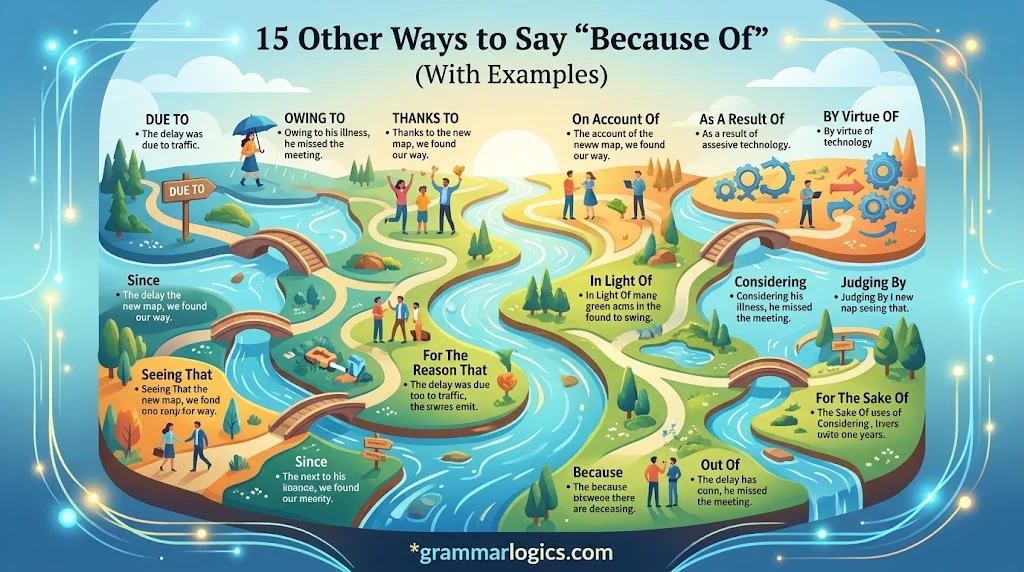
“Because of” is a common phrase used to explain the reason behind an action, situation, or event. However, using the same expression repeatedly can make your writing sound less engaging and repetitive.
Learning different ways to say “because of” can help you communicate more clearly and naturally. Whether you are writing an email, preparing an essay, creating blog content, or having everyday conversations, choosing the right alternative can make your sentences more effective. Expressions such as “due to,” “as a result of,” and “owing to” can add variety while keeping your original meaning clear. Understanding their meanings and appropriate contexts will help you choose the best phrase for every situation.
In this guide, we will explore 15 other ways to say “because of” with clear meanings, practical explanations, and example sentences. You will discover which alternatives work best in formal writing, professional communication, academic content, and casual conversations. Some expressions are more suitable for business emails, while others sound natural in everyday discussions. By exploring these alternatives, you can expand your vocabulary, improve your sentence structure, and avoid unnecessary repetition. Each phrase will help you express causes and reasons in a more precise and engaging way. Let’s explore these useful expressions and learn how to use them confidently.
What Does “Because Of” Mean?
“Because of” is a prepositional phrase used to explain the reason or cause behind an action, situation, or event. It tells readers why something happened or why a particular condition exists. For example, in the sentence, “The outdoor event was canceled because of the rain,” the phrase explains that rain was the reason for the cancellation.
In everyday English, “because of” is normally followed by a noun, pronoun, or noun phrase. It is commonly used in conversations, emails, academic writing, and professional communication. Although it expresses a clear relationship between a cause and an effect, different alternatives can communicate the same idea with a more formal, conversational, positive, or specific tone. It is important to remember that “because of” and “because” have different grammatical structures: “because of” introduces a noun phrase, while “because” introduces a complete clause.
Common Situations Where “Because Of” Is Used
People use “because of” in many everyday and professional situations when they want to explain a reason or provide background information.
- Everyday conversation: People use it to explain why they are late, tired, unavailable, or unable to do something. For example, “I stayed home because of the weather.”
- Text messages: It helps explain changes in plans or personal circumstances. Someone might write, “I couldn’t call because of work.”
- Workplace communication: Employees use it to explain delays, decisions, or unexpected situations. For example, “The meeting was postponed because of a scheduling conflict.”
- School and academic writing: Students use the expression to describe causes, effects, and reasons behind particular events.
- Personal relationships: It can help explain feelings, actions, or misunderstandings in a conversation.
- Customer communication: Businesses may use it to explain service interruptions, delivery delays, or changes in availability.
- Formal writing: The phrase can introduce reasons in reports, professional documents, and explanations.
Using alternatives can make these situations sound more natural, reduce repetition, and help communicate the intended relationship between two ideas.
Is It Professional or Polite to Say “Because Of”?
Yes, “because of” is both professional and polite when used appropriately. It is a neutral expression that clearly explains the reason behind something without sounding rude or overly emotional. It works well in workplace emails, business reports, academic assignments, customer messages, and everyday conversations. For example, “The deadline was extended because of unexpected circumstances” is clear and suitable for professional communication.
However, repeating the phrase several times in the same document can make the writing less varied. In formal situations, expressions such as “owing to,” “as a result of,” and “in light of” may provide a more polished style. For casual communication, “because,” “since,” or “thanks to” may sound more conversational, depending on the meaning. The best choice depends on the sentence, the relationship between the speakers, and whether the writer wants to emphasize a cause, a positive outcome, or a formal explanation.
Advantages and Disadvantages of Saying “Because Of”
Advantages
- Clear meaning: It directly identifies the reason behind an action or situation.
- Easy to understand: Most English speakers are familiar with the expression.
- Versatile usage: It works in conversations, emails, reports, and academic writing.
- Neutral tone: It does not automatically communicate blame, criticism, or strong emotion.
- Natural communication: It helps connect causes and effects without requiring complicated vocabulary.
Disadvantages
- Repetition: Using it too frequently can make writing sound monotonous.
- Limited stylistic variety: It may not always communicate the precise tone or emphasis a writer wants.
- Less formal in some contexts: Certain professional documents may benefit from more specific expressions.
- Possible ambiguity: Without enough context, readers may not fully understand the relationship between the cause and the result.
- Grammatical limitations: It is followed by a noun phrase, so writers must change the sentence structure when using alternatives such as “because,” “since,” or “as.”
15 Synonyms and Alternatives for “Because Of”
- Due to
- Owing to
- As a result of
- On account of
- Thanks to
- Because
- Since
- As
- Given
- In light of
- In view of
- Stemming from
- Resulting from
- Attributable to
- On the grounds of
1. Due to
Meaning
“Due to” means caused by or happening as a result of something. It explains the reason behind a particular event, condition, or situation. It is one of the closest alternatives to “because of” and is especially useful when you want your writing to sound slightly more formal.
Definition
A phrase used to identify the cause or reason for a particular situation, event, or outcome.
Detailed Explanation
“Due to” communicates a direct relationship between a cause and its effect. It is commonly used in professional emails, announcements, reports, and everyday explanations. The expression sounds neutral and slightly more formal than some casual alternatives. It is generally followed by a noun phrase rather than a complete clause, making it grammatically similar to “because of.”
Scenario Examples
Scenario 1: Workplace communication
Example: The meeting was postponed due to an unexpected scheduling conflict.
Scenario 2: Everyday conversation
Example: Our picnic was canceled due to heavy rain.
Scenario 3: Public announcement
Example: The road is temporarily closed due to construction work.
Best Use
Use “due to” in professional emails, formal announcements, reports, and everyday explanations when you want to identify a specific cause clearly.
Tone
Tone: Professional, neutral, informative.
It communicates a reason directly without adding unnecessary emotion or personal judgment.
2. Owing to
Meaning
“Owing to” means because something happened or existed. It introduces the reason behind a situation and is particularly useful in formal or carefully written communication.
Definition
An expression that identifies the cause or circumstance responsible for an event or condition.
Detailed Explanation
“Owing to” has a similar meaning to “because of,” but it often sounds more formal and polished. It is frequently used in written explanations, official notices, and professional documents. The phrase works best when the writer wants to explain circumstances without sounding overly conversational. It usually introduces a noun phrase rather than a complete sentence.
Scenario Examples
Scenario 1: Professional announcement
Example: Owing to technical difficulties, the online presentation will begin later than scheduled.
Scenario 2: Travel communication
Example: Our flight was delayed owing to unfavorable weather conditions.
Scenario 3: Academic writing
Example: Owing to limited resources, the research was conducted on a smaller scale.
Best Use
“Owing to” is especially appropriate for formal emails, academic writing, official announcements, and business communication.
Tone
Tone: Formal, respectful, professional.
Its slightly traditional wording gives explanations a more polished and composed feel.
3. As a Result of
Meaning
“As a result of” means something happened because of a particular event, action, or circumstance. It emphasizes the connection between a cause and its outcome.
Definition
A phrase used to introduce the reason that directly contributes to a particular result or consequence.
Detailed Explanation
This expression is especially useful when you want to highlight the cause-and-effect relationship in a sentence. Unlike a simple explanation of why something happened, it often draws attention to the outcome produced by a particular situation. It is common in academic writing, business reports, and formal explanations. The expression is generally followed by a noun phrase.
Scenario Examples
Scenario 1: Education
Example: Several students improved their grades as a result of regular practice.
Scenario 2: Workplace
Example: The company experienced increased productivity as a result of better teamwork.
Scenario 3: Everyday life
Example: The match was canceled as a result of severe weather conditions.
Best Use
Choose this phrase when discussing outcomes, consequences, research findings, business performance, or changes caused by a particular event.
Tone
Tone: Formal, explanatory, analytical.
It gives the reader a clearer understanding of how one event led to another.
4. On Account Of
Meaning
“On account of” means because of or for the reason that something happened. It introduces a circumstance that explains an action, decision, or situation.
Definition
An expression used to identify a particular reason or circumstance behind an event or action.
Detailed Explanation
“On account of” is a traditional expression that can replace “because of” in many sentences. It is often used in everyday speech, storytelling, and written explanations. Although it is understandable in formal English, it can sound slightly old-fashioned compared with “due to” or “because of.” It works particularly well when explaining a personal reason or an unexpected circumstance.
Scenario Examples
Scenario 1: Personal plans
Example: We decided to stay indoors on account of the cold weather.
Scenario 2: Travel
Example: The train service was interrupted on account of a technical problem.
Scenario 3: Everyday conversation
Example: I couldn’t attend the celebration on account of a family commitment.
Best Use
Use “on account of” in personal explanations, everyday conversation, storytelling, and written descriptions.
Tone
Tone: Neutral, conversational, slightly traditional.
It provides a straightforward explanation while giving the sentence a somewhat old-fashioned character.
5. Thanks To
Meaning
“Thanks to” means because of something that has contributed to a particular result. It is commonly used when the cause is positive, helpful, or beneficial.
Definition
An expression that identifies someone or something responsible for a favorable result or outcome.
Detailed Explanation
“Thanks to” is different from most alternatives because it often carries a positive or appreciative tone. It can show that a person’s help, an opportunity, or a useful circumstance made something possible. For example, “Thanks to your support, I completed the project” expresses appreciation rather than simply identifying a cause. However, it can also be used sarcastically when the result is negative, depending on the context and speaker’s intention.
Scenario Examples
Scenario 1: Personal appreciation
Example: Thanks to your encouragement, I finally achieved my goal.
Scenario 2: Workplace communication
Example: Thanks to the team’s hard work, we finished the project ahead of schedule.
Scenario 3: Everyday conversation
Example: Thanks to the new shortcut, I can reach the office much faster.
Best Use
Use this expression in friendly conversations, appreciation messages, personal communication, positive announcements, and informal writing.
Tone
Tone: Warm, appreciative, positive.
It adds gratitude and recognizes the contribution of a person or circumstance.
6. Because
Meaning
“Because” means for the reason that something happens or is true. It introduces a complete explanation and is one of the most common ways to communicate cause and reason in English.
Definition
A conjunction that connects a main statement with a clause explaining its reason.
Detailed Explanation
“Because” is a close alternative to “because of,” but the two expressions have different grammatical structures. “Because of” is normally followed by a noun phrase, whereas “because” introduces a clause containing a subject and a verb. This makes “because” particularly useful when you want to explain an action in a complete and natural sentence. It works equally well in casual conversation and professional communication.
Scenario Examples
Scenario 1: Everyday conversation
Example: I stayed home because I wasn’t feeling well.
Scenario 2: Workplace communication
Example: We moved the meeting because several team members were unavailable.
Scenario 3: Personal message
Example: She smiled because she received some wonderful news.
Best Use
Use “because” in everyday conversations, text messages, emails, academic explanations, and professional writing when you want to introduce a complete reason.
Tone
Tone: Neutral, direct, conversational.
It is simple and natural, making it suitable for almost every communication setting.
7. Since
Meaning
“Since” can mean because when it introduces a reason or explanation. It connects an action or situation with the circumstances that explain why it happened.
Definition
A conjunction used to introduce a reason that helps explain a statement or situation.
Detailed Explanation
“Since” is a useful alternative when the reason is already known, understood, or presented as background information. It can make an explanation sound smoother and less direct than repeatedly using “because.” However, “since” also refers to time, so the surrounding sentence should make its intended meaning clear. Unlike “because of,” it introduces a complete clause rather than a noun phrase.
Scenario Examples
Scenario 1: Workplace discussion
Example: Since everyone has arrived, we can begin the presentation.
Scenario 2: Everyday conversation
Example: Since it’s getting late, let’s head home.
Scenario 3: Personal communication
Example: Since you have already finished your work, why not take a break?
Best Use
“Since” works well in conversations, emails, explanations, professional discussions, and written communication when the reason serves as background information.
Tone
Tone: Natural, polite, explanatory.
It introduces a reason smoothly without making the explanation sound unnecessarily forceful.
8. As
Meaning
“As” can mean because when it introduces a reason for an action or situation. It explains why something happens while keeping the sentence flowing naturally.
Definition
A conjunction that introduces a clause explaining the cause or reason behind a statement.
Detailed Explanation
“As” is often used when the reason is already understood or does not need strong emphasis. It can make written explanations more concise and polished, particularly in formal or descriptive writing. However, it has several other meanings, including time, comparison, and manner, so context is important. Like “because” and “since,” it introduces a complete clause rather than a noun phrase.
Scenario Examples
Scenario 1: Professional communication
Example: As the manager is unavailable today, the assistant will lead the meeting.
Scenario 2: Everyday conversation
Example: As it was getting dark, we decided to return home.
Scenario 3: Formal writing
Example: As the application was incomplete, it could not be processed.
Best Use
Use “as” in formal writing, professional explanations, reports, and descriptive sentences where the reason does not need special emphasis.
Tone
Tone: Formal, smooth, neutral.
It creates a natural connection between the reason and the main statement.
9. Given
Meaning
“Given” means considering a particular fact, situation, or circumstance. It introduces information that provides a reasonable explanation for a decision, action, or conclusion.
Definition
A word used to introduce a relevant condition or fact that influences a particular judgment or outcome.
Detailed Explanation
“Given” is useful when you want to explain something by referring to circumstances that should be taken into account. Unlike “because of,” it often emphasizes the importance of the available information rather than simply identifying a cause. It is particularly common in professional communication, academic writing, and analytical discussions. The expression usually introduces a noun phrase, although “given that” introduces a complete clause.
Scenario Examples
Scenario 1: Workplace decision
Example: Given the limited budget, we should focus on the most important tasks first.
Scenario 2: Personal planning
Example: Given the distance, leaving early would be a sensible decision.
Scenario 3: Academic discussion
Example: Given the available evidence, the conclusion appears reasonable.
Best Use
Use “given” in professional discussions, reports, academic writing, planning, and decision-making when explaining a judgment based on particular circumstances.
Tone
Tone: Analytical, professional, thoughtful.
It shows that a decision or conclusion is based on relevant facts.
10. In Light Of
Meaning
“In light of” means considering a particular fact, development, or circumstance. It explains why an action or decision is appropriate based on new or relevant information.
Definition
A formal expression used to introduce information that influences a decision, opinion, or response.
Detailed Explanation
“In light of” is particularly useful when a situation changes because of new information or when an earlier decision needs to be reconsidered. It does not always describe a direct physical cause; instead, it emphasizes the circumstances that justify an action or conclusion. The phrase is common in business communication, official announcements, and formal writing. It normally introduces a noun phrase.
Scenario Examples
Scenario 1: Workplace announcement
Example: In light of recent developments, the company has revised its policies.
Scenario 2: Event planning
Example: In light of the weather forecast, we have decided to move the event indoors.
Scenario 3: Professional communication
Example: In light of your feedback, we will make a few changes to the proposal.
Best Use
Choose this phrase for formal emails, policy updates, business decisions, official announcements, and professional explanations.
Tone
Tone: Formal, considerate, professional.
It suggests that a decision has been made after carefully considering relevant information.
11. In View Of
Meaning
“In view of” means considering a particular fact, circumstance, or situation. It introduces a reason that influences a decision or explains why something is being done.
Definition
A formal expression used to indicate that an action or decision is based on certain circumstances.
Detailed Explanation
“In view of” is similar to “in light of,” but it often places emphasis on the circumstances being considered when making a decision. It is particularly appropriate for official notices, professional correspondence, and formal explanations. The expression can introduce a reason, but it does not always suggest that the circumstance directly caused an event. It usually sounds more formal than ordinary conversational alternatives.
Scenario Examples
Scenario 1: Official communication
Example: In view of the current circumstances, the application deadline has been extended.
Scenario 2: Workplace planning
Example: In view of the team’s workload, we should postpone the additional assignment.
Scenario 3: Personal decision
Example: In view of the travel expenses, we decided to choose a closer destination.
Best Use
Use “in view of” in formal letters, professional emails, official announcements, reports, and decision-making discussions.
Tone
Tone: Formal, measured, respectful.
It communicates that a decision has been made after considering the relevant situation.
12. Stemming From
Meaning
“Stemming from” means originating from or developing as a result of a particular cause. It explains where a problem, situation, feeling, or development began.
Definition
A phrase used to identify the source or underlying cause of a particular condition, event, or problem.
Detailed Explanation
“Stemming from” is especially useful when discussing the origin of a problem or situation rather than simply explaining why something happened. It often appears in reports, discussions, and analytical writing. The expression can suggest that a condition has developed over time from an earlier cause. It is normally followed by a noun phrase and may sound more analytical than “because of.”
Scenario Examples
Scenario 1: Workplace discussion
Example: The communication problems stemming from unclear instructions affected the entire project.
Scenario 2: Education
Example: Several learning difficulties stemmed from a lack of consistent support.
Scenario 3: Everyday conversation
Example: Her confidence issues stem from a difficult experience at school.
Best Use
Use “stemming from” in professional reports, problem-solving discussions, academic writing, and explanations of underlying causes.
Tone
Tone: Analytical, explanatory, professional.
It draws attention to the source from which a problem or situation develops.
13. Resulting From
Meaning
“Resulting from” means caused by or occurring as an outcome of something. It describes a situation, condition, or consequence that develops because of a particular event or action.
Definition
A phrase used to connect an outcome with the action or circumstance that produced it.
Detailed Explanation
“Resulting from” is especially useful when the sentence focuses on the effect rather than the original cause. For example, it can describe damage, changes, improvements, or problems produced by a particular event. Although it is closely related to “as a result of,” the grammatical structure differs: “resulting from” commonly follows the outcome it describes. It is frequently used in reports, formal explanations, and analytical writing.
Scenario Examples
Scenario 1: Workplace report
Example: The delays resulting from equipment failure affected the delivery schedule.
Scenario 2: Everyday explanation
Example: The injuries resulting from the accident required immediate medical attention.
Scenario 3: Business communication
Example: The savings resulting from improved processes helped reduce operating costs.
Best Use
Choose “resulting from” in reports, academic writing, business documents, technical explanations, and cause-and-effect discussions.
Tone
Tone: Formal, objective, informative.
It presents the connection between an outcome and its cause in a clear, factual way.
14. Attributable To
Meaning
“Attributable to” means that something can be explained or credited to a particular cause, factor, or influence. It identifies the reason considered responsible for a specific result.
Definition
A formal expression indicating that an outcome, change, or condition can be assigned to a particular cause.
Detailed Explanation
“Attributable to” is more formal and analytical than “because of.” It is commonly used when explaining the factors responsible for a result, especially in research, business reports, and professional discussions. The phrase can communicate a reason without necessarily claiming that it is the only contributing factor. This makes it useful when several circumstances may have influenced an outcome.
Scenario Examples
Scenario 1: Business report
Example: The increase in sales is largely attributable to improved customer service.
Scenario 2: Academic writing
Example: The changes in the results were attributable to differences in the testing conditions.
Scenario 3: Workplace discussion
Example: Much of the team’s progress is attributable to effective collaboration.
Best Use
Use this expression in academic research, analytical reports, professional presentations, business communication, and formal explanations.
Tone
Tone: Formal, analytical, authoritative.
It sounds precise and is especially suitable when discussing evidence, performance, or contributing factors.
15. On the Grounds Of
Meaning
“On the grounds of” means based on a particular reason, justification, or set of circumstances. It is commonly used when explaining why a decision, judgment, or action has been made.
Definition
A formal expression introducing the reason or justification supporting a decision, claim, or action.
Detailed Explanation
“On the grounds of” is not a universal replacement for “because of.” It is most appropriate when explaining the basis for an official decision, rejection, argument, or judgment. For example, a decision might be made on the grounds of safety or fairness. The phrase has a more formal and sometimes legal tone, so it may sound unnatural in casual conversations. Use it when the reason serves as a justification rather than simply describing an everyday cause.
Scenario Examples
Scenario 1: Professional decision
Example: The request was rejected on the grounds of insufficient documentation.
Scenario 2: Official communication
Example: The application was reviewed on the grounds of eligibility.
Scenario 3: Formal discussion
Example: The policy was challenged on the grounds of fairness.
Best Use
Use “on the grounds of” in formal decisions, legal discussions, official documents, professional arguments, and policy explanations.
Tone
Tone: Formal, authoritative, justified.
It presents a reason as the basis for a decision or position rather than as a simple explanation.
FAQs
1. What is another way to say “because of”?
Some natural alternatives include “due to,” “owing to,” “as a result of,” “on account of,” and “thanks to.” The best expression depends on your sentence and intended meaning. For professional writing, “due to” and “owing to” are useful choices. For positive situations, “thanks to” can communicate appreciation. You can also use “because,” “since,” or “as,” but these expressions introduce complete clauses rather than noun phrases.
2. What does “because of” mean?
“Because of” means as a result of something or for the reason that something happened. It connects a cause with an action, event, or situation. For example, “The school was closed because of heavy snow” explains why the school was closed. The phrase is commonly used in spoken and written English to provide a clear explanation.
3. Is “because of” professional?
Yes, “because of” is a perfectly acceptable expression in professional communication. It is clear, neutral, and easy to understand. You can use it in workplace emails, reports, presentations, and formal explanations. However, expressions such as “owing to,” “due to,” and “in light of” may offer stylistic variety in more formal documents.
4. What is a more polite way to say “because of”?
There is no single alternative that is automatically more polite in every situation. “Owing to” and “due to” can make explanations sound more formal, while “given the circumstances” can provide a considerate way to introduce a reason. For example, “Given the circumstances, we may need to reschedule our meeting” sounds measured and respectful. Choose wording that fits the situation rather than simply replacing the original phrase.
5. Which alternative works best in formal communication?
“Owing to,” “due to,” “in light of,” “in view of,” and “attributable to” are useful choices for formal communication. For example, “Owing to unforeseen circumstances, the event has been postponed” sounds appropriate in an official announcement. When discussing research or business results, “attributable to” can be more precise. Always consider the sentence structure and the relationship between the cause and its outcome.
Conclusion
Choosing the right expression can make your writing clearer, more engaging, and more natural. Although “because of” is a useful phrase for explaining reasons and causes, alternatives such as “due to,” “owing to,” “as a result of,” and “in light of” can add variety to your communication. Some expressions are better suited to professional writing, while others work naturally in everyday conversations or personal messages.
Remember that similar phrases do not always have identical meanings or grammatical structures. Consider your audience, purpose, and intended tone before selecting an alternative. By understanding these 15 expressions and their differences, you can explain reasons more effectively and develop a stronger, more flexible English vocabulary.
Latest Posts:
- 15 Other Ways to Say “Poop” (With Examples)
- 15 Other Ways to Say “Finally” (With Examples)
- 15 Other Ways to Say “I Love You Too” (With Examples)
- 15 Other Ways to Say “Best” (With Examples)
- 15 Other Ways to Say “Agree” (With Examples)